Traditional manufacturing lead times are no longer just a bottleneck; they are a liability that costs UK firms an average of £22,000 in lost productivity per project delay according to 2024 industry benchmarks. You know that waiting six weeks for a custom injection mould tool or a low-volume run of CNC parts is a relic of the past that your 2026 project timeline simply cannot afford. Industrial 3d printing has moved beyond the hobbyist lab and into the heart of the UK supply chain, offering a high-performance alternative for engineers who demand results yesterday.
We understand the frustration of technical confusion over FDM versus SLS and the prohibitive costs associated with traditional small-batch production. This guide will teach you how to master these complexities, from selecting the right technology to scaling production with lightning-fast turnaround. You will learn how to reduce your time-to-market by 70% and obtain precision engineering-grade parts even if you currently lack CAD files. We are laying out the exact workflow required to deliver zero-compromise components that beat the clock and keep your production line moving.
Key Takeaways
- Master the transition from traditional subtractive methods to high-performance 3d printing to streamline your manufacturing workflow.
- Evaluate the “Big Three” technologies—FDM, SLA, and SLS—to ensure your components meet exact material and surface finish specifications.
- Solve the missing CAD file dilemma by using professional 3D scanning to digitise physical parts for rapid reverse engineering.
- Pinpoint the economic tipping point where additive batch production delivers superior speed and value compared to traditional injection moulding.
- Learn how to leverage UK-based expertise and 24-hour turnarounds to beat the clock on time-sensitive engineering projects.
What is 3D Printing? The Shift to Additive Manufacturing
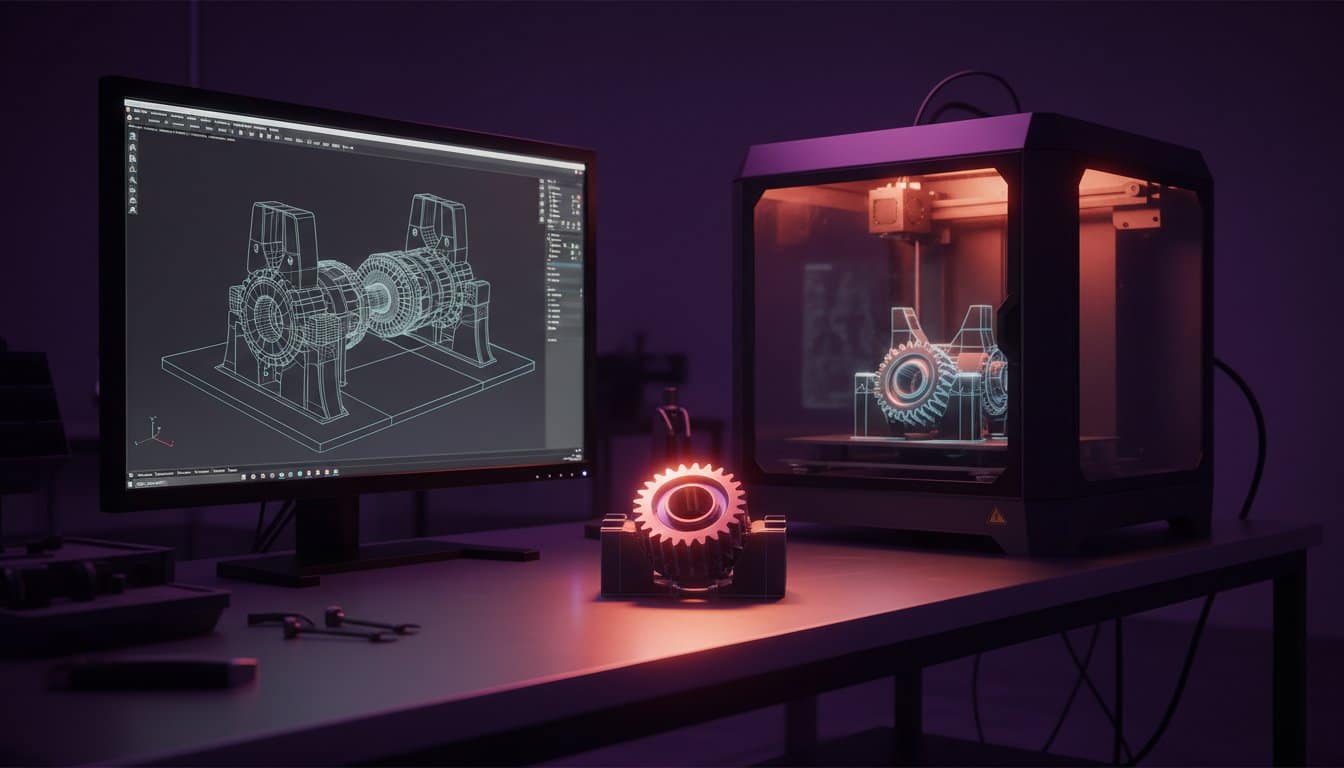
3D printing is an additive process that constructs three-dimensional objects layer-by-layer directly from a digital CAD file. This method represents a fundamental shift from traditional manufacturing. Substrictive methods, such as CNC machining, create parts by cutting away material from a solid block, which often results in significant waste. Formative methods, like injection moulding, rely on physical moulds that are expensive and time-consuming to produce. In contrast, additive manufacturing only uses the material required for the part itself, making it a cleaner and more efficient alternative.
By 2026, 3D printing has become the primary choice for UK firms requiring rapid prototyping and low-volume production. The technology has evolved beyond simple plastic models to produce high-performance, industrial-grade components. We champion a “Zero Compromise” approach. This means you no longer have to choose between the speed of a prototype and the precision of a final production part. You get both. Our systems deliver the accuracy required for aerospace and medical applications while maintaining the agility of a local design studio. Turn your ideas into reality without the typical industrial friction.
The Core Benefits for UK Engineering and Design
UK engineers use 3d printing to bypass the limitations of traditional tooling. It offers unmatched design freedom. You can create complex internal lattices and organic geometries that are impossible to manufacture via CNC or moulding. This capability allows for significant lightweighting of components without sacrificing structural integrity.
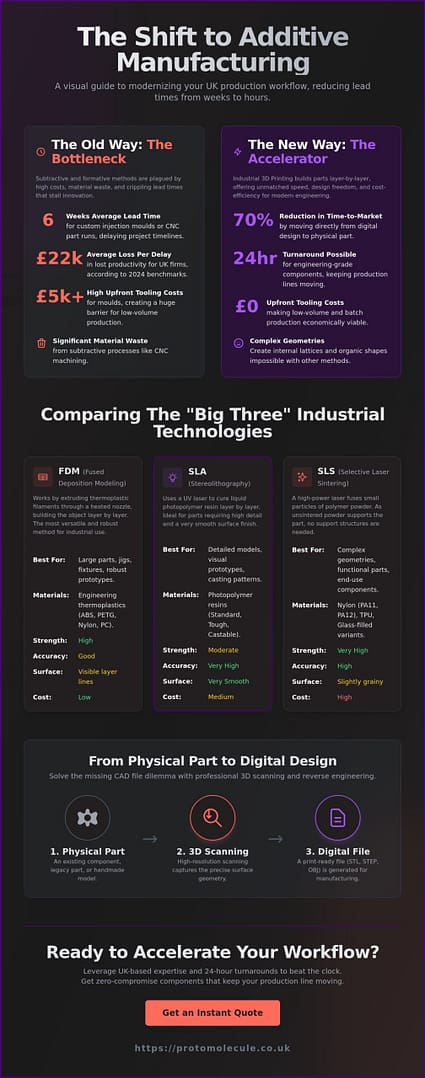
Cost-efficiency is another decisive factor. For small batches, 3D printing eliminates the need for expensive moulds which can cost between £5,000 and £25,000 depending on complexity. By removing these upfront costs, we make batch production viable for start-ups and specialized engineering firms alike. Speed remains our ultimate advantage. We reduce traditional lead times from several months to 24-hour cycles. Don’t let delays slow you down; beat the clock by moving from digital design to physical part in a single day.
Terminology: 3D Printing vs. Additive Manufacturing
While the public generally uses “3D printing” as a catch-all term, “Additive Manufacturing” (AM) is the correct technical designation for industrial applications. AM implies a professional level of control, material traceability, and repeatable precision. Within this ecosystem, rapid prototyping is a specific subset focused on quickly iterating designs to test fit, form, and function before committing to larger runs.
To start your project, you must understand the primary file formats used in the industry:
- STL: The most common format for 3D printing, representing the surface geometry of a 3D object as a raw, unstructured triangulated surface.
- STEP: A more advanced format used in professional CAD environments that preserves precise mathematical data, making it ideal for high-precision engineering.
- OBJ: Often used when colour or texture data is necessary for the final print.
Precision is the foundation of everything we do. If you are ready to accelerate your development cycle, get a quote today and see how our 24-hour turnaround can transform your workflow. Zero compromise on quality is our promise to every client.
Comparing Industrial 3D Printing Technologies: FDM, SLA, and SLS
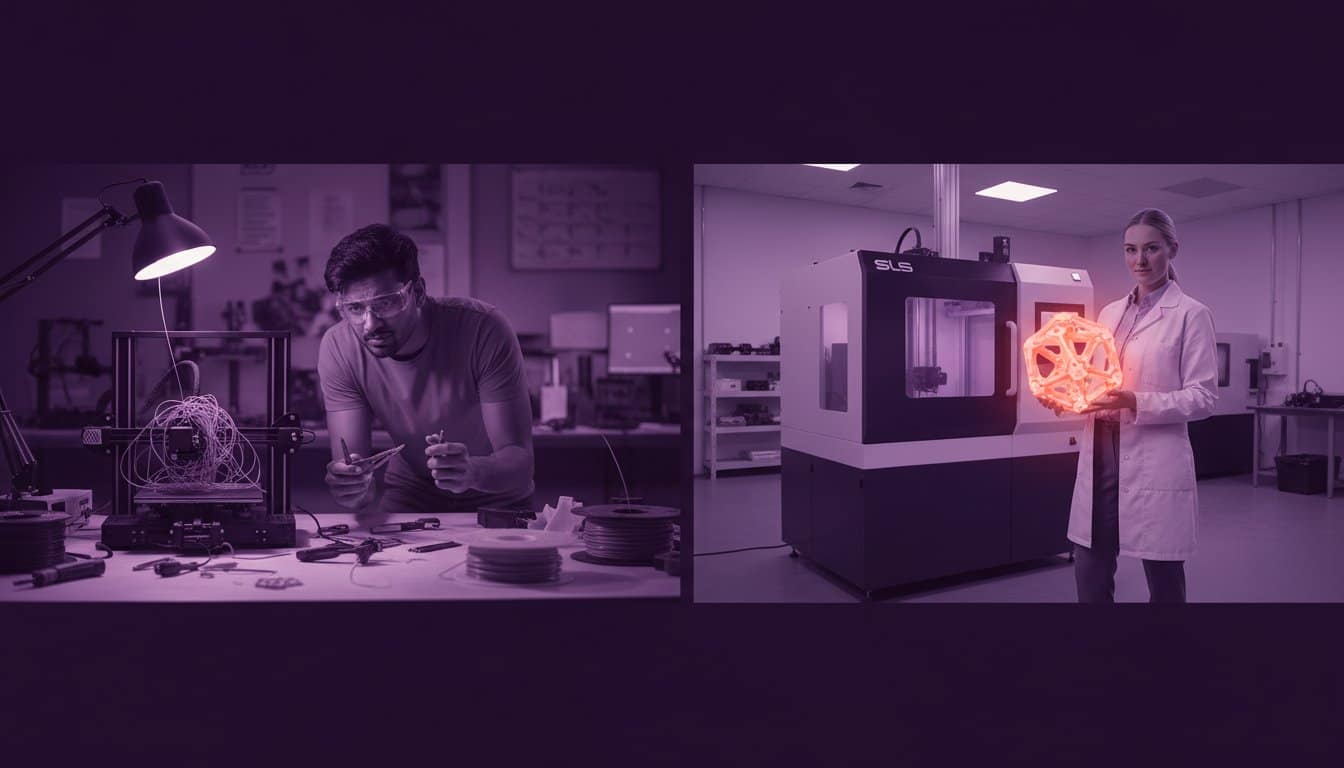
Industrial success depends on matching the process to the specific mechanical environment. In professional UK studios, the “Big Three” technologies, FDM, SLA, and SLS, form the foundation of modern production. Your choice of technology dictates everything from surface finish and dimensional accuracy to the final part’s cost. Protomolecule leads the way in Large Format FDM Printing for industrial applications, ensuring large-scale components don’t sacrifice precision for size. The Additive manufacturing standards defined by NIST provide a framework for these technologies, ensuring they meet the high-performance demands of 2026 engineering.
Fused Deposition Modelling (FDM): Versatile and Robust
FDM remains the most versatile 3d printing method for industrial environments. It works by extruding thermoplastic filaments through a heated nozzle, depositing material layer by layer to build the part. It’s the primary choice for functional prototypes, jigs, fixtures, and end-use industrial parts that require durability. We utilise a wide range of materials, moving from standard PLA for rapid fit-testing to high-performance engineering plastics like PETG, ASA, and Carbon Fibre Nylon. FDM parts are robust and ready for the workshop floor. If you need a fast turnaround on rugged components, rapid prototyping with FDM is the most efficient path forward.
Stereolithography (SLA) and Selective Laser Sintering (SLS)
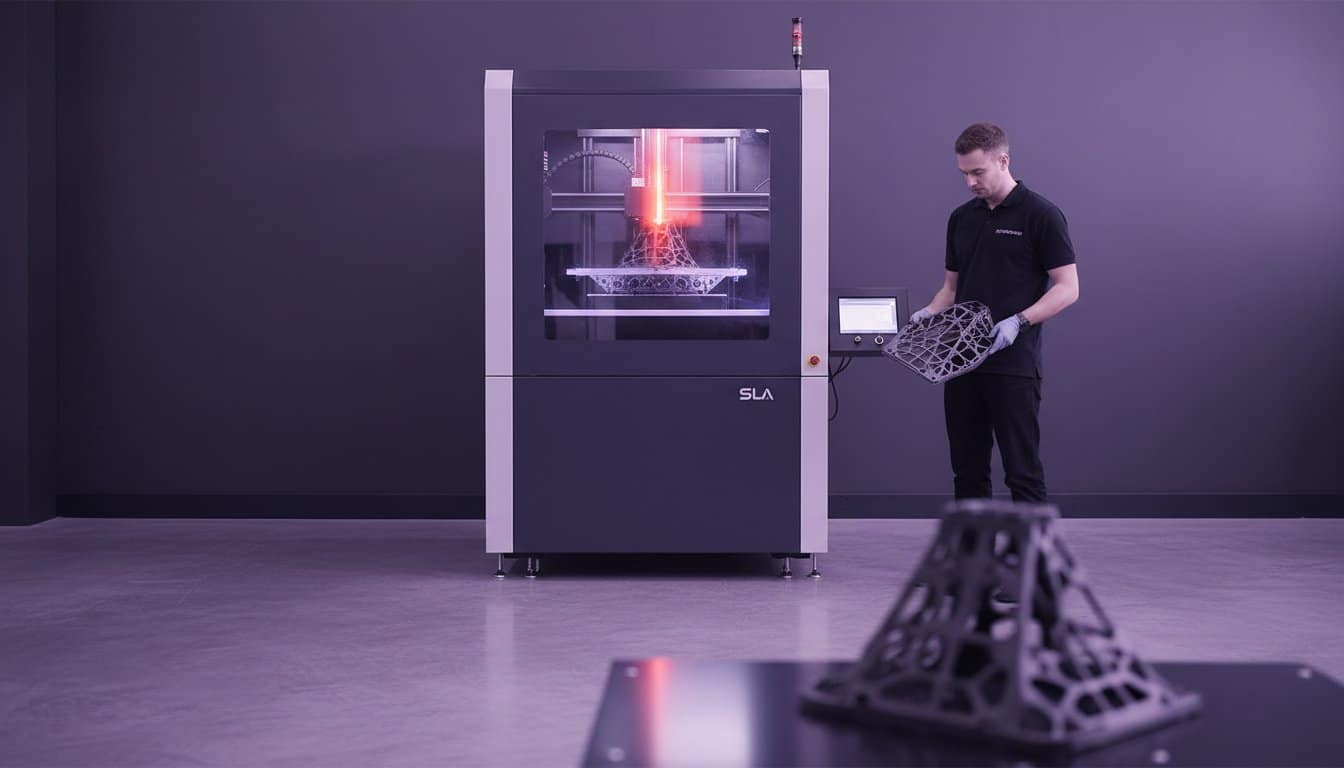
While FDM handles the heavy lifting, SLA and SLS provide specialised solutions for detail and strength. SLA uses UV lasers to cure liquid resin into solid plastic. This results in ultra-high detail and smooth finishes that often require zero post-processing. It’s the go-to for complex visual models or high-precision components where aesthetics are non-negotiable.
SLS takes a different approach by sintering nylon powder with high-power lasers. This creates high-strength, isotropic parts that are equally strong in all directions. Because the surrounding powder acts as a natural support, SLS allows for complex geometries without the need for support structures. Use SLA when surface finish is your priority. Opt for SLS when you need batch-produced, durable nylon parts that can withstand significant mechanical loads. We help you choose the right tech so you can beat the clock on your next project. Zero compromise on quality.
The Design Bridge: 3D Scanning and Reverse Engineering
The single biggest barrier to industrial 3d printing isn’t the technology itself; it’s the lack of a digital blueprint. We frequently encounter clients who possess a critical physical component but have no corresponding CAD file. Whether it’s a worn-out gear from a 1970s factory line or a bespoke automotive bracket, you can’t print what you haven’t defined. 3D Scanning provides the immediate solution to this bottleneck by digitising complex geometries into high-precision data sets. This process eliminates the need for manual measurements, which are often prone to human error and fail to capture organic curves or intricate internal features.
High-Resolution 3D Scanning Services
Precision data capture relies on two primary technologies: laser scanning and structured light. Laser scanners project a beam to map surfaces, making them ideal for large-scale objects or environments with challenging lighting. Structured light technology projects a series of light patterns onto the part, capturing sub-millimetre detail with incredible speed. These methods are now standard in the UK aerospace and military sectors to ensure components meet rigorous safety standards. 3D scanning acts as the essential bridge between the physical and digital manufacturing worlds. Recent research into high-speed data acquisition for 3-D printing demonstrates how these scans now allow for the recreation of multi-material assemblies with zero loss in fidelity. We use these tools to ensure your project starts with an accurate foundation, reducing the risk of costly iterations later.
Reverse Engineering for Legacy Parts
Capturing a scan is only half the battle. Raw scan data often contains “noise” or reflects the wear and tear of a damaged part. This is where reverse engineering becomes vital. Our engineers take the raw mesh and use 3D Design and CAD Modelling to reconstruct a “perfect” version of the component. We don’t just copy the part; we optimise it. This allows us to recreate obsolete components for machinery and high-end automotive restoration where original parts are no longer manufactured.
During this phase, we focus on three critical factors to ensure the new part outperforms the original:
- Dimensional Accuracy: We verify tolerances to within 0.02mm, ensuring the new part fits perfectly within the existing assembly.
- Structural Integrity: Using CAD modelling, we can identify stress points and reinforce them before the 3d printing process begins.
- Competitive Analysis: Reverse engineering allows you to deconstruct competitor products to understand their geometry and improve your own designs.
Don’t let a missing file stop your production. Turn your physical parts into digital assets today and beat the clock on your next project. Zero compromise on quality starts with an accurate scan. Get a quote to digitise your inventory and future-proof your manufacturing workflow.
From Rapid Prototyping to Batch Production
Speed defines modern manufacturing. You no longer have the luxury of waiting weeks for a factory overseas to return a single proof-of-concept. The transition from a digital file to a physical part happens in hours, not months. This shift allows you to move seamlessly from a single prototype to a full production run without the traditional delays of tooling and setup. We focus on a “Beat the Clock” mentality; rapid cycles mean you can complete multiple design iterations in days. If a part fails a fit test on Monday, you can have a revised, functional version in your hands by Tuesday afternoon. This agility is the core advantage of 3d printing in a competitive market.
The economic “sweet spot” for additive manufacturing has shifted. Traditional injection moulding often requires an upfront investment of £3,000 to £15,000 for a single mould. For production runs between 1 and 1,000 units, 3D printing is the superior financial choice. You eliminate the “tooling tax” and start production immediately. This allows for a leaner supply chain where capital isn’t tied up in expensive steel moulds that might become obsolete after a single design tweak.
The Rapid Prototyping Workflow
Success starts with a disciplined approach to development. Follow these three steps to ensure your part is ready for the real world:
- Step 1: Conceptual 3D Design. We take your initial ideas and perform CAD optimisation to ensure the geometry is suited for additive processes.
- Step 2: Rapid Iteration. Use FDM for structural testing or SLA for high-detail fit checks. This stage identifies interference issues before they become costly.
- Step 3: Functional Testing. Deploy the prototype in its actual operating environment to verify mechanical performance and durability.
Scaling with Batch Production
When you move beyond the prototype, Batch Production ensures every part in a 500-unit run matches the first. Managing consistency requires rigorous quality control and professional post-processing. Our systems maintain tight tolerances across every build plate, delivering industrial-grade results every time. This “On-Demand” manufacturing model can reduce warehouse costs by up to 30% because you only produce what you need, when you need it. It also enables mass customisation for specialised sectors like medical devices or bespoke automotive components. You can vary the design of every tenth part without stopping the machines or increasing the unit cost. 3d printing makes this level of flexibility possible for any UK business.
Stop waiting for slow supply chains. Turn your designs into high-performance parts today.
Choosing a 3D Printing Service UK: Precision and Speed
Selecting a partner for 3d printing in the UK is a strategic decision that impacts your entire product development cycle. For engineering firms in hubs like Nottingham or Sheffield, a domestic partner eliminates the friction of international customs and the unpredictability of global shipping. When a critical production line halts, waiting two weeks for a component from overseas can cost a business upwards of £5,000 in lost productivity every single day. Staying within the UK keeps your supply chain agile and your deadlines secure.
Evaluating a service provider requires looking beyond the price tag. You need to assess their technical depth and the range of industrial technologies they house, from FDM to high-resolution resin systems. Protomolecule provides a 24-hour turnaround promise that bridges the gap between rapid speed and industrial quality. We don’t just print parts; we solve complex geometry problems that traditional manufacturing can’t touch. Our team handles everything from 80s JDM wheel centre caps to heavy-duty passenger train seat arms with the same level of meticulous detail.
Why Lead Times Matter in Modern Manufacturing
Speed is the primary currency of the modern industrial sector. In a landscape where “just-in-time” delivery is the standard, a delay of even 24 hours can ripple through a project and cause significant financial strain. Same-day services and local collection options allow UK firms to iterate faster, testing three versions of a prototype in the time it takes an international competitor to ship one. Speed in 3d printing is a direct function of both raw machine capacity and the engineering expertise required to optimize print orientations and support structures. This combination allows us to beat the clock without sacrificing the structural integrity of the finished part.
Getting Started with Your 3D Printing Project
Moving from a rough sketch to a functional component is a streamlined process when you use professional Rapid Prototyping services. To ensure the fastest possible lead time, you need to prepare your digital assets correctly. We recommend using STEP files whenever possible because they maintain exact mathematical curves; STL files are useful but can occasionally result in “faceted” surfaces on high-precision parts. When you submit your project for review, include these three critical details:
- Material Requirements: Specify if the part needs high heat resistance, chemical stability, or specific tensile strength.
- Tolerances: Clearly state if you have critical fitments, such as a +/- 0.1mm requirement for bearing housings.
- Quantities: Indicate if this is a one-off functional test or the start of a small batch production run.
Don’t let logistics or slow vendors hold your innovation back. If you have a file ready or a problem that needs an immediate engineering solution, we are ready to help. Get an instant quote from Protomolecule today and experience zero compromise on quality.
Accelerate Your Production Cycle Today
By 2026, the transition from rapid prototyping to full-scale batch production has redefined the UK manufacturing landscape. Industrial 3d printing is now a critical tool for maintaining a competitive edge in fast-moving sectors. Protomolecule delivers the technical precision required for high-stakes applications across the Military, Space, and Commercial industries. We specialize in Large Format FDM and complex reverse engineering, ensuring your legacy parts and new innovations meet exacting standards every time. Our facility is engineered for speed, providing a reliable 24-hour turnaround to eliminate bottlenecks in your supply chain. We focus on results so you can focus on growth.
Don’t let outdated lead times hold your engineering team back. Our experts handle the technical complexities of SLS, SLA, and FDM with zero compromise on quality. It’s time to leverage professional-grade additive manufacturing to outpace your competition and secure your project’s success. We’re ready to help you hit your next milestone without delay. Whether you are in Nottingham, Mansfield, or operating nationally, we bring industrial-grade solutions to your doorstep.
Turn your ideas into reality with our ultra-fast 3D printing service
Frequently Asked Questions
What is the fastest turnaround for a 3D printing service in the UK?
You can achieve a 24-hour turnaround for 3d printing projects in the UK. At Protomolecule, we prioritise speed to beat the clock on your tightest deadlines. For standard FDM or SLS components, parts often ship within 1 business day of order confirmation. This rapid cycle ensures your product development never stalls. Whether you’re in Nottingham or London, we provide lightning-fast delivery to keep your engineering schedule on track.
Can 3D printed parts be used for functional engineering applications?
Yes, industrial additive manufacturing produces high-performance, end-use parts for the UK’s aerospace and automotive sectors. Modern processes utilise high-performance polymers like Carbon Fibre Nylon and ULTEM 9085. These materials offer tensile strengths exceeding 70 MPa. From 80s JDM wheel centre caps to passenger train seat arms, we deliver components that withstand rigorous mechanical stress. You get zero compromise on quality for every industrial-grade part.
Do I need a CAD file to use a 3D printing service?
You generally need a 3D CAD file such as an STL, STEP, or IGES to begin the manufacturing process. These digital blueprints guide the machinery with precision. If you don’t have a file, our team provides reverse engineering services to convert physical parts into digital assets. We use high-resolution scanners to capture geometry within 0.02mm accuracy. Turn your physical concept into a print-ready file today.
What is the difference between FDM and SLS 3D printing?
FDM builds parts by extruding melted filament layer by layer, while SLS uses a high-power laser to fuse nylon powder. FDM is often more cost-effective for rapid prototyping and jig manufacture. SLS offers superior geometric complexity and isotropic strength because it doesn’t require support structures. Choose SLS for batch production of complex components and FDM for fast, functional 3d printing prototypes. We help you select the right process for your specific application.
How much does a professional 3D printing service cost?
Professional additive manufacturing costs depend on the part volume, material choice, and required turnaround time. Small, simple prototypes might start from £20, while large-scale industrial components or complex assemblies command higher prices. According to 2024 industry benchmarks, material costs for standard resins and filaments range from £30 to £150 per kilogram. Get an instant quote to see exactly how your specific project fits your budget without any hidden fees.
What materials can be used in industrial 3D printing?
Industrial additive manufacturing utilises a vast array of materials including engineering-grade thermoplastics like PA12 Nylon, TPU, and PEEK. We also process high-performance composites reinforced with carbon fibre for maximum rigidity. Metal systems use stainless steel, titanium, and aluminium alloys. These materials allow us to solve complex engineering problems for clients in Nottingham and across the UK. Every material is selected to meet specific mechanical requirements and environmental conditions.
Is 3D printing cheaper than injection moulding for batch production?
Additive manufacturing is significantly cheaper than injection moulding for small batch production, typically for quantities under 1,000 units. Injection moulding requires expensive steel tooling that often costs between £2,000 and £15,000 before a single part is made. 3D printing eliminates these upfront costs, allowing you to start production immediately. It’s the most efficient choice for bridge manufacturing or bespoke components where high tooling investments aren’t justified for your project.
Can you 3D scan a part and print a copy of it?
Yes, we can 3D scan an existing part to create a precise digital twin for printing. This process is ideal for replicating obsolete components or customising existing hardware. Our industrial scanners capture data with sub-millimetre precision, ensuring the new 3D printed copy matches the original dimensions exactly. Don’t let discontinued parts stop your progress. We bridge the gap between physical reality and digital manufacturing to deliver exact replacements with a 24-hour turnaround.