Your next load-bearing component doesn’t need to be forged in a furnace to outperform traditional steel. For many UK engineering firms, the frustration of parts failing under load or waiting weeks for offshore metal shipments has become an avoidable bottleneck. You’ve likely felt that additive manufacturing was reserved for aesthetic prototypes, yet the shift toward a professional high strength 3d printing service is rapidly redefining industrial production. We recognise that reliability isn’t optional when your assembly depends on consistent mechanical properties across every batch.
This guide shows you how to leverage advanced additive manufacturing to produce functional, industrial-grade parts that rival metal components in both durability and performance. You’ll learn how the fusion of polymer science and design optimisation makes metal-replacement a reality for modern engineering. We’ll also preview how expert engineering validation ensures your designs are fit for purpose, whilst our streamlined batch production service secures your supply chain without the typical delays of traditional manufacturing. By the end, you’ll understand how to integrate these high-performance materials into your workflow to reduce lead times and improve component longevity.
Key Takeaways
- Understand the critical shift from aesthetic prototyping to end-use manufacturing by utilising high-performance industrial polymers.
- Discover how to select specialised materials like Carbon Fibre Nylon to achieve superior stiffness-to-weight ratios for load-bearing applications.
- Master design optimisation techniques that ensure your 3D printed components meet strict industrial durability and safety standards.
- Transition seamlessly from rapid prototyping to reliable batch production with a professional high strength 3d printing service.
- Implement robust quality assurance processes to guarantee consistent mechanical properties across every component within your production run.
Defining High-Strength 3D Printing for Industrial Applications
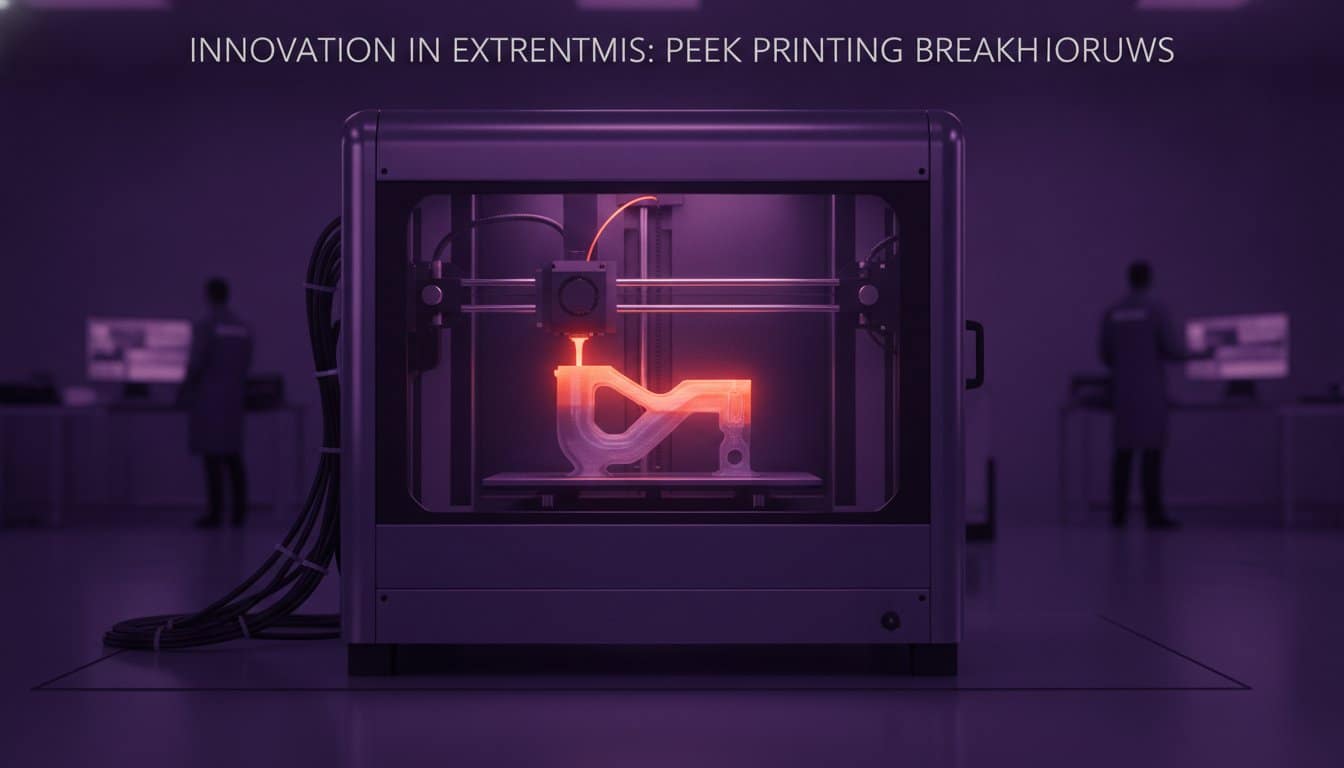
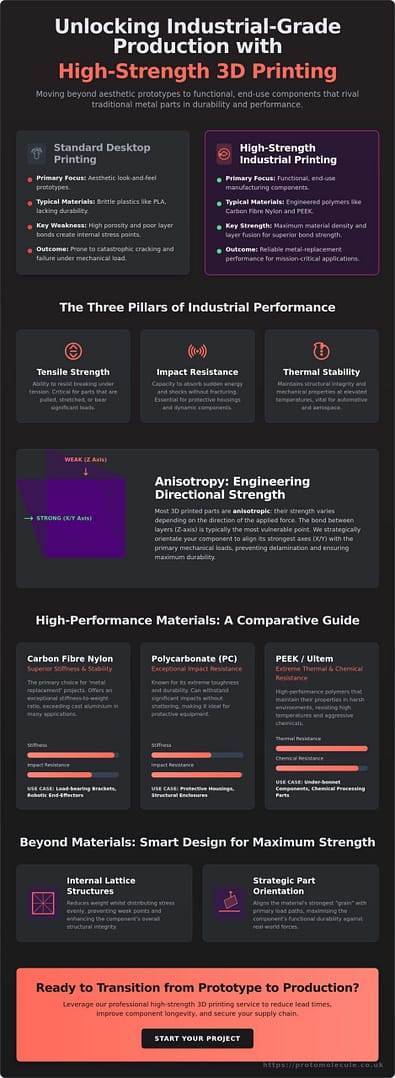
Stop viewing additive manufacturing as a tool for look-and-feel prototypes. Industrial-grade production demands parts that survive real-world stresses, not just visual inspection. Whilst hobbyist machines churn out PLA models, a professional high strength 3d printing service focuses on end-use components. We’ve moved beyond brittle plastics to high-performance polymers like Carbon Fibre Nylon and PEEK. These materials aren’t just plastic; they’re engineered composites capable of replacing aluminium or steel in demanding environments.
Aerospace, defence, and automotive engineers now rely on these technologies for mission-critical assemblies. Success in these high-stakes sectors depends on three core pillars: tensile strength to resist breaking under tension, impact resistance to absorb energy without fracturing, and thermal stability to maintain structural integrity at elevated temperatures. By selecting the right 3D printing processes, you can achieve mechanical properties that were previously impossible without expensive tooling.
The Problem with Standard 3D Printing
Standard desktop prints often fail because they lack the molecular bond strength required for mechanical loads. Porosity acts as a catalyst for failure. These microscopic gaps between layers create internal stress concentrations. In an industrial setting, these defects lead to catastrophic cracking. Our rapid prototyping workflows use industrial-grade hardware to ensure maximum layer fusion and density, eliminating the fragility associated with entry-level machines.
Understanding Isotropic vs Anisotropic Strength
Most 3D printed parts are anisotropic, meaning their strength varies depending on the direction of the applied force. Anisotropy in 3D printing refers to the inherent weakness along the Z-axis, where the bond between layers is typically the most vulnerable point of the component. Managing this requires precise part orientation and advanced material science to ensure the component doesn’t shear under pressure. We validate your design’s orientation to align the strongest axes with your expected mechanical loads.
Engineering for Durability: Material Selection and Design Optimisation
Selecting the right material is only half the battle. True durability stems from how you align material properties with your specific mechanical environment. When you utilise a high strength 3d printing service, you gain access to High-Performance Polymers in 3D Printing that can withstand environments where standard plastics melt or shatter. Carbon Fibre reinforced filaments, for instance, offer a stiffness-to-weight ratio that often exceeds that of cast aluminium. This makes them the primary choice for ‘metal replacement’ projects in the automotive and aerospace sectors, where every gram saved translates to improved efficiency.
High-Performance Materials: A Comparative Look
The table below outlines the mechanical strengths of our core industrial materials to help you decide which fits your UK manufacturing requirements.
| Material | Key Benefit | Primary Use Case |
|---|---|---|
| Carbon Fibre Nylon | Superior stiffness and dimensional stability. | Load-bearing brackets and robotic end-effectors. |
| Polycarbonate (PC) | Exceptional impact resistance and toughness. | Protective housings and structural enclosures. |
| PEEK / Ultem | Extreme thermal and chemical resistance. | Under-bonnet components and chemical processing parts. |
Design for Additive Manufacturing (DfAM) for Maximum Load Bearing
Raw material strength is useless if the design doesn’t account for the unique physics of a high strength 3d printing service. We use internal lattice structures to distribute stress more evenly across the part. This allows for significant weight reduction without compromising the component’s integrity. Orientation also plays a pivotal role. By strategically placing the part on the build plate, we ensure the strongest grain of the print aligns with your primary load path. If your current CAD files aren’t optimised for these forces, our 3D Design Services can refine your geometry for peak performance.
Ready to see how these materials perform for your specific application? Request a technical quote to begin your validation process today.
Scaling with a Professional UK High-Strength 3D Printing Service
Transitioning from a single validated prototype to a full production run requires more than just hitting ‘print’ multiple times. It demands a rigorous approach to repeatability and process control. For low-to-medium volumes, our high strength 3d printing service provides a superior alternative to traditional injection moulding. You eliminate the prohibitive costs and long lead times associated with steel tooling whilst retaining the ability to refine your design between batches. This flexibility is a decisive advantage for UK engineering firms that need to stay agile.
Industrial-grade production isn’t just about volume; it’s about consistency. We’ve developed a workflow that ensures the thousandth part possesses the same mechanical integrity as the first. By leveraging advanced 3D printing technologies, we provide a reliable supply chain that responds to your project deadlines. We prioritise results over filler, ensuring your components are ready for deployment without the typical delays of offshore manufacturing.
The Path from Prototype to Batch Production
Successful scaling follows a disciplined sequence to mitigate mechanical risk and ensure performance.
- Step 1: Perform functional prototyping and exhaustive mechanical testing to verify the design under specific load cases.
- Step 2: Execute design refinement to optimise geometry for batch repeatability and dimensional accuracy.
- Step 3: Commencing final production through our Batch Production Services to deliver end-use, load-bearing parts.
Uncompromising Standards: Why UK Expertise Matters
Choosing a UK-based partner eliminates the communication lag and quality variance that often plague offshore providers. We offer direct technical support to solve complex engineering challenges as they arise. Protomolecule maintains part consistency across every production run by implementing strict industrial quality assurance protocols. We don’t just ship components; we provide engineering accountability and a commitment to uncompromising standards. Our regional foundation ensures we’re as invested in your project’s success as you are.
Don’t let inconsistent mechanical properties or long lead times stall your development cycle. Get a Quote for your next high-strength project and experience the precision of a dedicated manufacturing partner.
Accelerate Your Production with Industrial-Grade Additive Manufacturing
Success in modern engineering depends on your ability to deploy durable, load-bearing parts without the delays of traditional tooling. You now understand how a professional high strength 3d printing service bridges the gap between conceptual models and functional, end-use components. By mastering material selection and design optimisation, you can achieve metal-replacement results that significantly reduce weight and production costs whilst maintaining structural integrity.
Our team brings specialist expertise to the Aerospace and Defence sectors, ensuring every part meets uncompromising standards. We pair this technical knowledge with advanced 3D scanning and reverse engineering capabilities to solve your most complex geometry challenges. With fast turnaround UK-wide delivery, we ensure your project remains on schedule regardless of the manufacturing complexity. Don’t let outdated supply chains hold back your innovation. Request a Quote for Your High-Strength 3D Printing Project and start building parts that are engineered to perform. We look forward to helping you solve your next engineering bottleneck.
Frequently Asked Questions
What is the strongest material for 3D printing industrial parts?
PEEK (Polyether ether ketone) and Carbon Fibre reinforced polymers are the strongest materials available for industrial applications. PEEK offers exceptional mechanical strength and heat resistance up to 250°C, whilst Carbon Fibre Nylon provides incredible stiffness-to-weight ratios. These materials allow our high strength 3d printing service to produce components that withstand extreme mechanical loads and harsh chemical environments without deforming.
Can 3D printed parts actually replace machined metal components?
Yes, high-performance thermoplastics can replace machined metal in specific load-bearing scenarios where weight reduction is a priority. By using materials like Ultem or Carbon Fibre composites, you can achieve the necessary tensile strength whilst reducing part weight by up to 60% compared to aluminium. This metal replacement strategy is particularly effective for bespoke brackets, housings, and jigs where traditional milling is too slow or expensive for low-volume production.
How does part orientation affect the strength of a 3D print?
Part orientation dictates how the internal ‘grain’ of the material aligns with external forces. Because 3D prints are built layer by layer, they’re strongest along the X and Y axes and more vulnerable to shearing along the Z-axis. We optimise every build to ensure the layer lines are perpendicular to the primary load path. This technical precision is what distinguishes a professional high strength 3d printing service from basic prototyping shops that ignore directional physics.
What is the difference between SLS and FDM for high-strength applications?
SLS uses a laser to fuse polymer powder, resulting in parts with more consistent strength across all axes and complex geometries. FDM extrudes thermoplastic filaments and is the preferred method for integrating continuous carbon fibre for maximum stiffness in a specific direction. Whilst SLS is ideal for intricate components without support structures, industrial FDM is often better for creating the high-density, reinforced components required for heavy-duty engineering tasks.