A 3D print is only as good as its final surface, yet far too many industrial projects fail at the finishing line. You likely recognise the frustration of a prototype that functions perfectly but looks unfinished due to visible layer lines, or a component that fails a pressure test because the material remains porous. Achieving high surface finish 3d printing uk isn’t just about aesthetics; it’s a critical engineering requirement for parts that must meet strict tolerances or provide air-tight seals. We understand that in the competitive UK manufacturing sector, you can’t afford to wait weeks for a part that still requires hours of manual sanding.
This guide demonstrates how professional post-processing transforms raw additive parts into high-performance, retail-ready industrial components. You’ll learn how to eliminate the common 3D printed look while maintaining the precision required for niche automotive or aerospace applications. We will explore the technical processes that deliver water-tight integrity and paint-ready surfaces, all within the rapid turnaround times your project deadlines demand. From vapour smoothing to advanced polishing, discover the path to uncompromising quality in every print.
Key Takeaways
- Understand how strategic post-production bridges the gap between a raw prototype and a retail-ready industrial component.
- Explore the technical advantages of vapour smoothing and functional plating to achieve air-tight seals and enhanced durability.
- Master the design principles required for high surface finish 3d printing uk to ensure parts are finish-friendly from the initial CAD stage.
- Learn how part orientation directly impacts surface quality and lead times, allowing for faster turnaround on complex projects.
- Identify the specific finishing processes needed to transform porous polymer prints into mission-critical engineering assets.
Why Professional 3D Print Finishing is Essential for UK Industry
In the high-stakes world of British engineering, a 3D print is rarely ready for use the moment it leaves the build plate. Professional finishing encompasses a comprehensive suite of industrial finishing techniques that transform raw additive parts into mission-critical assets. This stage is vital for improving surface quality, durability, and accuracy. Without it, components often remain “raw” prototypes rather than retail-ready products. For industries like aerospace and defence, where high surface finish 3d printing uk is a standard requirement, these processes ensure compliance with rigorous performance benchmarks.
Specialised surface treatments also address the inherent anisotropic characteristics of 3D prints. By smoothing the exterior and sealing the material, we reduce surface-level stress concentrators that could lead to premature failure under load. This transition from a porous, layered structure to a solid, uniform component allows our 3D printing service to deliver parts that compete with traditional injection moulding in demanding environments.
Overcoming the Limitations of Raw Additive Parts
Fused Deposition Modelling (FDM) naturally produces visible layer lines that can compromise both aesthetics and mechanical integrity. Professional sanding removes these ridges whilst maintaining the underlying geometry. Conversely, Stereolithography (SLA) parts require precise UV curing and support removal to reach their full mechanical strength amongst other critical post-curing steps. These actions don’t just “clean” the part; they finalise the chemical bonds within the resin to ensure long-term stability.
Managing Engineering Tolerances During Post-Processing
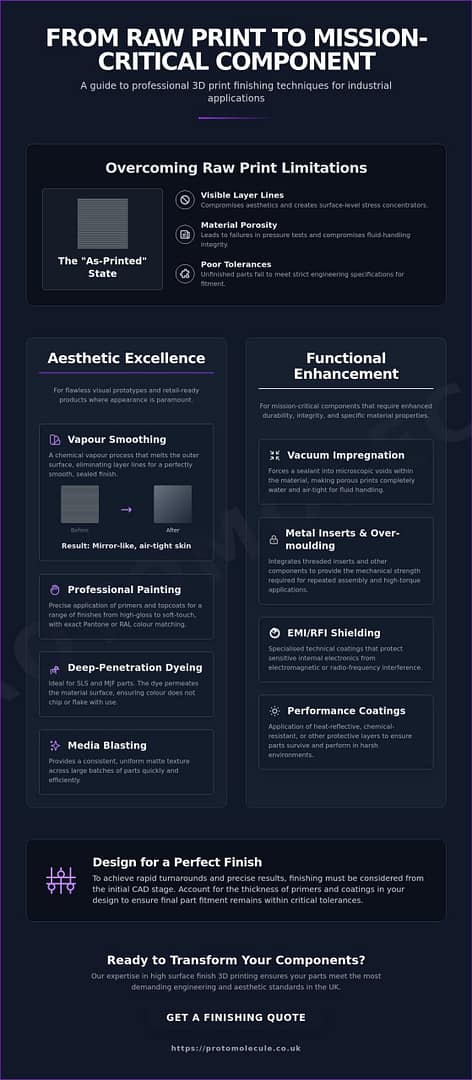
When designing for high-end finishes, you must account for the specific thickness of primers and topcoats within your CAD models to ensure final fitment remains within specification. Precision is non-negotiable when finishing mating parts or installing threaded inserts. Even minor deviations can cause assembly failures or compromise the integrity of mechanical joints. We maintain these tight margins through rigorous inspection to ensure every component integrates perfectly into your larger assembly.
Industrial Finishing Techniques: Aesthetic vs Functional
Choosing between aesthetic and functional finishes depends entirely on the end application. While a visual prototype requires a flawless exterior, industrial components often need internal sealing or chemical resistance. Achieving high surface finish 3d printing uk involves selecting the right process for the material and environment. Vapour smoothing stands as the premier choice for polymers; it uses a chemical vapour to partially melt the surface, creating a mirror-like, air-tight skin. For large-scale runs where a uniform matte texture is preferred, media blasting provides a consistent finish across hundreds of parts in a single batch.
The shift towards professional 3D print finishing allows additive parts to serve as end-use components in sectors like aerospace. Beyond surface texture, technical coatings add vital properties. EMI/RFI shielding protects sensitive electronics, whilst heat-reflective paints and chemical-resistant layers ensure parts survive in harsh environments. These aren’t just decorative additions. They’re engineering solutions that extend the lifecycle of your hardware. Achieving a high surface finish 3d printing uk standard is particularly critical when preparing parts for these technical coatings.
Aesthetic Excellence: Painting and Dyeing
Surface painting offers a vast range of finishes, from high-gloss to soft-touch. We use precise Pantone or RAL colour matching to ensure brand consistency across high-end prototypes. For SLS and MJF parts, deep-penetration dyeing is often superior to painting. The dye permeates the material surface, which means the colour won’t chip or flake even if the part is scratched. This makes it ideal for components handled frequently by end-users.
Functional Sealing and Structural Reinforcement
Porous prints can fail under pressure, which is why we utilise vacuum impregnation to make components completely water and air-tight. This process forces a sealant into the microscopic voids of the material, ensuring total integrity for fluid handling. To further enhance the utility of rapid prototyping projects, we integrate metal inserts and over-moulding. These additions provide the mechanical strength required for repeated assembly and high-torque applications. If you need parts that perform as well as they look, consider our batch production service for your next project.
Optimising Your Project for Rapid Finishing and Delivery
Speed is the lifeblood of product development, but lead times often stall during the final stages of production. To maintain momentum, you must design for the finish from the very first sketch. Integrating smart 3D design choices, such as generous fillet radii in internal corners, significantly reduces the manual labour required for sanding and polishing. Sharp, recessed angles are difficult to reach; rounded transitions allow for uniform media flow and faster mechanical finishing. Consult with our team early in the cycle to align your finishing requirements with your project deadlines.
Part orientation within the build volume is equally critical. The location of support structures determines where the “scarring” occurs. By orienting critical aesthetic surfaces away from support attachments, you minimise the need for aggressive post-processing. This strategic planning ensures a high surface finish 3d printing uk result without adding days to the delivery schedule. Use this checklist to prep your CAD for the fastest possible turnaround:
- Add Fillets: Use a minimum radius of 1mm on internal edges to simplify abrasive cleaning.
- Define Critical Surfaces: Mark faces that require the highest quality to guide our orientation strategy.
- Account for Offsets: Leave 0.1mm to 0.2mm of clearance for parts requiring heavy primer or paint.
Streamlining the Post-Processing Workflow
Efficiency increases when you group parts for batch dyeing. This method ensures total colour uniformity across an entire assembly whilst remaining far more cost-effective than individual painting. Ultimately, your choice of 3D printing service technology dictates the path. SLS parts are ideal for deep dyeing, whilst SLA resins provide the best foundation for high-gloss automotive finishes. We select the process that balances your aesthetic needs with the necessary speed of delivery.
Securing a Fast-Turnaround Quote
To provide an accurate and rapid quote, we need specific data. Clearly define your required surface finish level, Pantone or RAL colour specifications, and any functional needs like air-tightness or chemical resistance. Providing this detail upfront eliminates the back-and-forth that delays production. Ready to accelerate your cycle? Visit our portal to get a quote and move your project from screen to reality today. Our uncompromising standards ensure your components are retail-ready the moment they arrive.
Elevate Your Engineering with Industrial-Grade Finishing
Transitioning from a raw prototype to a mission-critical component requires more than just a standard print. You’ve discovered how professional post-processing eliminates layer lines and seals porous materials to meet the highest industrial standards. By optimising your CAD files and leveraging advanced techniques like vapour smoothing, you can secure a high surface finish 3d printing uk that rivals injection moulding. Our UK-based studio prioritises industrial reliability and rapid turnaround to keep your project on track. We combine specialist expertise in military and aerospace-grade finishing with integrated 3D scanning and reverse engineering to ensure every part delivers a precision fit. This comprehensive approach ensures that your hardware doesn’t just look the part but performs under the most demanding conditions.
Don’t let a raw finish compromise your engineering integrity or delay your time-to-market. Request a Rapid Quote for Professional 3D Print Finishing and transform your designs into high-performance, retail-ready assets today. We’re ready to solve your most complex finishing challenges with uncompromising speed and precision. Let’s build something exceptional together.
Frequently Asked Questions
How much does 3D print finishing cost in the UK?
The cost of post-processing is determined by the labour intensity of the chosen method and the total surface area of the component. Manual processes like multi-stage automotive painting or hand-polishing require more time than automated solutions such as vapour smoothing or batch media blasting. We provide bespoke quotes based on your specific geometry and the required level of surface refinement to ensure you receive the most cost-effective solution for your project.
Can 3D printed parts be made completely waterproof?
You can achieve total water-tight and air-tight integrity by using specialised sealing techniques. Vapour smoothing is particularly effective for thermoplastic polymers because it fuses the outer layers into a continuous, non-porous skin. For parts that must withstand higher pressures, vacuum impregnation forces a technical resin into the material’s microscopic voids, ensuring the component remains impermeable under rigorous testing conditions.
How long does the finishing process add to my delivery time?
Professional finishing typically adds between two and five working days to your production cycle, depending on the complexity of the requirement. Rapid processes like dyeing or media blasting are completed quickly, whilst high surface finish 3d printing uk projects involving multiple layers of primer and paint require additional time for proper curing. We maintain a brisk communication rhythm to ensure your finished parts are delivered in line with your project deadlines.
Is it possible to achieve a chrome finish on a plastic 3D print?
It is entirely possible to achieve a chrome or metallic finish through vacuum metallisation or specialised electroplating. This process requires an exceptionally smooth foundation; any remaining layer lines will be magnified by the reflective coating. We first prepare the part to a high-gloss standard before applying the metallic layer, resulting in a component that possesses the aesthetic appeal and surface conductivity of solid metal.