Waiting six months for a single iterative revision is a liability that costs UK aerospace firms millions in lost opportunities as we approach 2026. You recognize that traditional manufacturing lead times and the high cost of design changes are the primary barriers to staying competitive. It is time to stop letting legacy part obsolescence and material sourcing delays ground your most ambitious projects.
This guide empowers you to master aerospace component prototyping by leveraging high-performance materials and lightning-fast iteration. We show you exactly how to reduce development cycles from months to just a few days while achieving a 30% weight reduction through precision topology optimization. You will discover the path to flight-ready components and how to secure a reliable UK-based partner for national delivery that ensures zero compromise on quality. From reverse engineering legacy parts to batch production, we provide the technical roadmap to beat the clock and turn your concepts into reality.
Key Takeaways
- Bridge the gap between theoretical CAD models and flight-ready validation by mastering the rapid iteration cycles essential for 2026 mission success.
- Identify the high-performance 3D printing materials and FDM techniques best suited for mission-critical ducting and internal cabin components.
- Determine when to leverage additive manufacturing over CNC machining to achieve superior weight reduction through advanced aerospace component prototyping and topology optimization.
- Streamline your development cycle using a precision workflow that integrates digital reverse engineering of legacy parts with expert-led 3D design.
- Accelerate your path to market with Protomolecule’s lightning-fast 24-hour turnaround and agile batch production services tailored for the UK aerospace industry.
The Critical Role of Aerospace Component Prototyping in 2026
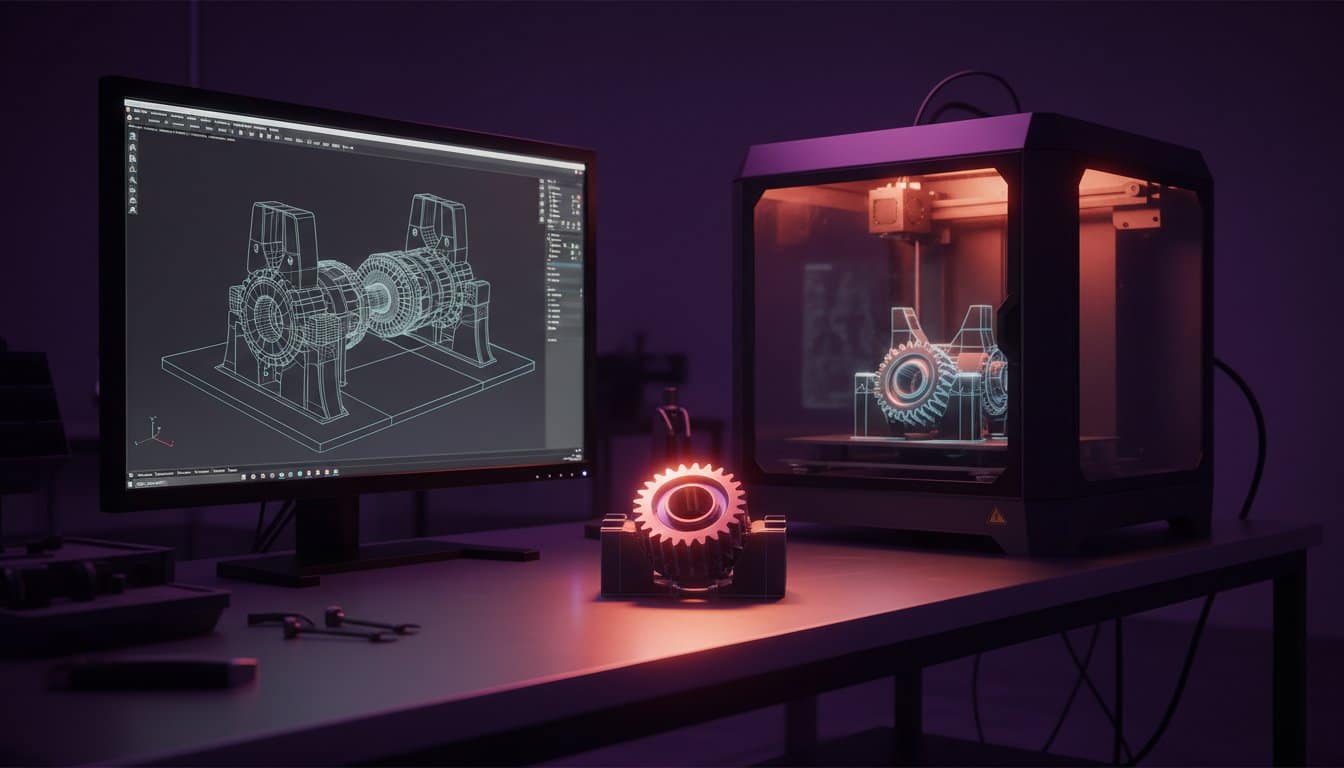
Aerospace component prototyping serves as the vital link between theoretical CAD models and the rigorous demands of flight-ready validation. In 2026, this process isn’t just about creating a visual model; it’s about proving performance in a high-stakes environment where fuel efficiency and mission success are dictated by micron-level tolerances. Engineers use these physical iterations to verify aerodynamic properties and structural integrity before committing to expensive production runs. Protomolecule delivers this transition with a focus on speed, ensuring that your innovations move from the screen to the test bench without delay.
Failure in the aerospace sector carries a heavy price. A single design flaw identified late in the development cycle can result in millions of pounds in wasted R&D or, worse, catastrophic hardware loss during flight. Prototyping mitigates these financial and safety risks by identifying interference issues or thermal weaknesses early. We operate under a “Zero Compromise” philosophy for national UK aerospace standards, ensuring every part aligns with the stringent safety requirements expected by the Civil Aviation Authority (CAA) and the Ministry of Defence. This approach guarantees that reliability is baked into the component from the very first print.
Reducing Lead Times: The Race to Launch
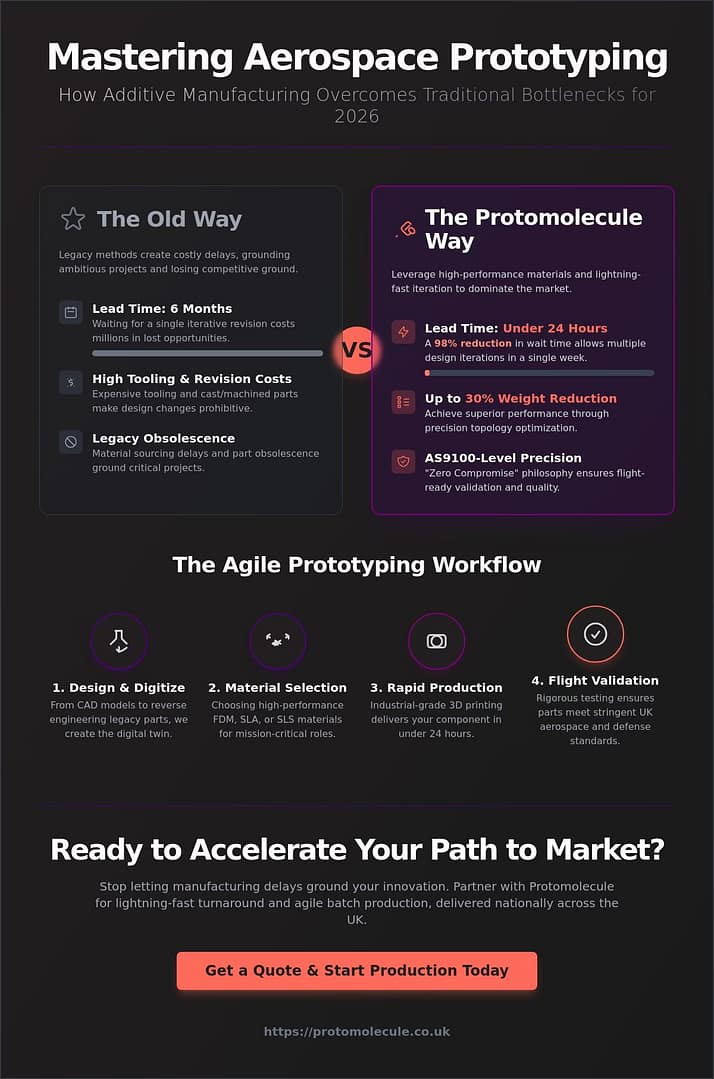
Traditional manufacturing often traps engineers in 12-week lead times for cast or machined parts. Modern rapid prototyping cycles slash these timelines to under 24 hours. This 98% reduction in wait time allows R&D teams to conduct multiple design iterations within a single week, a pace that was impossible a decade ago. By utilizing agile additive manufacturing, we eliminate the need for expensive tooling, allowing for immediate adjustments to geometry. Rapid Prototyping is a decisive competitive advantage for the UK defense and space sectors, providing the agility to test, fail, and succeed faster than traditional procurement cycles allow. Don’t let delays slow you down when you can get a quote and start production today.
Meeting AS9100-Level Precision Standards
Precision is the baseline for any flight-ready component. Aerodynamic testing in 2026 requires high-resolution outputs that mimic final production materials to provide accurate data. Rapid prototyping techniques have evolved to provide the surface finish and dimensional accuracy required for wind tunnel evaluations. Digital manufacturing ensures that a part produced in our Nottingham studio is identical to the next, maintaining repeatability across national supply chains. Material traceability remains paramount; every resin or filament batch is tracked to guarantee structural integrity and compliance. This level of detail ensures that your aerospace component prototyping project meets the high-performance benchmarks required for modern aviation. Zero compromise on quality is our ultimate promise to every engineer we partner with.
Advanced 3D Printing for Aerospace: Technologies and Materials
Aerospace engineering moves at a relentless pace. You can’t afford to wait weeks for a single design iteration. Utilizing professional 3D printing services allows your team to bypass traditional tooling delays and move directly from CAD to functional testing. In 2026, aerospace component prototyping relies on a tiered approach to additive manufacturing, selecting specific technologies based on the part’s final environment.
Industrial-grade Stereolithography (SLA) and Selective Laser Sintering (SLS) provide the high-resolution finish required for intricate engine components and functional housings. While SLA offers unmatched surface smoothness for fluid flow analysis, SLS delivers the isotropic mechanical properties needed for parts that must survive rigorous stress testing. These Digital prototyping methods, as documented by NASA, are essential for shortening development timelines for complex systems by up to 40%. By integrating these technologies, you ensure that every prototype is a step closer to flight certification.
FDM and Large Format Printing for Structural Components
Large-format Fused Deposition Modelling (FDM) is the workhorse for aerodynamic fairings and internal cabin ducting. It allows for the production of large, lightweight structures that would be impossible or prohibitively expensive to machine. Industrial-grade filaments, particularly carbon-filled variants, provide the necessary stiffness to endure high-vibration environments without fatigue.
When you’re preparing models for wind-tunnel testing, layer height selection is critical. We recommend a layer height of 0.1mm to 0.15mm for external surfaces to minimize drag and ensure accurate airflow data. This precision allows you to validate aerodynamic profiles with zero compromise on quality.
High-Performance Polymers vs. Traditional Alloys
The shift toward advanced polymers like PEEK and ULTEM 9085 is transforming how we approach weight reduction. These materials offer a strength-to-weight ratio that often exceeds 6061 aluminium by more than 50%. For components located near propulsion systems, thermal resistance is the primary concern. ULTEM 9085 is a preferred choice because it maintains structural integrity at temperatures reaching 153°C and meets strict flame, smoke, and toxicity (FST) requirements.
Before selecting a material for your next prototype, use this checklist to ensure it meets environmental demands:
- Altitude: Does the material meet ASTM E595 standards for low outgassing in a vacuum?
- Thermal Load: Is the Glass Transition Temperature (Tg) significantly higher than the expected operating heat?
- Chemical Exposure: Can the polymer withstand contact with Jet A-1 fuel or hydraulic fluids?
- Mechanical Stress: Will the part experience high-frequency vibration that requires carbon-fibre reinforcement?
Don’t let material limitations slow your innovation. Explore our rapid prototyping
Comparing Manufacturing Methods: Additive vs. Subtractive Aerospace Components
Choosing between additive and subtractive methods defines your project’s speed and cost-efficiency. CNC machining offers unmatched surface finishes for specific alloys, yet it struggles with the geometric complexity required for next-generation flight hardware. 3D printing excels in the aerospace component prototyping phase because it allows for rapid iterations without the lead times of custom tooling. The “Buy-to-Fly” ratio is a critical metric here. Subtractive manufacturing often sees 80% to 90% of a titanium block end up as waste on the shop floor. Additive techniques reverse this trend; they use only the powder or filament necessary for the final geometry. This precision reduces material costs and speeds up the production cycle significantly.
Achieving Weight Reduction through Topology Optimisation
Topology optimisation is the mathematical approach to removing material from areas that carry no load. In the aerospace sector, where fuel costs and emissions are under constant scrutiny, this is a game-changer. Additive manufacturing creates internal lattice structures that are impossible to machine with traditional tools. Advanced 3D printing for aerospace facilitates these complex geometries, ensuring parts are as light as possible without sacrificing structural safety. Data from industry leaders suggests that a 1% reduction in aircraft weight can lead to a 0.75% increase in fuel efficiency. Every gram saved translates to increased payload capacity, making your design more competitive in a demanding market. Don’t let heavy, outdated designs limit your project’s potential.
Part Consolidation and Supply Chain Simplification
Reducing part counts is the most direct way to enhance reliability. When you use aerospace component prototyping to turn a 12-piece manifold assembly into a single 3D-printed part, you eliminate the need for welds, gaskets, and rivets. These joints are often where fatigue cracks begin. By removing them, you create a more resilient component that requires less maintenance over its lifecycle. This approach also simplifies your logistics. You no longer need to manage multiple suppliers for different fasteners or wait for various sub-components to arrive.
The impact on your bottom line is immediate. Fewer parts mean a more robust design with fewer potential points of failure. Once your design is ready, moving to batch production allows for rapid scaling with zero compromise on quality. This efficiency ensures you stay ahead of deadlines and deliver results when they matter most. Follow these steps to streamline your hardware:
- Identify assemblies with high fastener counts for potential consolidation.
- Use 3D scanning to verify tolerances of integrated components.
- Transition to batch production to maintain consistency across the fleet.
Beat the clock by simplifying your hardware at the design stage. Our team provides the technical expertise to solve complex engineering problems, ensuring your consolidated parts are flight-ready in record time. Turn your ideas into reality and get a quote for your next project today.
The Rapid Prototyping Workflow: From CAD Design to Flight-Ready Validation
Speed is the primary currency in modern aviation development. Our workflow for aerospace component prototyping is engineered to eliminate bottlenecks, moving from initial concept to a physical part in 24 hours. This aggressive timeline doesn’t sacrifice precision; it demands it. We follow a rigorous five-step process to ensure every iteration brings you closer to flight-ready status.
- Step 1: Digital capture of requirements or reverse engineering of legacy parts to establish a baseline.
- Step 2: High-precision 3D Design and optimization, focusing on weight reduction and structural integrity for specific additive processes.
- Step 3: Rapid printing of functional prototypes using high-performance polymers like PEEK or carbon-fibre reinforced nylon.
- Step 4: Intensive post-processing and finishing to meet strict aerodynamic or aesthetic specifications.
- Step 5: Iterative testing and final validation, preparing the design for small-batch production.
By 2026, the integration of generative design and real-time print monitoring has reduced the prototype-to-production cycle by 40 percent. We use these tools to ensure that every aerospace component prototyping project meets the rigorous safety standards required for modern flight. Zero compromise on quality is our baseline.
Reverse Engineering for Legacy Aircraft Support
Maintaining ageing fleets presents a significant challenge when original technical drawings are lost or corrupted. We use industrial-grade 3D scanning to create accurate digital twins of existing hardware. This process captures geometry with micron-level accuracy. We then convert these point clouds into manufacturable CAD models, allowing you to reproduce obsolete components without the lead times of traditional forging. Don’t let a missing drawing ground your project.
Surface Finishing and Post-Processing for Aerodynamics
Aerospace components require specific surface roughness (Ra) values to maintain laminar flow and reduce drag. A standard 3D print might have an Ra of 15 to 30µm; we use vapor smoothing and precision sanding to achieve finishes below 1.6µm Ra for critical external surfaces. We apply specialized coatings for UV and chemical resistance to protect parts in harsh high-altitude environments. Dimensional accuracy is non-negotiable. We verify every mating surface to ensure a perfect fit during assembly. Beat the clock and get your project moving with a precision prototyping quote today.
Scaling with Protomolecule: National Aerospace Prototyping and Batch Production
Protomolecule acts as the agile partner for the UK aerospace sector. We specialise in the high-stakes engineering projects that other firms reject as too complex. Our facility in the East Midlands bridges the gap between digital design and physical hardware. We understand that in 2026, the race to net-zero flight and advanced propulsion requires a partner who moves as fast as your engineering team. We don’t just print parts; we solve the geometric puzzles that stall traditional manufacturing lines. Our “Expert Problem Solver” persona is built on years of handling intricate sensor housings, lightweight structural brackets, and fluid manifold systems that demand absolute fidelity to CAD data.
Our commitment to a 24-hour turnaround isn’t just a marketing slogan. It’s a logistical necessity for modern R&D. Don’t let delays slow your mission. While larger, slower manufacturers are still processing paperwork, we’re already calibrating machines for your first build. This speed allows UK firms to maintain a competitive edge in a global market, ensuring that innovation isn’t throttled by lead times. We serve as a dedicated extension of your workshop, providing the technical muscle needed to push boundaries.
From One-Off Prototypes to Reliable Batch Production
Transitioning from a single component to batch production requires a fundamental shift in process control. We apply the same level of scrutiny to a run of 50 flight-ready brackets as we do to the initial proof-of-concept. Consistency is the primary requirement for aerospace component prototyping at scale. We ensure every part meets the exact specification, whether it’s delivered to a hangar in Prestwick or a testing facility in Bristol. Our quality management systems are designed to eliminate dimensional drift across small batches.
- Rigorous inspection protocols for every unit in the batch.
- Material traceability to ensure compliance with aerospace standards.
- Scalable workflows that transition seamlessly from rapid prototyping to end-use parts.
This reliability allows engineers to move directly from validation to low-volume deployment without the friction of switching suppliers. If your project demands precision at scale, get a quote today to secure your production slot and keep your timeline on track.
The 24-Hour Advantage: Beating the Clock in Aerospace
Speed is the ultimate differentiator in modern aerospace R&D. Every day spent waiting for a part is a day lost to your competitors. We’ve built our reputation on a 24-hour turnaround because we know the pressure of a looming flight test or a critical design review. Our brand promise is simple: zero compromise on quality with lightning-fast delivery. We’ve helped UK aerospace firms cut their development cycles by as much as 40% through rapid iteration cycles that others can’t match.
We combine advanced CNC machining and industrial-grade additive manufacturing to deliver results while the competition is still reviewing spreadsheets. This agility allows you to fail fast, learn quickly, and succeed sooner. Whether you’re working on interior components like passenger train seat arms adapted for aviation or complex engine internals, we provide the hardware you need exactly when you need it. Turn your aerospace concepts into reality before the competition starts their machines.
Accelerate Your Flight-Ready Innovation Today
The transition to advanced additive manufacturing is a necessity for the 2026 aerospace landscape. Successful aerospace component prototyping now demands the mastery of high-performance polymers and the ability to produce complex geometries that traditional machining cannot achieve. Precision isn’t just a goal; it’s the baseline. Protomolecule removes the bottlenecks from your workflow by providing a 24-hour turnaround on urgent prototypes, ensuring your project remains on schedule. We specialize in high-performance materials that meet the industry’s most stringent requirements, maintaining zero compromise on aerospace quality standards at every stage. From our facility in the UK, we help you move from a digital concept to a flight-ready component with lightning speed. Don’t let slow lead times ground your innovation or stall your validation process. Take control of your production timeline and partner with experts who value precision as much as you do. Get an Instant Quote for Your Aerospace Project and let’s bring your next engineering breakthrough to life.
Frequently Asked Questions
What are the best materials for 3D printing aerospace components?
High-performance polymers and aerospace-grade metal alloys provide the best results for flight-related applications. We utilize ULTEM 9085 for its flame-retardant properties and heat deflection temperature of 153 degrees Celsius. For metallic requirements, Titanium Ti64 and Inconel 718 are the industry standards, offering exceptional strength to weight ratios that meet 2026 aviation requirements. These materials ensure your parts withstand the rigorous thermal and mechanical stresses of high-altitude environments.
Can 3D printed parts be used for functional flight testing?
Yes, 3D printed parts are suitable for functional flight testing if they meet Civil Aviation Authority (CAA) or EASA Part 21 standards. Protomolecule produces components that undergo rigorous validation to ensure they handle real-world aerodynamic loads. We focus on high-performance materials that maintain structural integrity during 100 percent of the test flight duration. Our process bridges the gap between digital design and physical validation, helping you achieve flight-ready status faster.
How does topology optimization improve aerospace component performance?
Topology optimization reduces component mass by up to 45 percent while maintaining the required structural stiffness. Our aerospace component prototyping process uses advanced algorithms to redistribute material only where it is functionally necessary. This results in complex, organic shapes that are impossible to manufacture via traditional methods. By removing every unnecessary gram, we help you increase fuel efficiency and payload capacity without any compromise on safety or part longevity.
What is the typical turnaround time for an aerospace prototype?
We provide a lightning-fast 24-hour turnaround for standard geometries and 48 to 72 hours for complex, multi-material assemblies. Beat the clock by utilizing our rapid production cycles that eliminate the weeks of waiting associated with traditional tool-making. Don’t let delays slow you down when we can ship precision parts from our Nottingham facility to your site within one business day. We prioritize speed to ensure your development timeline remains on track.
How do you ensure dimensional accuracy for complex aerospace geometries?
We achieve dimensional accuracy through 5-axis CNC machining and high-resolution laser scanning that maintains tolerances of +/- 0.005mm. Every aerospace component prototyping project undergoes a strict inspection protocol using CMM technology to verify the digital model against the physical part. This level of precision is vital for components like turbine blades or manifold systems where even a 0.01mm deviation can impact performance. We guarantee every part meets your exact specifications.
Is reverse engineering possible for obsolete aircraft parts?
Reverse engineering is a core service we provide to restore grounded aircraft or maintain legacy fleets. We use 3D scanners with a 0.02mm resolution to capture the exact geometry of worn or broken components. Once we create a high-fidelity digital twin, we can reproduce the part using modern materials that often exceed the original 1980s or 1990s specifications. This process saves thousands of pounds in potential storage costs and keeps historic assets operational.
Does Protomolecule support national UK aerospace projects?
Protomolecule is a dedicated partner for UK aerospace innovation, supporting projects from the Midlands to national research hubs. We work closely with engineering firms in Nottingham and Mansfield to strengthen the local supply chain while serving Tier 1 aerospace suppliers across Great Britain. Our facility is geared toward the specific regulatory and security requirements of the UK market. We take pride in being a British manufacturer that delivers industrial-grade results with a local touch.
How do I get a quote for a custom aerospace prototyping project?
Get a quote by uploading your CAD files directly to our secure online portal for an instant technical assessment. Our team reviews your specifications and provides a detailed breakdown of costs in GBP within hours. Turn your ideas into reality by starting the process today; we handle everything from initial file optimization to final surface finishing. Whether you need a single test part or a small batch of 50 units, we provide a transparent and efficient pricing structure.