In 2026, the difference between winning a £10 million commercial contract and losing it often rests on the physical precision of your pitch model. You understand the pressure of a looming competition deadline when traditional model makers quote lead times that simply don’t align with your project schedule. Fragile, hand-built models that break during transit or fail to reflect the complexity of your BIM files are risks you can’t afford. Partnering with a professional architectural model 3d printing service eliminates these vulnerabilities by converting digital data into high-performance physical assets with lightning-fast speed.
We agree that your time is better spent on design than on fixing broken scale models or managing inaccurate prototypes. This guide promises to master the technical and commercial advantages of additive manufacturing, showing you how to reduce model-making costs by 50% compared to traditional methods. You’ll learn to beat the clock with 24-hour turnarounds that accommodate even the most sudden design changes. We’ll preview the essential materials, scaling techniques, and delivery workflows that ensure your next presentation leaves zero room for doubt and secures that critical commission.
Key Takeaways
- Discover how to integrate industrial-grade additive manufacturing into the RIBA Plan of Work to validate structural concepts and secure stakeholder buy-in faster.
- Match the right technology—SLA, SLS, or Large Format FDM—to your project goals to ensure the perfect balance of precision, durability, and scale.
- Master the essential checklist for preparing “water-tight” CAD and BIM files, eliminating the common geometry errors that cause print failures.
- Partner with a high-performance architectural model 3d printing service to beat the clock on competition deadlines with reliable 24-hour turnaround.
- Accelerate your delivery timelines and win more UK commissions by moving from digital renders to tangible, high-impact physical models with zero compromise on quality.
The Strategic Value of an Architectural Model 3D Printing Service
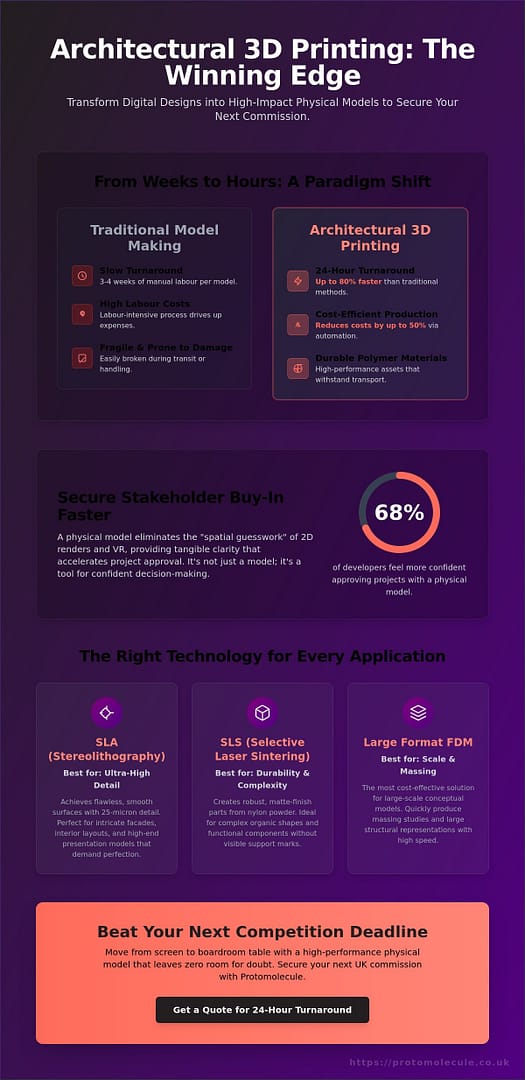
Architectural 3D printing is an industrial-grade additive manufacturing process that converts complex BIM and CAD data into high-fidelity physical structures. By 2026, the UK construction sector has moved beyond the era of balsa wood and foam board. Professional firms now rely on high-speed digital fabrication to communicate design intent with absolute clarity. While Virtual Reality (VR) offers an immersive digital walkthrough, it cannot replace the tactile spatial understanding provided by a physical model. A 2024 survey of UK property developers found that 68% of stakeholders feel more confident approving a project when they can physically interact with a scale model. This tangible presence eliminates the “spatial guesswork” often associated with 2D renders or headsets.
Utilising a professional architectural model 3d printing service allows your firm to compress project timelines significantly. Traditional model making often requires three to four weeks of manual labour. We reduce this to a matter of days. At Protomolecule, our workflow is designed for the high-pressure environment of UK architecture. We focus on rapid prototyping to ensure you meet every deadline without sacrificing detail. Don’t let slow production cycles stall your planning applications. Beat the clock and get your designs off the screen and onto the boardroom table.
- Speed: Turnaround times reduced by up to 80% compared to traditional methods.
- Precision: Accuracy within microns, ensuring every structural element is represented.
- Clarity: Immediate spatial comprehension for non-technical stakeholders.
Winning Competitions with Physical Precision
In high-stakes architectural pitches, the “wow factor” is a commercial necessity. We use high-detail Stereolithography (SLA) resin to produce intricate facades and textures that manual carving cannot match. This level of detail is vital for winning competitive tenders in cities like London and Manchester. We also prioritise your intellectual property. Our secure facility in the East Midlands ensures that sensitive competition entries remain confidential from initial file upload to final delivery. Turn your ideas into reality and secure your next contract with a model that demands attention.
Cost-Efficiency vs Traditional Model Making
Manual model making is a labour-intensive cost centre. By automating the fabrication process, we reduce manual labour requirements by approximately 85%. This shift allows for easy scalability. You can print multiple iterations of a design for internal refinement at a low marginal cost. Modern polymers also offer superior durability compared to traditional materials. A 3D printed model won’t warp, yellow, or degrade during transport to client meetings across the UK. It’s a high-performance solution for a demanding industry. Get a quote today to see how we can streamline your workflow. Zero compromise on quality is our brand promise.
Selecting the Right Technology: SLA, SLS, and Large Format FDM
Choosing the correct hardware for your architectural model 3d printing service is the difference between a winning pitch and a missed deadline. We match specific technology to your project goals to ensure the final output meets your exact requirements for detail, durability, or scale. Professional results demand industrial-grade machines. Desktop hobbyist printers simply cannot match the dimensional stability or the 99.8% geometric precision required for 1:100 scale accuracy across large build plates.
Industrial machines eliminate the warping and layer shifting common in consumer-grade setups. This reliability ensures every component fits together perfectly the first time. We focus on three primary technologies to cover every architectural need from conceptual massing to high-end marketing suites.
SLA and SLS for High-Detail Presentation Models
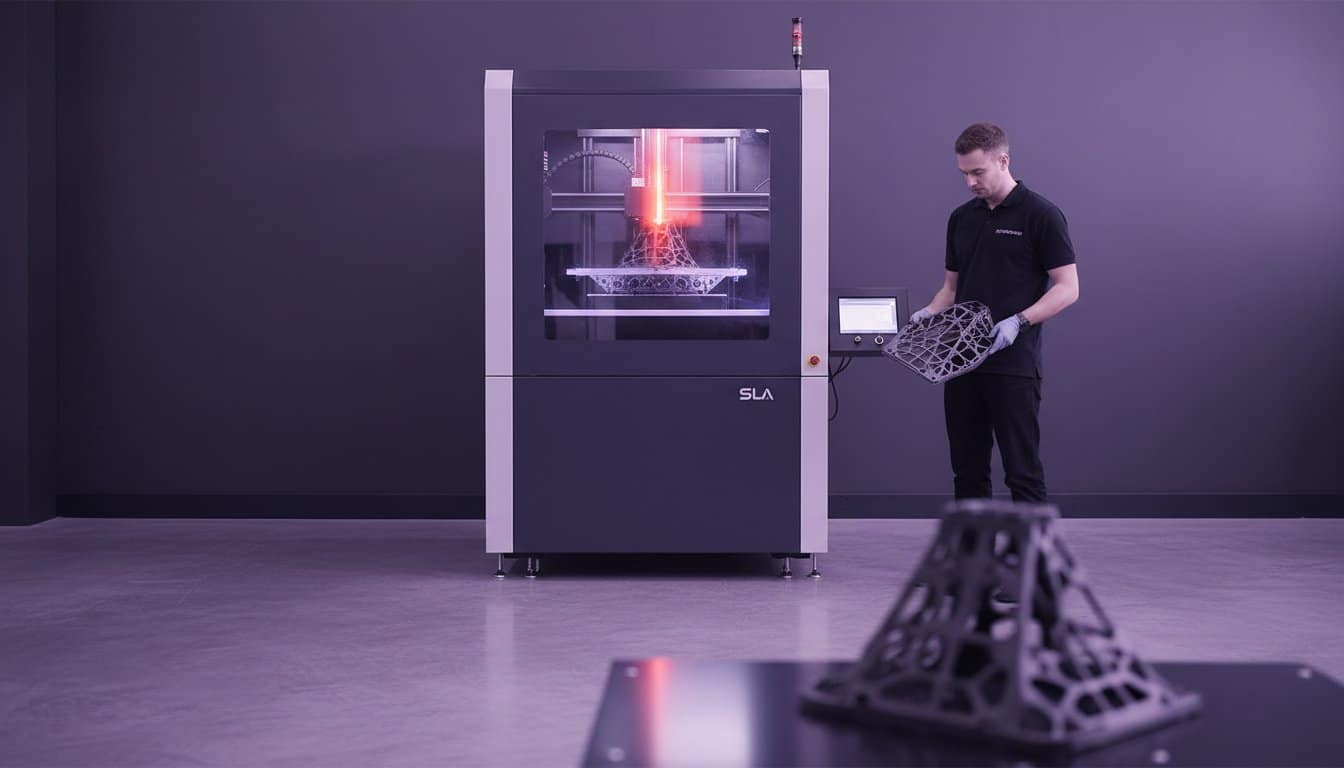
Stereolithography (SLA) is the gold standard for ultra-smooth surfaces. It achieves 25-micron detail, making it the primary choice for 1:50 interior layouts where furniture, fixtures, and fine textures must look flawless. For projects requiring high durability without visible support marks, Selective Laser Sintering (SLS) is the superior option. It uses a laser to fuse nylon powder, creating robust, matte-finish parts that handle complex organic shapes with ease.
- SLA Resins: We use specialised translucent resins to simulate glazing, water features, or clear acrylic finishes.
- SLS Nylon: This material is perfect for structural components and “white-model” aesthetics that need to withstand frequent handling.
- Precision: These methods capture intricate brickwork, window mullions, and ornate facades that other technologies miss.
Large Format FDM for Context and Urban Planning
Fused Deposition Modelling (FDM) excels when scale is the priority. When you need to print entire city blocks or massive topographical maps, large-format FDM beds provide the necessary volume. We utilise industrial FDM to produce volumetric studies that help planners visualise density and shadow paths. It is the most cost-effective method for massive site models, allowing for rapid iteration on 1:500 or 1:1000 scale urban masterplans.
- White PLA: This remains the industry standard for clean, crisp conceptual massing models.
- Build Volume: Our large-format machines can print components up to 1 metre in a single piece, which significantly reduces assembly time and visible join lines.
- Efficiency: Balance cost and speed for large-scale projects without losing the professional finish your clients expect.
Don’t let technical limitations or slow hardware hold your design back. You can explore our professional 3D printing capabilities to see how industrial-grade output can beat the clock on your next submission. Whether you need a single high-detail resin tower or a 5-metre topographical site map, we deliver with zero compromise on quality.
Integrating 3D Printing into the RIBA Plan of Work
The RIBA Plan of Work 2020 demands precision at every milestone. Incorporating a professional architectural model 3d printing service into Stages 0 through 4 transforms abstract concepts into tactile reality. During Stage 2 (Concept Design), rapid prototyping allows architects to iterate on massing studies in hours rather than weeks. You don’t have to wait for manual model making to catch up with your CAD data. We deliver physical concepts that allow stakeholders to understand spatial relationships immediately.
By Stage 3 (Spatial Coordination), 1:100 scale models serve as critical risk-mitigation tools. Physical models expose structural clashes and spatial inconsistencies that screen-based BIM environments sometimes obscure. Identifying a design flaw in a physical model before reaching the technical design phase can save thousands of pounds in rework costs. For planning applications, high-detail context models provide local authorities with clear proof of how a building interacts with its environment. This transparency often accelerates the approval process by eliminating ambiguity.
Accuracy is non-negotiable in modern architecture. Our industrial-grade printers maintain tolerances of +/- 0.1mm, ensuring that complex geometries like cantilevered sections or intricate facades are represented exactly as intended in your Revit or Rhino files. We’ve helped firms reduce lead times on model production by 60%, allowing more time for design refinement and less time spent on fabrication logistics.
Heritage Restoration and Reverse Engineering
Preserving the UK’s architectural history requires merging traditional aesthetics with modern technology. We use high-precision 3D scanning to capture the intricate geometry of Grade I and II listed structures. If ornaments are missing or structural components have decayed, our reverse engineering services allow for the exact recreation of period-correct details. This process ensures that restoration projects meet strict conservation requirements while benefiting from modern material durability and lightning-fast production.
Batch Production for Large-Scale Developments
Marketing suites for multi-unit housing developments require absolute consistency. When you need 50 identical housing units for a site model, manual fabrication is too slow and prone to error. Our batch production services deliver identical, high-resolution components at scale. We maintain tight tolerances across every piece, ensuring that multi-part site models fit together perfectly the first time. Beat the clock on your next project launch with ultra-fast production cycles and zero compromise on quality.
Technical Excellence: Preparing CAD and BIM Files for Print
The biggest hurdle in any architectural model 3d printing service is the “visual vs. physical” gap. Architectural renders are designed to look good in a digital viewport; 3D prints must survive the laws of physics. Most BIM files contain “paper-thin” surfaces that have no real-world volume. If a wall has zero thickness, the printer cannot see it. You must ensure your geometry is manifold and “water-tight” before submission. This means every edge connects to exactly two faces with no gaps in the mesh. Industry data suggests that 85% of standard BIM exports require manual mesh repair before they are print-ready.
Wall thickness management is critical when scaling down. A 200mm structural wall becomes a fragile 1mm sliver at 1:200 scale. We recommend a minimum wall thickness of 0.8mm for FDM and 0.5mm for SLA to maintain structural integrity. Our 3D design teams act as the bridge between your vision and the machine; they repair broken meshes and thicken delicate features to prevent mid-print failure. We don’t just print what you send; we optimise it for success.
- Manifold Check: Ensure no holes exist in the geometry.
- Normal Orientation: Verify all surface normals point outward.
- Scale Verification: Check that fine details like window mullions remain printable at the final scale.
- Boolean Operations: Merge overlapping components into a single solid body.
From Revit and Rhino to STL: The Workflow
Software like Revit and ArchiCAD prioritises metadata over geometry. This often leads to non-manifold edges and flipped normals during STL export. Flipped normals confuse the printer’s logic; the machine tries to print the air instead of the object. We utilise advanced repair algorithms to sanitise these files. Whether you’re working in Rhino, SketchUp, or Vectorworks, we convert your complex assemblies into verified assets for your architectural model 3d printing service without losing architectural detail.
Post-Processing and Finishing Options
Precision doesn’t end when the printer stops. We meticulously remove support structures to protect fine details like balustrades. Our team provides professional surface finishing, including sanding and priming, to eliminate layer lines. We can apply professional spray painting to match specific site materials or RAL codes. To add realism, we integrate 3D printed context like scale figures and foliage, ensuring your model is ready for the boardroom. Zero compromise on quality is our standard.
Protomolecule: Ultra-Fast Architectural 3D Printing UK
Protomolecule stands as the definitive agile partner for UK architectural firms. We understand that in a competitive landscape, your bid hinges on the physical representation of your vision. Our architectural model 3d printing service is designed to eliminate the bottleneck of traditional model making. We offer a strict 24-hour turnaround promise on standard builds. This allows you to beat the clock on competition deadlines and present finished models while your rivals are still waiting for material deliveries.
We don’t settle for “good enough.” Every project benefits from industrial-grade precision across every scale, from 1:500 urban masterplans to 1:20 interior details. Our facility serves as a central hub for the entire country, enabling reliable national delivery to site or studio anywhere in the UK. Whether you’re based in London, Manchester, or Edinburgh, your model arrives exactly when you need it. Zero compromise on quality is our brand promise, ensuring that every staircase, mullion, and topographic contour is rendered with absolute fidelity.
Our Technology Stack for Architects
We house high-performance FDM, SLA, and SLS capabilities under one roof to meet diverse project requirements. For massive urban context projects, our large format printing handles extensive site layouts without the need for excessive sectioning. Our engineers provide expert support from your initial CAD file through to the final post-processed model. We ensure your digital geometry translates perfectly into a physical asset. This technical oversight prevents common printing failures and guarantees that the finished product meets professional standards for durability and aesthetic finish.
- High-Resolution SLA: Perfect for intricate facades and detailed interior layouts.
- Industrial SLS: Ideal for durable, complex geometries that require no support structures.
- Large Format FDM: The go-to choice for rapid, cost-effective massing models and site context.
Get Your Architectural Project Started
Efficiency starts the moment you engage with us. You can upload your files for an instant assessment of printability and cost, reducing the time spent on administrative back-and-forth. You’ll consult directly with our engineers to select the optimal material and technology for your specific use case. Whether you need a durable nylon model for a public consultation or a high-detail resin piece for a boardroom presentation, we provide the technical guidance to make it happen.
Don’t let slow production times compromise your next submission. Our team is ready to transform your digital designs into tangible assets with the speed and precision your firm demands.
Ready to build? Get a Quote or Contact our experts to secure your delivery slot.
Secure Your Competitive Edge in 2026
The transition from digital BIM files to physical reality shouldn’t be a bottleneck in your design process. By integrating a professional architectural model 3d printing service into your RIBA Plan of Work, you gain the ability to validate complex geometries and catch structural discrepancies before they reach the construction site. Utilizing industrial-grade SLA and SLS technology ensures every detail, from delicate facade textures to intricate internal voids, is represented with absolute precision.
Protomolecule is built for speed and reliability. We offer a 24-hour turnaround for urgent project deadlines; this ensures you never miss a planning committee meeting or a high-stakes client presentation. With national UK delivery and a commitment to zero compromise on quality, we provide the industrial-grade results your practice requires. Stop waiting weeks for traditional model makers and start iterating in real-time. Our team handles the technical complexity so you can focus on the architecture.
Get an Instant Quote for Your Architectural Model
We’re ready to help you turn your most ambitious concepts into tangible, high-performance models today.
Frequently Asked Questions
How much does an architectural 3D printing service cost?
Costs for a professional architectural model 3d printing service typically start at approximately £100 for basic massing models and can exceed £5,000 for complex, multi-material site plans. Final pricing depends on material volume, print time, and the level of post-processing required. We provide transparent, rapid quotes based on your specific CAD data to ensure your project stays on budget without hidden fees.
How fast can I get an architectural model 3D printed?
You can receive your completed model in as little as 24 hours by utilizing our ultra-fast rapid prototyping workflow. While standard turnarounds for complex assemblies usually range between 3 and 5 working days, we prioritize urgent deadlines to help you beat the clock for planning presentations. Submit your files before our 2 PM daily cutoff to trigger immediate production and same-day processing where possible.
What file format do I need for architectural 3D printing?
We primarily require STL or OBJ files for 3D printing, as these formats define the surface geometry needed for slicing. We also accept STEP and IGES files for high-precision components that require CNC machining or specific engineering tolerances. Every file undergoes a rigorous 10-point integrity check to ensure the mesh is watertight and ready for our industrial-grade hardware.
Can you 3D print directly from my Revit or BIM model?
You can’t print directly from a native .RVT file, so you’ll need to export your BIM data to an STL or OBJ format. We recommend stripping out internal metadata and non-essential structural elements to optimize the architectural model 3d printing service results. This simplification reduces file size and ensures the printer focuses on the visible architectural features you need to showcase.
What is the maximum size for a 3D printed architectural model?
Our industrial printers offer a single-piece build volume of up to 500mm x 500mm x 500mm. For larger scale masterplans or 1:50 models, we split the design into logical, interlocking sections that we assemble during the finishing stage. This modular approach allows us to create models spanning several meters while maintaining structural rigidity and seamless joins across the entire site.
How detailed can a 3D printed model be?
Our high-performance resin systems achieve layer heights as fine as 25 microns, which allows for the reproduction of intricate window mullions and facade textures. For larger massing studies, we use FDM technology with resolutions between 100 and 200 microns. We maintain a zero compromise on quality policy, ensuring that every sharp edge and architectural detail translates perfectly from your digital twin to the physical world.
Do you offer post-processing and painting for models?
Yes, we provide comprehensive post-processing including support removal, sanding, and professional spray painting to match your specific RAL or Pantone requirements. Our technicians can apply specialized finishes to simulate materials like brushed steel, timber, or frosted glass. These presentation-ready finishes turn a raw print into a powerful marketing tool that helps you secure stakeholder approval and win new bids.
Is 3D printing cheaper than traditional model making?
3D printing typically reduces production costs by 40% to 70% compared to traditional hand-built methods. This significant saving is due to the reduction in manual labor hours and the ability to run production 24/7 without human intervention. Digital manufacturing also makes revisions more affordable, as you can update a file and reprint a specific section rather than rebuilding an entire physical model from scratch.