
Late-stage design changes due to manufacturability issues account for up to 30% of total product development costs in discrete manufacturing. You’ve likely experienced the frustration of receiving an unexpectedly high production quote or a flat rejection from a manufacturer because a feature is simply impossible to produce. It’s a costly bottleneck that drains your budget and stalls your project momentum. Understanding how to design for manufacturability is the only way to bridge the gap between a digital concept and a physical reality that is commercially viable.
We agree that your time is better spent on innovation rather than fixing avoidable errors. This guide will help you master the essential DFM principles needed to reduce unit costs, minimise technical errors, and significantly accelerate your time-to-market. We will explore specific technical optimisations for 3D printing and batch production to ensure your parts work perfectly the first time they hit the machine. Let’s dive into the strategies that turn complex engineering challenges into streamlined, high-yield results.
Key Takeaways
- Understand the ‘Rule of Ten’ to prevent design errors from multiplying your production costs at every subsequent stage of development.
- Master how to design for manufacturability by prioritising part standardisation and reducing assembly complexity to slash unit costs.
- Accelerate your development cycle by using rapid prototyping to validate fabrication feasibility in hours rather than weeks.
- Identify critical DFM opportunities in legacy components through strategic reverse engineering and 3D scanning.
- Eliminate manufacturer rejections by optimising CAD models for specific batch production constraints from the outset.
Understanding Design for Manufacturability (DFM) and Its Economic Impact
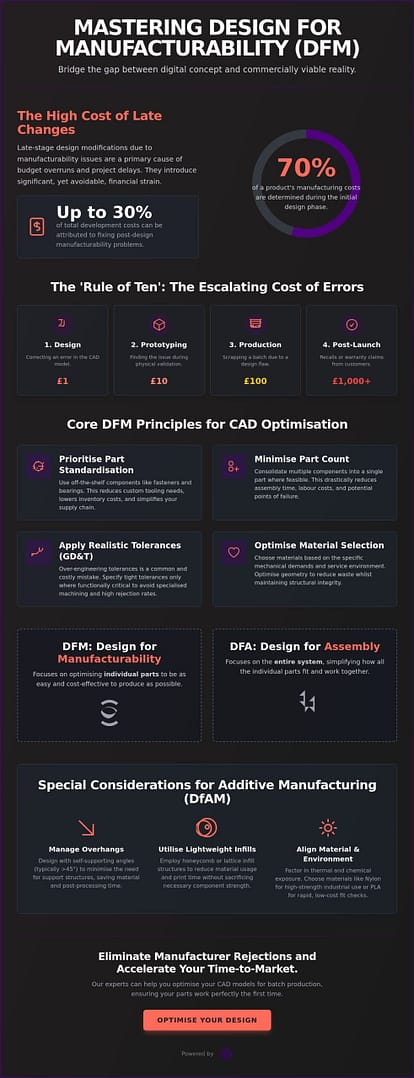
Design for Manufacturability is the engineering practice of designing parts specifically for ease of fabrication at the lowest possible cost. It bridges the gap between a sleek digital CAD model and a tangible physical component that performs under pressure. Learning Design for Manufacturability (DFM) is essential because approximately 70% of a product’s manufacturing costs are determined during the initial design phase. If you wait until the production floor to address fabrication issues, you’ve already lost the battle for efficiency.
Engineers must respect the ‘Rule of Ten’ when considering how to design for manufacturability. This principle states that a design error costs ten times more to fix at each subsequent stage of the production cycle. A mistake corrected in your CAD software might cost pennies; that same error discovered during batch production or in the field can cost thousands. Successful DFM requires a deep understanding of how material selection interacts with specific processes. For instance, designing a part for FDM printing requires different wall thicknesses and support strategies than designing for SLS, where self-supporting geometry is more achievable.
The Core Benefits of a DFM-First Approach
Adopting a DFM-first mindset delivers immediate competitive advantages for any project:
- Significant cost reduction: You eliminate unnecessary complexity and non-standard hardware that inflate procurement and machining costs.
- Accelerated time-to-market: Reduced redesign cycles and simplified tooling requirements mean your product reaches the client faster.
- Enhanced reliability: By minimising the number of potential failure points during the assembly phase, you ensure a more robust final product.
DFM vs DFA: Why Both Matter for UK Engineers
While often grouped together, DFM and DFA address different challenges. DFM focuses on individual part fabrication, ensuring each component is easy to produce. In contrast, Design for Assembly (DFA) looks at the system level, aiming to simplify the way those parts fit together. For high-stakes projects, we recommend a holistic DFMA strategy. This approach is vital for scaling from a single prototype to large-scale manufacturing without compromising on quality or precision. It’s about making sure your parts aren’t just possible to make, but easy to build at scale.
Core DFM Principles: Optimising Your CAD Models for Success
Optimising CAD models is where the most significant savings are found. Knowing how to design for manufacturability means looking at your assembly through the lens of a production manager. Start by prioritising standardisation. Using off-the-shelf fasteners, bearings, and connectors reduces inventory costs and eliminates the need for bespoke tooling. This approach ensures your supply chain remains resilient and your assembly remains cost-effective.
Simplicity is your most powerful tool. Minimise the total part count to reduce assembly time and narrow the margin for human error. If you can consolidate two components into a single part without over-complicating the fabrication process, do it. Simultaneously, apply realistic Geometric Dimensioning and Tolerancing (GD&T). Over-engineering tolerances is a frequent mistake that drives up costs by requiring specialised machining or resulting in high rejection rates. Only specify tight tolerances where they are functionally critical for the part’s performance.
Material efficiency also plays a vital role in your bottom line. Optimise your geometry to reduce waste whilst maintaining the structural integrity required for the part’s service life. Refining these details early ensures a smooth transition to batch production without the need for expensive late-stage redesigns.
Designing for Additive Manufacturing (DfAM)
When working with 3D printing, traditional DFM rules shift. Manage overhangs carefully to minimise the need for support structures. Designing with self-supporting angles, typically 45 degrees or more, reduces material usage and post-processing labour. Utilise honeycomb or lattice infills to lighten the component without sacrificing strength. If you need assistance with complex geometry, our 3D Design services provide expert CAD optimisation to ensure your files are production-ready from day one.
Material Selection and Service Environment
Align your material choice with the mechanical demands of the final application. Whether you choose PLA for rapid fit-checks or Nylon for high-strength industrial components, you must consider the service environment. Factor in thermal and chemical exposure during the design phase to prevent premature failure. Leveraging Rapid Prototyping allows you to validate these material properties under real-world stress before you scale up. This practical testing phase is the final insurance policy for your design’s long-term durability.
Leveraging Rapid Prototyping to Accelerate the DFM Cycle
3D printing enables ‘physical DFM’ by allowing you to test fit and function in hours. This immediate feedback loop is critical for mastering how to design for manufacturability. It moves the trial-and-error process away from the factory floor and into a controlled, low-cost environment. Professional rapid prototyping serves as the ultimate validation tool. It ensures your assembly is flawless before you commit significant capital to larger runs.
Reverse engineering also plays a vital role. By using 3D scanning on legacy components, you can identify DFM opportunities that were previously hidden. This allows you to modernise parts for faster production cycles and lower material waste. This proactive approach eliminates the ‘fail slow’ mentality that plagues traditional engineering cycles. It replaces guesswork with tangible data, ensuring your final parts are optimised for speed and precision.
From Digital Model to Batch Production
Transitioning from a functional prototype to cost-effective batch production requires a disciplined approach. Use iterative physical testing to identify potential manufacturing bottlenecks early. By catching these issues during the prototyping stage, you prevent costly downtime and ensure your production line runs at peak efficiency. This transition is where your earlier DFM efforts pay dividends through reduced rejection rates and lower unit costs.
Collaborating with a Specialist Manufacturing Partner
Involving manufacturing experts during the initial 3D design phase is a strategic move. At Protomolecule, we provide technical feedback that aligns your vision with practical fabrication limits. This collaboration ensures uncompromising standards and the fast turnaround times your project demands. We act as your dedicated partner to solve complex engineering problems before they impact your deadlines. Our goal is to make your production process as streamlined and reliable as possible.
Ready to validate your design? Get a fast, professional quote today.
Streamline Your Production from Concept to Component
Mastering how to design for manufacturability transforms your engineering workflow from a series of costly corrections into a streamlined path toward commercial success. By prioritising part simplicity and applying realistic tolerancing early in the CAD phase, you insulate your project against the compounding costs of the Rule of Ten. These strategic decisions ensure your components are not only functional but also financially viable for large-scale fabrication.
Protomolecule acts as your dedicated partner in this transition, offering expert 3D design and CAD modelling to refine your most complex assemblies. Our fast turnaround 3D printing service provides the physical validation you need to move forward with total confidence. Whether you require a single high-precision prototype or specialist batch production for UK industry, we deliver results that meet uncompromising standards. Don’t let design inefficiencies stall your project momentum.
Take the next step toward optimised manufacturing today. Get a Professional 3D Printing Quote and see how our agile, tech-savvy studio can accelerate your time-to-market. Your project deserves the precision and speed of a dedicated manufacturing partner.
Frequently Asked Questions
What is the most important rule in DFM?
The most important rule is to simplify the design by minimising the total number of parts. Reducing complexity directly lowers assembly time and decreases the risk of failure during production. You should also prioritise standard, off-the-shelf components over bespoke hardware whenever possible. This strategy ensures your project remains cost-effective and avoids the long lead times associated with custom-made fasteners or fittings.
How does DFM differ when designing for 3D printing versus CNC machining?
DFM for 3D printing focuses on managing additive constraints like overhangs and support structures to reduce post-processing labour. Conversely, CNC machining requires a subtractive mindset where tool access and internal radii are the primary concerns. Whilst 3D printing allows for complex internal lattices, CNC often demands simpler geometries to avoid expensive multi-axis setups. Understanding these process-specific rules is central to learning how to design for manufacturability effectively.
Can DFM principles be applied to existing products to reduce costs?
You can apply DFM principles to legacy products to drive down unit costs and improve performance. By using reverse engineering and 3D scanning, we identify inefficient geometries or obsolete components that are inflating your production budget. Redesigning these parts for modern fabrication methods often leads to weight reduction and faster turnaround times. It’s a practical way to breathe new life into older designs whilst increasing their commercial viability.
How much can I expect to save by implementing DFM early in the design cycle?
Implementing DFM early can reduce your total product development costs by up to 30% by preventing expensive late-stage changes. Data shows that late-stage design changes account for 20% to 30% of total development costs in discrete manufacturing. By addressing how to design for manufacturability at the CAD stage, you ensure that the majority of your production costs are optimised before you commit to tooling. This proactive approach prevents the massive expenses associated with redesigning parts after production has already commenced.