A 0.5mm warp on a critical component isn’t just a minor defect; it’s a total failure that halts UK production lines and drains your budget. You’ve likely felt the frustration of pulling a part off the bed only to find it snapped under thermal stress or failed a tolerance check by a fraction of a millimetre. We understand that in high-stakes engineering, you can’t afford to guess based on conflicting data sheets. This guide settles the abs vs petg for functional parts debate by focusing on the 2026 engineering standards required for real-world durability and precision.
Mastering the technical trade-offs between these two polymers ensures your components survive 95°C environments and repeated mechanical loads without losing their structural integrity. We’ll provide the definitive data you need to select the right material for your specific industrial application, helping you eliminate assembly issues and ensure long-term part reliability. From impact resistance to chemical exposure, here is the breakdown of how to choose the material that delivers zero compromise on quality for your next batch production.
Key Takeaways
- Identify why PETG’s susceptibility to mechanical “creep” makes it a risk for parts under constant tension compared to the legacy rigidity of ABS.
- Discover how to overcome ABS warping challenges to achieve the precision dimensional accuracy required for complex mechanical interlocks.
- Compare abs vs petg for functional parts across industrial standards for UV stability and chemical resistance to ensure long-term durability in UK environments.
- Learn how to scale from a single prototype to reliable batch production of 100+ parts without compromising on engineering tolerances or part consistency.
- Master the technical trade-offs necessary to select the right material and beat the clock on your project deadlines with zero compromise on quality.
Defining the Functional Requirement: ABS vs PETG in 2026
In 2026, a functional part is defined by its ability to maintain mechanical integrity under specific environmental stressors such as heat, UV exposure, or chemical contact. Additive manufacturing has moved beyond simple visual models; today’s components must perform under load. Stop choosing materials based on which one is easier to print. High-performance results require matching the polymer to the end-use application. Acrylonitrile Butadiene Styrene (ABS) remains the legacy standard for rigid, heat-resistant components. It has served as a cornerstone of industrial manufacturing since the mid-20th century. Conversely, PETG serves as the versatile modern alternative for parts requiring high impact strength and superior layer fusion. When evaluating abs vs petg for functional parts, you must prioritise the end-use environment over the convenience of the print bed. Don’t let poor material choice lead to field failures. Use our rapid prototyping services to validate your designs before moving to batch production.
When to Prioritise Rigid Thermal Resistance
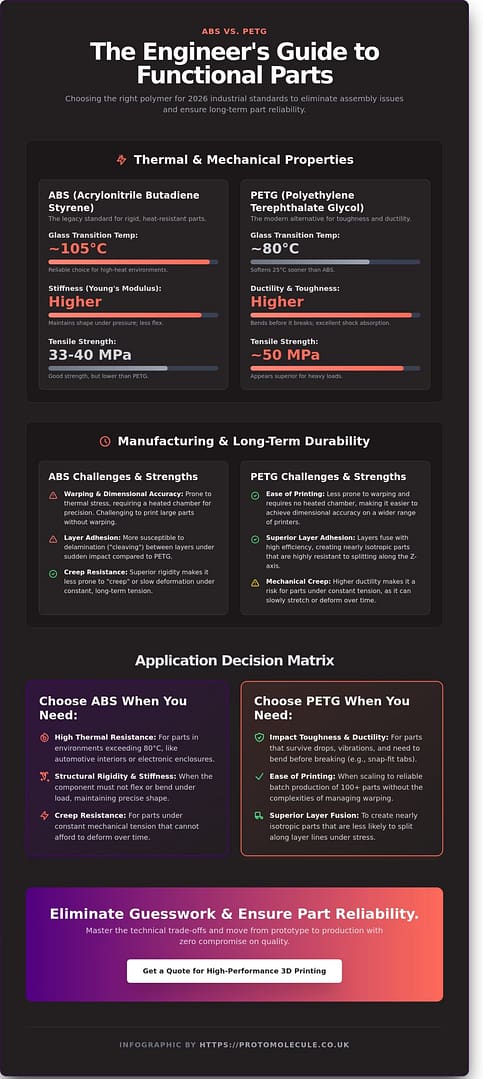
A component’s glass transition temperature marks the specific point where the polymer shifts from a rigid, “glassy” state to a flexible, rubbery one. ABS boasts a glass transition temperature of approximately 105°C. This makes it essential for automotive interior trim, which can reach temperatures of 70°C during a UK summer. PETG begins to soften at roughly 80°C. This 25°C gap is the difference between a durable electronic enclosure and a warped, failed assembly. If your part operates near heat sources or inside unventilated machinery, ABS is the only reliable choice. Zero compromise on thermal stability is required for industrial reliability.
When Impact Toughness and Ductility Matter Most
PETG excels where ABS often fails: layer adhesion and shock absorption. While ABS is prone to delamination or “cleaving” between layers under sudden stress, PETG layers fuse with high efficiency to create a nearly isotropic part. This ensures the component survives sudden drops or high-vibration environments that would shatter a more brittle ABS equivalent. Ductility refers to the material’s capacity to undergo significant plastic deformation before rupture, allowing snap-fit tabs to flex without snapping during assembly. PETG’s superior ductility ensures these features remain functional through multiple cycles. Abs vs petg for functional parts decisions often come down to this specific mechanical trade-off. If you need a part that bends before it breaks, choose PETG. Beat the clock on your next project and get a quote for high-performance 3D printing today.
Mechanical Integrity: Comparing Strength, Toughness, and Creep
Engineering success requires a precise understanding of material limits. When evaluating abs vs petg for functional parts, you cannot rely solely on raw data sheets. PETG typically displays a higher tensile strength of approximately 50 MPa, while standard ABS hovers between 33 and 40 MPa. This makes PETG appear superior for heavy loads. However, ABS offers a higher Young’s modulus, providing the stiffness necessary for parts that must maintain their shape under pressure. In contrast, PETG is more ductile, which allows it to flex before breaking.
Performance in a lab rarely matches performance on the factory floor. The internal geometry of your component, specifically wall thickness and infill density, changes everything. Increasing wall loops from two to four can improve part strength by up to 30 percent, regardless of the filament used. We utilize rapid prototyping to validate these mechanical properties through iterative testing. This ensures your final component meets the exact rigours of its intended environment without unnecessary weight or material waste.
Tensile Strength vs. Real-World Toughness
A material’s theoretical strength often fails to account for the anisotropy of 3D printed parts. Layer bonding efficiency dictates the actual failure point. PETG excels here; its high melt temperature and molecular structure create superb adhesion between layers. This makes it less likely to split along the Z-axis. ABS is more technically demanding and prone to warping, but it offers better impact resistance. When choosing between PETG and ABS, consider how the part will fail. ABS tends to deform or crack locally, whereas PETG may shatter if subjected to high-velocity impacts beyond its limit. For parts like protective housings or brackets, managing these stress concentrations is vital for long-term reliability.
Long-Term Structural Stability and Creep
Mechanical creep is the slow, permanent deformation of a material under constant stress. This is the primary reason to choose abs vs petg for functional parts in load-bearing applications. PETG is notorious for creep. If you use a PETG bracket to hold a heavy shelf, you might find the bracket sagging after six months. ABS is far more stable under continuous mechanical tension, making it the industrial standard for clips, enclosures, and automotive components.
- ABS: High resistance to creep; maintains dimensions under 24/7 stress.
- PETG: Prone to “flow” over time; best suited for static parts with intermittent loads.
- Mitigation: If you must use PETG for a stressed assembly, increase the surface area of the load-bearing face to distribute pressure.
Precision matters when your project is on the line. If you need parts that won’t fail under pressure, get a quote from our engineering team today to ensure the right material choice for your specific application.
Overcoming Manufacturing Challenges: Warping and Dimensional Accuracy
Precision defines the success of any engineering project. When evaluating abs vs petg for functional parts, the primary obstacle is often how the material reacts to temperature changes during the print cycle. ABS is notorious for warping. It requires a strictly controlled thermal environment to prevent the edges from lifting off the build plate and ruining the part geometry. We eliminate these common FDM defects by using industrial-grade hardware with active chamber heating. This ensures every layer cools at a uniform rate, maintaining the structural integrity of your component. Don’t let manufacturing delays slow you down; our process is optimized for speed and accuracy to keep your project on track.
Managing Thermal Contraction in ABS
ABS warps because of internal stresses created as the plastic transitions from a molten state to room temperature. Without a heated chamber maintained at 80°C or higher, large parts will inevitably distort or delaminate. The coefficient of thermal expansion for industrial filaments is the numerical value representing how much a material’s length changes per degree of temperature variation. For ABS, this value is significantly higher than PETG, making it far more prone to shrinkage. Protomolecule manages these physics through precise thermal regulation. We provide industrial-grade results for clients across the UK, ensuring your parts meet exact specifications every time.
Dimensional Precision for Functional Assemblies
Achieving tight tolerances for mechanical interlocks requires a deep understanding of material shrinkage. ABS typically shrinks by 0.8% to 1.2% during cooling. PETG remains more stable with a shrinkage rate of roughly 0.2%. You must account for these variables during the 3D design phase to ensure functional assemblies fit together perfectly. Beyond thermal issues, hygroscopy plays a role; PETG absorbs moisture quickly. This can lead to bubbling and poor dimensional accuracy if the filament isn’t dried properly. We use industrial desiccant systems to keep materials in peak condition.
When comparing abs vs petg for functional parts, the choice often comes down to how much post-print processing you can tolerate. Our team handles the complexities of material-specific behavior so you don’t have to. Whether you need 80s JDM wheel centre caps or passenger train seat arms, our approach ensures zero compromise on quality. Our lightning-fast turnaround means you get your precision parts when you need them. Turn your ideas into reality with a partner that understands the technical demands of modern manufacturing.
Chemical and Environmental Durability: Industrial Standards
Industrial environments demand materials that don’t just survive but thrive under stress. In UK manufacturing hubs nationwide, selecting between abs vs petg for functional parts often comes down to the specific chemical or atmospheric exposure the component will face. Engineers must account for everything from UV degradation to caustic cleaning agents to ensure a part’s lifecycle meets its design requirements. Reliability isn’t just a goal; it’s a necessity for maintaining production uptime.
UV Resistance and Outdoor Longevity
PETG is the superior choice for outdoor applications. Standard ABS degrades rapidly when exposed to solar radiation. UV rays break down the polymer chains, leading to a 25% to 40% reduction in impact strength within six months of direct exposure. This results in the characteristic yellowing and surface chalking seen in older automotive components. PETG remains naturally more stable under these conditions. It maintains its structural integrity and colour for significantly longer periods. If your project requires ABS for its heat resistance but will live outdoors, you must apply a UV-resistant clear coat or high-performance paint to prevent premature failure. Don’t risk your reputation on a part that turns brittle after one summer.
Chemical Compatibility in Industrial Settings
Choose your material based on your workshop’s cleaning or processing agents. PETG resists a broad range of chemicals, including dilute acids, alkaline solutions, and various alcohols. This makes it a staple for UK medical and food processing environments where aggressive sanitisation is mandatory. Conversely, ABS is vulnerable to many solvents but offers a unique advantage. It dissolves in acetone. We use this property for vapour smoothing to create airtight, liquid-proof seals on functional prototypes. However, you should avoid ABS if the part will contact petrol or industrial oils. These substances cause the polymer to swell and crack. For abs vs petg for functional parts in a factory setting, PETG’s resistance to hydrocarbons often makes it the safer bet.
- Aerospace: PETG is frequently specified for non-critical interior jigs due to its chemical stability.
- Commercial Manufacturing: PETG’s food-safe potential, often meeting EU 10/2011 standards, gives it the edge for custom packaging machinery.
- Automotive: ABS remains the standard for interior trims where high heat resistance is the priority over chemical exposure.
Precision and speed are the cornerstones of modern manufacturing. Whether you’re producing passenger train seat arms or specialized enclosures, the material choice dictates the longevity of the solution. We help you navigate these technical requirements to ensure zero compromise on quality. Stop guessing and start building with confidence.
Don’t let material failure slow your project down. Start your batch production with the right high-performance filament today.
Scaling to Production: Professional Batch Manufacturing
Deciding between abs vs petg for functional parts is only the first step in the product development lifecycle. The real challenge begins when you move from a single successful prototype to a full production run. Transitioning to batch production requires a level of consistency that standard desktop printers cannot sustain. Protomolecule bridges this gap, transforming your digital designs into high-performance physical assets with industrial precision. We focus on delivering results that meet the rigorous demands of UK engineering firms and independent innovators alike.
Scaling up means managing variables that don’t appear in one-off prints. Thermal fluctuations, filament moisture, and mechanical wear can all compromise a batch of 100+ parts. We use professional-grade systems to ensure that the 500th part is identical to the first. This reliability is essential for functional assemblies where a tolerance deviation of even 0.2mm can lead to total system failure. Our workflow is designed to eliminate these risks, providing a stable foundation for your hardware rollout.
Consistency in Large-Scale FDM
Repeatability in professional FDM manufacturing depends on rigorous machine calibration and environmental control. We maintain strict ambient temperature profiles to prevent the warping issues often associated with ABS. High-performance filaments undergo a 24-hour dehydration process before they ever reach the extruder to ensure zero porosity and maximum layer strength. This professional approach reduces batch variance by 95% compared to unmanaged “hobbyist” setups. For critical functional parts, our industrial-grade hardware maintains tight tolerances, ensuring every component in your assembly integrates perfectly without manual filing or adjustment.
Getting Your Functional Parts to Market
Speed is your primary competitive advantage in the modern market. Our rapid manufacturing workflow allows you to bypass the typical 8-week lead times required for traditional injection mold tooling. We frequently deliver production-ready batches of 200+ units to clients across the UK within 3 to 5 business days. By optimizing build plate layouts and nesting geometries, we maximize machine efficiency and significantly reduce the cost-per-part for our partners.
Post-processing is the final touch that elevates a printed part to a commercial product. Whether it’s mechanical finishing for a matte aesthetic or heat treating PETG for enhanced thermal resistance, we tailor the finish to your specific application. Don’t let slow supply chains or inconsistent quality stall your progress. Get a precision quote for your functional parts today and beat the clock on your next project. Zero compromise on quality is our brand promise, ensuring your parts perform exactly as engineered, every single time.
Accelerate Your Production Cycle with High-Performance Engineering
Navigating the technical differences between abs vs petg for functional parts ensures your components survive the rigours of 2026 industrial standards. While PETG excels in chemical resistance and impact strength, ABS remains the critical choice for parts requiring dimensional stability at temperatures exceeding 95°C. Protomolecule eliminates the manufacturing guesswork. We apply specialist expertise honed in the military and space sectors to every batch we produce, ensuring your components meet rigorous requirements every time.
Our team delivers industrial-grade components with a zero compromise on quality policy, moving your designs from digital files to physical reality using our 24-hour rapid prototyping service. Don’t let material selection bottlenecks or slow lead times stall your development cycle. Whether you’re developing 80s JDM wheel centre caps or mission-critical aerospace housings, we provide the precision your engineering demands. Get an Instant Quote for Professional 3D Printing and secure the high-performance parts your project requires today. We’re ready to help you beat the clock and launch your next innovation with total confidence.
Frequently Asked Questions
Is ABS stronger than PETG for functional parts?
ABS offers higher structural rigidity and tensile strength, typically reaching 40 MPa compared to PETG’s 30 MPa. However, PETG provides 20% more flexibility, allowing it to absorb impacts without shattering. When selecting abs vs petg for functional parts, choose ABS for rigid frameworks and PETG for components subject to sudden shocks or vibrations. This choice ensures your mechanical assembly performs under pressure without premature fatigue.
Does PETG degrade in sunlight more than ABS?
ABS degrades significantly faster in sunlight because it lacks inherent UV stability. Exposure to ultraviolet radiation causes ABS to yellow and become brittle within 6 months of outdoor use in the UK. PETG maintains its structural integrity and colour for much longer periods. For any UK based outdoor project, PETG is the superior choice to ensure a 5 year or longer service life without UV related failure.
Which material is better for parts that need to withstand heat?
ABS is the clear winner for high temperature environments. It maintains its shape up to 105°C, whereas PETG begins to soften at 80°C. If your component operates near engines or industrial machinery, PETG will likely deform under load. Use ABS to ensure your functional parts remain dimensionally stable in environments exceeding 85°C. This prevents costly downtime and keeps your production line moving at full speed.
Can PETG be used for load-bearing components?
PETG is highly effective for load-bearing components that require a degree of flexibility rather than absolute rigidity. It handles constant tension well but can suffer from creep if the load is sustained at temperatures above 50°C. For heavy duty brackets or mechanical linkages, PETG provides the necessary toughness to prevent catastrophic snaps during peak stress events. It’s a reliable choice for 80% of general mechanical applications.
Why does ABS warp more than PETG during the printing process?
ABS warps because it has a high thermal contraction coefficient of approximately 1.5%. As the plastic cools from 240°C to room temperature, it shrinks rapidly, pulling the corners of the print away from the bed. PETG shrinks less than 0.5% during cooling. This stability makes PETG easier to print on open machines, while ABS requires a 60°C heated enclosure to manage internal stresses and prevent delamination.
Is PETG chemically resistant to oils and fuels?
PETG shows excellent resistance to oils, greases, and most common fuels used in UK automotive applications. It won’t degrade when exposed to paraffin or diluted acids, making it ideal for engine bay fluid reservoirs or workshop tools. In contrast, ABS reacts poorly to acetone and certain esters. These chemicals can melt or weaken the part surface within 30 seconds of contact, leading to immediate structural failure.
How do I choose between ABS and PETG for an outdoor enclosure?
Choose PETG for outdoor enclosures if the primary concern is UV exposure and moisture resistance. It withstands the UK’s variable weather cycles without becoming brittle or cracking. If the enclosure must survive high impact or sits in a high heat area, select ABS but apply a UV resistant coating. Comparing abs vs petg for functional parts in outdoor settings usually favours PETG for its 3 year weathering advantage.
What is the glass transition temperature of ABS vs PETG?
ABS has a glass transition temperature of 105°C, making it suitable for demanding thermal applications. PETG has a lower glass transition temperature of 80°C. This 25 degree difference is critical for your project’s success. If your part must operate in a car interior during a UK summer heatwave, ABS is the only reliable option to prevent sagging. Don’t risk failure by choosing the wrong thermal profile.