Your production schedule shouldn’t be held hostage by a twelve-week lead time for a steel mould. You’ve likely felt the frustration of a design that’s ready for market but remains stuck in a manufacturing bottleneck. Committing to expensive hard tooling before final design validation is a high-stakes gamble that often results in lost opportunities and drained capital. Integrating bridge tooling with 3d printing into your workflow allows you to bypass these traditional delays and start delivering functional parts to your customers immediately.
We know that maintaining momentum is critical in the competitive UK industrial sector. This article shows you how 3D printed bridge tooling slashes lead times and reduces upfront costs during the high-pressure transition from prototype to mass production. You’ll learn how to validate designs using end-use materials whilst protecting your budget from premature hard-tooling investments. We’ll explore the strategic shift from simple prototyping to industrial-grade production that keeps your project moving and ensures your product reaches the market without unnecessary delays.
Key Takeaways
- Close the 8-12 week “tooling gap” by bypassing traditional steel mould manufacturing to keep your revenue flowing and your project on schedule.
- Utilise bridge tooling with 3d printing to transition from prototype to end-use parts without the high financial risk of premature hard-tooling commitments.
- Compare the mechanical strengths and surface finishes of FDM, SLA, and SLS technologies to select the most effective solution for your specific industrial application.
- Apply Design for Additive Manufacturing (DfAM) principles to ensure batch production runs of 50 to 500+ units perform exactly like injection-moulded equivalents.
- Accelerate your route to market by moving rapidly from CAD optimisation to high-quality component delivery across the UK.
What is Bridge Tooling & Why Use Additive Manufacturing?
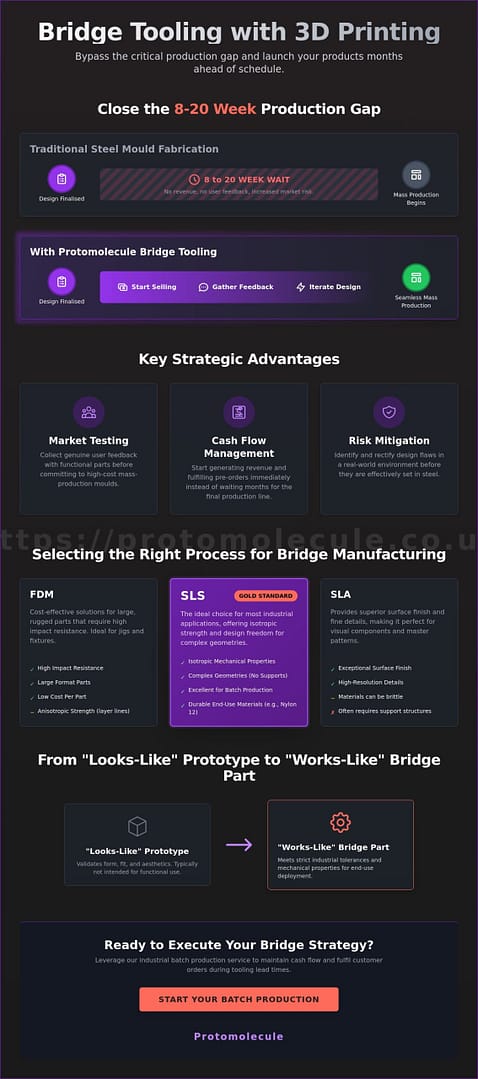
Bridge tooling is the vital production phase that connects the initial prototype to full-scale mass production. It serves as a temporary manufacturing solution whilst permanent, high-volume tools are being fabricated. In traditional manufacturing, this creates a significant “Tooling Gap.” Steel or aluminium moulds typically take 8 to 12 weeks to manufacture; a delay that effectively halts your revenue stream and pushes back your market entry. For many UK firms, this period is a period of high risk where competitors can gain a foothold.
Deploying bridge tooling with 3d printing eliminates this bottleneck. Unlike traditional methods that require high upfront capital expenditure (CAPEX) for permanent moulds, additive manufacturing offers zero tooling costs and an immediate start. This makes it the superior choice for small batches, allowing you to fulfil orders whilst the hard tooling is still in development. It is a strategic application of Rapid Tooling that ensures your production line never sits idle. By utilising our rapid prototyping expertise, you can move from a digital file to a physical batch in days rather than months.
The Strategic Advantage of Rapid Market Entry
This approach enables a “soft launch,” providing a window to gather real-world consumer feedback before the design is finalised in steel. If a user identifies a necessary adjustment, you can iterate the design instantly. You aren’t stuck with a static tool. You maintain the agility to refine your product even after the first units have shipped, ensuring the final mass-produced version is perfectly optimised for your audience.
Reducing Risk in Modern Engineering
Committing to expensive metal tools for an unproven design is a massive financial risk. Additive manufacturing prevents you from “locking in” a flawed geometry that would cost thousands to rectify in a steel mould. It also bolsters your supply chain resilience. During global disruptions, having the capability to print parts on-demand in the UK ensures you can meet deadlines without relying on overseas toolmakers or long-distance shipping logistics.
Selecting Technologies and Materials for Bridge Production
Choosing the right platform for bridge tooling with 3d printing depends on your part’s mechanical requirements and the desired surface finish. You need a technology that produces parts capable of withstanding real-world testing conditions whilst bridging the gap to mass production. FDM offers robust, large-format capabilities for structural components. SLA provides unmatched surface smoothness for aesthetic validation. SLS delivers high-complexity, support-free geometries with isotropic strength.
Achieving functional equivalence requires expert 3D design optimisation. You must account for layer orientation and shrinkage to ensure the part mimics its injection-moulded successor. We utilise high-performance polymers like carbon-fibre reinforced nylons to provide the necessary stiffness for industrial applications. To guarantee precision, we integrate 3D scanning to verify that every bridge component meets the original CAD specifications before it reaches your assembly line.
FDM vs SLS: Which technology fits your batch?
FDM is your go-to for large-scale components and functional jigs or fixtures where durability is the priority. It handles substantial geometries that other methods might find cost-prohibitive. SLS is better suited for high-complexity, nestable parts that require isotropic strength without the constraints of support structures. This allows for dense packing within the build volume, which is ideal for our batch production service.
Material Transition: From Additive to Injection Moulding
Select 3D materials that mimic the thermal and mechanical properties of final plastics, such as glass-filled nylons for high-temperature environments. Material parity is the key to valid bridge phase testing. If your bridge part doesn’t behave like the final product, your validation data is worthless. If you’re unsure which polymer matches your production grade, contact our engineering team for a technical consultation.
Implementing Bridge Tooling: From CAD to Batch Production
Successful bridge tooling with 3d printing requires a streamlined workflow that prioritises speed without sacrificing precision. It begins with 3D design optimisation to ensure your digital model is refined for rapid print cycles. This stage is crucial for identifying potential failure points before you commit to a batch production run. We handle quantities ranging from 50 to over 500 units, providing a tangible bridge that keeps your distribution channels active whilst permanent tooling is finalised.
If you’re working with legacy components that lack digital files, our reverse engineering service can recover critical tooling data. We use advanced scanning to recreate and improve upon original parts, ensuring your bridge production remains accurate to the original intent. Rigorous quality control remains at the centre of this process. Every part must meet exact tolerances to ensure it performs reliably in its final application, especially within high-stakes sectors like aerospace or transport.
Scaling with Professional 3D Printing Services
Outsourcing to a specialist studio like Protomolecule guarantees industrial-grade quality and speed that standard in-house machines often can’t match. As a UK-based partner, we offer rapid turnaround times and clear, technical communication. We understand the pressures of industrial deadlines and act as an agile extension of your engineering team, solving complex bottlenecks with proven expertise.
Final Assembly and Post-Processing
Match end-use aesthetics through professional post-processing. We offer vapour smoothing to achieve a high-gloss finish, dyeing for uniform colour, or precision machining for tight-tolerance features. These steps ensure your bridge parts are indistinguishable from final injection-moulded components. You don’t have to wait months for your project to progress. Get a quote today to see how quickly we can reduce your lead times and secure your production schedule.
Secure Your Market Lead with Agile Manufacturing
Bridging the gap between prototype and mass production no longer requires a twelve-week wait for steel moulds. By integrating bridge tooling with 3d printing into your development cycle, you eliminate the high financial risk of premature hard-tooling and maintain critical production momentum. You’ve seen how selecting the right high-performance polymers and optimising CAD designs ensures your bridge parts meet industrial standards for strength and finish. This strategy allows you to validate functional performance in real-world conditions whilst your permanent tools are still in fabrication.
Protomolecule provides the technical expertise required for high-stakes sectors, including military and aerospace, delivering fast turnaround services across the UK. Our comprehensive 3D design and reverse engineering support ensures your project moves from digital concept to physical batch without friction. Don’t let traditional manufacturing delays stall your revenue or give competitors an advantage. Accelerate your production cycle; get a rapid 3D printing quote today and keep your project moving at the speed of modern industry. Your next batch is ready when you are.
Frequently Asked Questions
How long does 3D printed bridge tooling typically last?
Most 3D printed bridge tools are designed to produce between 50 and 500 parts, depending on the complexity of the geometry and the material being injected. Whilst they aren’t a permanent replacement for hardened steel, they provide the necessary durability to sustain production during the critical lead-time gap. High-performance polymers like glass-filled nylons extend the tool’s life by resisting thermal degradation during repeated cycles.
Can 3D printed moulds be used for actual injection moulding?
Yes, 3D printed moulds are frequently used for low-volume injection moulding to validate designs in end-use materials. This specific application of bridge tooling with 3d printing allows engineers to test functional performance without the cost of metal tooling. We utilise high-temperature resins that withstand the pressures and heat of the injection process, ensuring the resulting parts meet your exact specifications.
What are the typical cost savings of bridge tooling versus traditional methods?
Bridge tooling offers significant savings by eliminating the high capital expenditure associated with traditional steel or aluminium moulds, which often cost thousands of pounds. You save on initial setup fees and avoid the financial risk of design changes that would require expensive tool modifications. By using our batch production service, you only pay for the parts you need whilst maintaining your project’s momentum.
Is bridge tooling suitable for complex internal geometries?
Bridge tooling excels at producing complex internal geometries that are often impossible or prohibitively expensive to achieve with traditional subtractive manufacturing. Additive processes allow for the creation of intricate internal channels and undercuts without the need for complex multi-part moulds. This capability is particularly valuable for aerospace and automotive components where lightweighting and fluid dynamics are critical to the part’s performance.