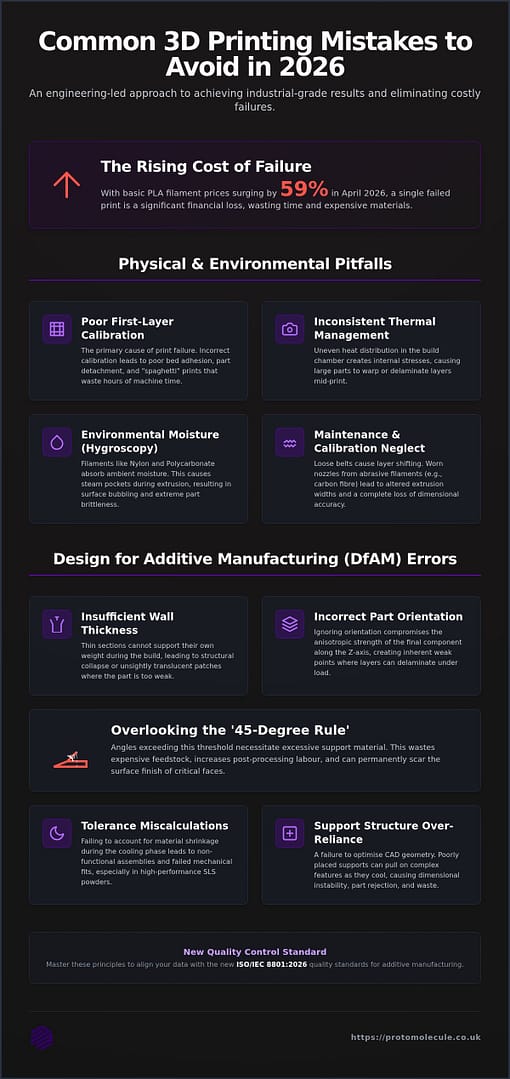
With basic PLA prices surging by 59% in April 2026, a single failed print is no longer just a minor frustration; it’s a direct hit to your project’s bottom line. Achieving industrial-grade results requires more than just hitting ‘print’ and hoping for the best. You need a rigorous, engineering-led approach to identify and rectify common 3d printing mistakes to avoid before they waste your time and expensive materials.
We understand the pressure of meeting tight deadlines whilst maintaining uncompromising standards for functional prototypes. You want repeatable, high-quality results across every batch, yet inconsistent part quality and structural weaknesses often stand in the way. This guide provides the technical expertise you need to master additive manufacturing in 2026. You will learn to align your data with the new ISO/IEC 8801:2026 quality control standards, optimise your CAD designs for manufacturing, and recognise exactly when to transition from in-house builds to professional-grade services.
Key Takeaways
- Prevent hardware failures by mastering first-layer calibration and managing environmental moisture to eliminate filament brittleness and surface bubbling.
- Optimise CAD designs using the 45-degree rule and precise wall thickness calculations to reduce support waste and prevent structural collapse.
- Identify the most common 3d printing mistakes to avoid when scaling production to ensure your chosen technology matches your specific engineering requirements.
- Account for the significant time and labour required for professional-grade post-processing to maintain realistic project timelines.
- Recognise the critical transition point where utilising a professional 3D printing service is necessary to guarantee repeatable, industrial-grade accuracy.
Physical and Environmental Pitfalls: Why Your Hardware Fails
Precision in additive manufacturing begins at the build plate. Poor bed adhesion and incorrect first-layer calibration remain the primary drivers of hardware-related failures in industrial settings. If your first layer isn’t perfectly compressed against the surface, you risk total part detachment or “spaghetti” prints that waste hours of machine time. This is one of the most critical common 3d printing mistakes to avoid when working with high-performance materials that have high shrink rates.
Thermal management is equally vital, especially for large-format FDM components. Inconsistent heat distribution across the build chamber leads to internal stresses, causing parts to warp or delaminate before the cycle is even complete. Hygroscopy is the phenomenon where a material attracts and holds water molecules from the surrounding environment, which specifically compromises the structural integrity of nylon and polycarbonate materials by causing steam pockets during extrusion. This moisture manifests as surface bubbling and extreme brittleness in finished parts, rendering them useless for functional testing.
Material Management and Storage Errors
Engineering-grade polymers require climate-controlled storage to maintain their chemical integrity. Leaving spools exposed to ambient workshop humidity is a recipe for project delays. Degraded filament increases machine downtime through frequent nozzle blockages and inconsistent extrusion rates. Use sealed dry boxes or dedicated industrial drying ovens to ensure your feedstock remains in peak condition for critical production runs. Protecting your materials is as vital as the print settings themselves.
Calibration and Maintenance Neglect
Don’t overlook the mechanical health of your hardware. Conduct regular audits of axes and belts to prevent layer shifting, particularly during high-speed manufacturing cycles. Nozzle wear is another silent killer of precision; abrasive filaments like carbon fibre composites can quickly enlarge a nozzle diameter. This alters extrusion widths and compromises the dimensional accuracy required for industrial assemblies. Maintaining a strict maintenance schedule ensures your 3D printing service delivers repeatable, high-quality results every time.
Design for Additive Manufacturing: Solving Errors at the CAD Stage
Industrial success in additive manufacturing is won or lost at the CAD stage. Design for Additive Manufacturing (DfAM) requires a fundamental shift from traditional subtractive mindsets. Insufficient wall thickness often leads to structural collapse or unsightly translucent patches, particularly in SLA and FDM components where thin sections cannot support their own weight during the build. You must also account for part orientation; ignoring this compromises the anisotropic strength of the final component along the Z-axis, creating inherent weak points where layers may delaminate under mechanical load. Utilising professional 3D design services ensures your geometry is optimised for the specific physics of your chosen manufacturing method.
Overlooking the ’45-degree rule’ for overhangs is one of the most frequent common 3d printing mistakes to avoid. When angles exceed this threshold, the system necessitates excessive support material. This doesn’t just waste expensive feedstock; it significantly increases post-processing labour and can scar the surface finish of critical functional faces. High-precision projects require a strategic approach to geometry to maintain both speed and quality.
Tolerance and Clearance Miscalculations
Failing to account for material shrinkage during the cooling phase leads to non-functional assemblies and failed mechanical fits. This is especially prevalent in high-performance SLS powders where thermal contraction is significant. If you need to match legacy components, professional reverse engineering is essential to capture exact dimensions and adjust for modern manufacturing tolerances. Precision at this stage prevents costly re-runs and ensures parts fit perfectly the first time.
Support Structure Over-Reliance
Strategic design reduces material waste and preserves the aesthetic integrity of your part. Over-reliance on supports often indicates a failure to optimise the CAD model for the additive process. Beyond surface scarring, poorly placed supports can pull on complex internal geometries as they cool, leading to dimensional instability and part rejection. Refine your geometry early to ensure your rapid prototyping phase remains efficient and cost-effective.
Strategic Production Mistakes: Scaling Beyond the Prototyping Phase
This requirement for professional precision in aesthetics is mirrored in other industries; for example, the specialists at Advanced PMU explain how professional-grade techniques in the beauty sector ensure a level of durability and longevity that standard alternatives cannot match.
Falling into the ‘DIY Trap’ is amongst the most expensive common 3d printing mistakes to avoid when scaling. Attempting batch production on a fleet of hobbyist machines often results in higher long-term costs due to inconsistent part geometry and frequent hardware failures. Professional batch production services ensure the rigorous consistency and material traceability that consumer-grade setups simply cannot match. This reliability is vital for maintaining project momentum and meeting strict delivery schedules.
Choosing the Correct Additive Technology
Align your choice of FDM, SLA, or SLS with your specific functional or aesthetic requirements to prevent material wastage. Whilst FDM is ideal for durable jigs and fixtures, SLS offers superior isotropic strength for complex functional assemblies without the need for support structures. Identifying the optimal manufacturing process early in the rapid prototyping cycle accelerates your time-to-market and reduces overall development costs.
The Cost of In-House Failure vs. Professional Reliability
Calculate the hidden costs of failed in-house prints before committing to a large-scale project. Machine wear, electricity, and the engineering hours spent troubleshooting are often excluded from initial budget estimates. Professional 3D printing services provide a more reliable ROI, particularly for high-stakes commercial and military sectors where failure is not an option. Partnering with an agile, industrial-grade studio allows you to focus on design whilst we handle the complexities of precision manufacturing.
Future-Proof Your Manufacturing Strategy
Mastering additive manufacturing in 2026 requires a disciplined shift from hobbyist experimentation to industrial-grade precision. By addressing the common 3d printing mistakes to avoid, you protect your project’s timeline and budget from the hidden costs of material wastage and mechanical failure. Success depends on rigorous CAD optimisation and a deep understanding of how environmental factors influence polymer integrity. You’ve seen how design choices and material management dictate the final part’s viability; it’s now time to apply these standards to your production workflow.
When your project demands uncompromising standards, partnering with an expert studio ensures repeatable, high-quality results. We bring advanced industrial-grade SLA, SLS, and FDM capabilities to every build, backed by technical expertise developed for the demanding military and space sectors. We specialise in rapid turnaround for time-sensitive UK projects, delivering functional components whilst maintaining the uncompromising standards required for aerospace and industrial transport. It’s the most efficient way to scale without compromising on part strength or surface finish.
Ready to eliminate the risk of failed prints? Get a rapid quote for your next engineering project and move from prototype to production with absolute confidence. Your most complex engineering challenges are within reach.
Frequently Asked Questions
Why is my 3D print failing halfway through the process?
Mid-print failures usually stem from heat creep or mechanical exhaustion in the extrusion system. As the heat break loses efficiency, filament softens prematurely and causes a blockage that stops extrusion whilst the motor continues to move. Regular maintenance of cooling fans and using high-quality thermal paste in the hotend assembly prevents this. Additionally, check for tangled filament spools; physical resistance on the spool can easily overwhelm the extruder motor during long cycles.
How can I prevent warping and bed adhesion issues in large prints?
Eliminate warping by using an actively heated build chamber and ensuring your first-layer height is perfectly calibrated. Large parts are prone to thermal contraction; as upper layers cool, they pull the base away from the build plate. Use a wide brim or a raft to increase the surface area in contact with the bed. For industrial materials like ABS or Polycarbonate, maintaining a consistent ambient temperature is non-negotiable to prevent uneven cooling across the part’s geometry.
What are the most common design mistakes for FDM 3D printing?
The most common 3d printing mistakes to avoid in FDM design include ignoring the Z-axis strength and failing to include internal fillets. Parts are weakest at the layer lines, so orient your model to ensure load-bearing forces don’t pull layers apart. Avoid sharp internal corners that act as stress concentrators; adding small fillets distributes mechanical loads more evenly. Always verify that your wall thickness is a multiple of your nozzle diameter to ensure solid, gap-free perimeters.
When should I switch from DIY 3D printing to a professional service?
Transition to a professional service when your project requires material traceability, repeatable batch consistency, or complex geometries that hobbyist hardware cannot resolve. If your engineering hours are consumed by machine troubleshooting rather than design, the ROI of in-house printing has likely vanished. Professional labs provide access to industrial-grade SLS and SLA systems. These deliver the dimensional accuracy and structural integrity required for regulated sectors like aerospace and automotive manufacturing.