

Would you trust a mission-critical aerospace component to a material chosen simply because it was the cheapest option on the shelf? In 2026, choosing the right 3d printing material is no longer a matter of preference; it’s a rigorous engineering requirement that determines the viability of your entire production cycle. With the global additive manufacturing market now exceeding $28 billion, the margin for error has vanished. You’re likely facing a dizzying array of new filaments and resins, whilst worrying that a single poor choice could lead to catastrophic part failure during field testing.
We understand that balancing high-performance mechanical properties against tight commercial budgets feels like a constant battle. This guide promises to simplify that complexity by providing the technical criteria you need to ensure your engineering projects achieve maximum durability. You’ll gain a clear understanding of the latest ISO/IEC 8801:2026 standards and a curated shortlist of materials tailored for your specific industry. We’ll examine the spectrum from high-speed PLA to industrial-grade PEEK, giving you the confidence to select a manufacturing partner that delivers results without compromise.
Key Takeaways
- Understand why the distinction between thermoplastics and thermosetting resins is the first step in choosing the right 3d printing material for your specific engineering application.
- Identify the essential mechanical and thermal properties required to ensure your components withstand real-world environmental stressors such as UV exposure and moisture.
- Learn how precise material selection accelerates the rapid prototyping cycle and reduces friction during the transition to large-scale batch production.
- Master the cost-benefit analysis of high-performance polymers to balance project budgets with industrial-grade durability and performance requirements.
- Gain the technical insight needed to select a manufacturing partner capable of delivering results for high-stakes industries like aerospace and defence.
Navigating the 3D Printing Material Landscape: FDM, SLA, and SLS
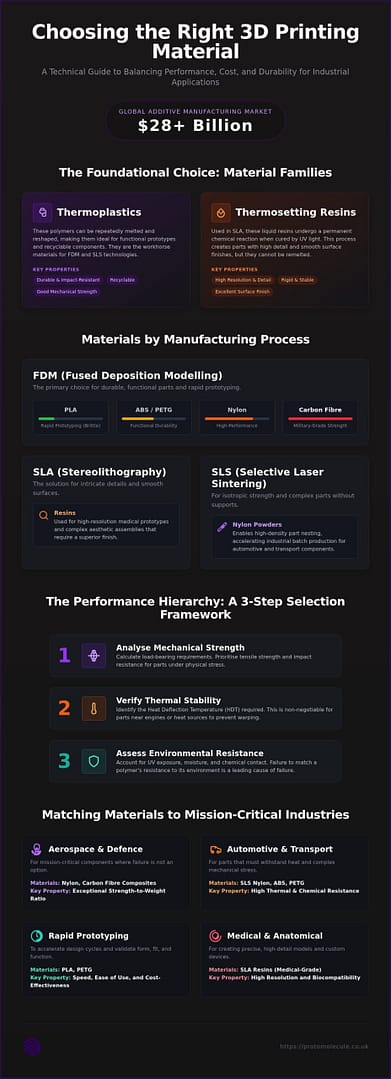
Success in additive manufacturing requires a deep understanding of polymer chemistry. The industrial market divides into two primary categories: thermoplastics and thermosetting resins. Thermoplastics, utilised in FDM and SLS, can be melted and reshaped multiple times, making them ideal for recyclable or functional prototypes. Conversely, SLA resins are thermosets that undergo a permanent chemical reaction when cured by UV light. This distinction is critical because choosing the right 3d printing material dictates the mechanical limits and environmental resistance of your part. For instance, common 3D printing materials like PLA offer ease of use but lack the thermal stability required for rigorous industrial environments.
Material choice is inextricably linked to the printing process; you cannot separate the polymer’s performance from the method used to layer it. In the UK manufacturing sector, moving beyond decorative models to end-use components requires industrial-grade materials that survive real-world stress. Engineering-grade polymer compatibility is the precise alignment of a material’s molecular structure with the thermal and mechanical parameters of its intended additive manufacturing process. We focus on delivering parts that meet these strict criteria for high-stakes sectors like aerospace and defence.
To explore how these engineering-grade standards are implemented by global development firms, you can check out VPrint3D Limited and their integrated prototyping solutions.
Industrial FDM Filaments for Functional Parts
FDM is the primary choice for our 3D printing service when durability is the priority. Whilst PLA serves well for initial rapid prototyping, it’s often too brittle for mechanical assemblies. We recommend ABS or PETG for functional durability and better impact resistance. For military-grade applications, we deploy high-performance Nylon and Carbon Fibre-reinforced filaments. These composites offer the exceptional strength-to-weight ratios required for mission-critical components, ensuring they perform under extreme pressure without deformation.
Resins and Powders: SLA and SLS Specialist Materials
When a 3D design demands intricate detail or isotropic strength, resins and powders provide the solution. SLA resins offer high-resolution finishes for complex assemblies and medical-grade prototypes. However, for industrial batch production, SLS Nylon is often the superior choice. It enables the creation of complex geometries without the need for support structures. This allows for high-density nesting in the build chamber, which significantly accelerates production speeds for industrial transport and automotive parts.
Selection Framework: Matching Properties to Performance
Engineering success depends on a strict hierarchy of needs. Mechanical strength, thermal stability, and chemical resistance form the essential foundation for any industrial component. When choosing the right 3d printing material, you must prioritise these functional requirements over aesthetics to ensure long-term reliability. Environmental factors like UV exposure or moisture absorption can degrade part longevity if they aren’t accounted for during the initial design phase. We’ve seen that failing to match a polymer’s chemical resistance to its operating environment is the leading cause of premature part failure in the field.
The most common objection we hear is whether 3D printing is strong enough for heavy-duty use. The answer lies in the data. Modern industrial processes achieve high layer adhesion and tensile strength that rival traditional manufacturing. For example, academic research into the mechanical properties of ABS demonstrates that when print orientation is correctly optimised, the material provides the structural integrity needed for demanding enclosures and brackets. Don’t settle for “good enough” when technical data can guarantee performance.
Mechanical and Thermal Stress Analysis
Calculate your load-bearing requirements before you select a filament or resin. You must identify the Heat Deflection Temperature (HDT) to ensure parts don’t warp under operational heat. This is non-negotiable for automotive or aerospace components where engine bay temperatures often exceed the limits of standard PLA. If your project involves complex geometry and high stress, our 3d design service can help validate your material choice through rigorous simulation.
Aesthetic Requirements and Post-Processing
Functional performance often clashes with aesthetic finish. Materials like SLA resin offer superior resolution for components requiring reverse engineering via high-precision 3d scanning. However, if you need the ruggedness of FDM, post-processing techniques like vapour smoothing, sanding, or painting can bridge the gap between industrial utility and a professional appearance. Choose a material that supports the specific finishing steps your application demands.
Optimising Production: From Material Choice to Batch Delivery
Material selection is a commercial lever. Speed in the rapid prototyping cycle depends entirely on how well your material choice aligns with the production workflow. If you choose a complex polymer that requires extensive post-processing, your lead times will inevitably stretch. By choosing the right 3d printing material early, you eliminate these bottlenecks and move from CAD to functional part in hours. This efficiency is central to optimizing production with 3D printing, allowing firms to bypass traditional supply chain delays whilst maintaining uncompromising standards.
Scaling with Precision and Speed
Mastering the process of choosing the right 3d printing material ensures your batch production remains profitable. Precision matters. We organise our material workflows to prioritise rapid turnaround times across all UK projects. When moving into batch production services, the volume of material used becomes the primary driver of per-unit cost. Selecting a polymer that offers high print reliability reduces the failure rate. This is the most effective way to lower expenses in large-scale runs. Our industrial-grade systems are calibrated for specific high-performance polymers, ensuring that the thousandth part is identical to the first.
Expert Consultation for Complex Projects
Early engagement with a professional 3D printing service prevents the costly material errors that derail high-stakes projects. Many clients come to us with legacy parts that lack documentation. In these cases, we use 3d scanning and reverse engineering to identify original material properties. Whether you’re developing niche automotive components or industrial transport parts for national UK manufacturing, this consultative approach ensures your project benefits from the latest polymer innovations of 2026. Don’t leave your material strategy to chance; get a quote today to validate your requirements with our engineering team. We deliver results through precision, speed, and uncompromising standards.
Secure Your Engineering Future with Precision Materials
Protomolecule delivers advanced industrial FDM, SLA, and SLS capabilities to meet the most stringent requirements. We provide specialist expertise for the space and military sectors, offering national UK coverage with the rapid turnaround times your deadlines demand. Don’t leave your material performance to guesswork when precision is a phone call away. Request a Professional Material Consultation and Quote to ensure your next project achieves peak durability. We’re ready to solve your most complex manufacturing challenges today.
Frequently Asked Questions
What is the strongest 3D printing material for industrial use?
High-performance polymers like PEEK and Carbon Fibre-reinforced Nylon are the strongest options for industrial applications. These materials offer exceptional tensile strength and chemical resistance, making them suitable for replacing metal components in demanding environments. PEEK remains the gold standard for parts requiring extreme mechanical properties and thermal stability under pressure, whilst Carbon Fibre composites provide an excellent strength-to-weight ratio for automotive and aerospace sectors.
How do I choose between FDM and SLA materials for my project?
Base your decision on the balance between mechanical durability and surface resolution. FDM is the superior choice for functional prototypes and end-use parts that require impact resistance and structural integrity. SLA materials are better suited for intricate designs and high-resolution models where visual detail and tight tolerances are more critical than raw strength. Choosing the right 3d printing material involves matching these process strengths to your specific part geometry and functional requirements.
Which 3D printing materials are best for outdoor or high-temperature environments?
ASA is the preferred material for outdoor longevity due to its superior UV resistance and weatherability, preventing the degradation commonly seen in ABS. For high-temperature environments, industrial-grade PEI or PEEK provide the necessary Heat Deflection Temperature (HDT) to prevent warping. These materials maintain their mechanical properties at temperatures that would cause standard filaments to soften, ensuring reliability in engine bays or industrial exhaust systems.
Can 3D printing materials be used for end-use military or aerospace parts?
Yes, industrial 3D printing materials are now standard for end-use components in the military and aerospace sectors. High-performance polymers and advanced composites meet the rigorous safety and performance standards required for mission-critical applications. Choosing the right 3d printing material for these high-stakes industries ensures that components withstand extreme vibration, pressure, and thermal fluctuations whilst remaining lightweight, which is essential for fuel efficiency and tactical performance.