
What happens to your proprietary CAD files the moment you hit “upload” on a faceless, global manufacturing portal? You’ve spent months perfecting a design that could redefine your industry, so the fear of corporate espionage or data leaks isn’t just paranoia; it’s a rational response to an increasingly fragmented supply chain. For those handling sensitive military or aerospace components, finding a confidential 3d printing service that operates within a secure, closed-loop environment is no longer optional. It’s a fundamental requirement for protecting your competitive advantage.
You deserve a manufacturing partner that treats your intellectual property with the same rigour as your own engineering team. We understand that a fast turnaround shouldn’t come at the cost of data security. This guide explores how to safeguard your designs in 2026, detailing the latest EU design law reforms that protect 3D print files and explaining why an independent UK studio is your strongest defence against IP theft. Discover how to move from prototype to batch production with total peace of mind and guaranteed confidentiality from design to delivery.
Key Takeaways
- Learn why a true confidential 3d printing service involves managing the entire data lifecycle, moving far beyond standard non-disclosure agreements.
- Identify the critical security benchmarks for evaluating a manufacturing partner, including file encryption protocols and in-house production guarantees.
- Understand the risks associated with global manufacturing aggregators and why a closed-loop, UK-based studio offers superior IP protection.
- Discover how specialist expertise in high-stakes sectors like aerospace and defence ensures your designs remain secure from upload to final delivery.
- Master the balance between rapid prototyping speeds and industrial-grade confidentiality to maintain your competitive edge in 2026.
The Critical Role of Confidentiality in Additive Manufacturing
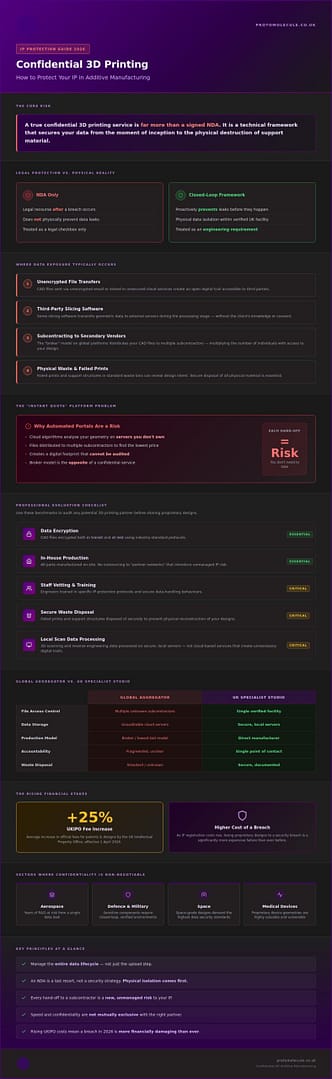
A true confidential 3d printing service is far more than a signed non-disclosure agreement. It is a technical framework that secures your data from the moment of inception to the physical destruction of support material. Whilst standard services treat confidentiality as a legal checkbox, industrial-grade partners treat it as an engineering requirement. This is particularly vital as the industrial applications of additive manufacturing expand into sensitive sectors like aerospace and defence, where a single data leak can compromise years of research and development.
Data exposure typically occurs at specific points in the manufacturing workflow:
- Unencrypted email transfers or unsecured cloud storage.
- Third-party “slicing” software that transmits data to external servers.
- Subcontracting files to secondary vendors without the client’s knowledge.
Choosing an independent specialist studio prevents these failures. It ensures your proprietary designs remain within a controlled facility rather than being broadcast across a global manufacturing network. Every hand-off is a risk you don’t need to take.
Why “Instant Quote” Platforms May Risk Your IP
Automated portals rely on cloud-based algorithms to analyse geometry and calculate costs. This process creates a digital footprint on servers you don’t own and can’t audit. These networks often distribute your CAD files to multiple third-party subcontractors to find the lowest price. This “broker” model multiplies the number of individuals with access to your designs, which is the opposite of a confidential 3d printing service. A direct relationship with a manufacturer-led rapid prototyping service eliminates this risk by keeping your data in-house.
The Legal vs. Physical Reality of NDAs
An NDA is only as strong as the security protocols behind it. It provides legal recourse after a breach has occurred, but it doesn’t physically prevent the leak. For high-stakes projects, you need a partner that combines legal protection with physical data isolation. A strict “closed-loop” data policy ensures that sensitive military or space-grade designs never leave a single, verified UK facility. This proactive approach stops leaks before they happen, providing a level of security that a simple legal document cannot match.
Evaluating a Confidential 3D Printing Partner: A Professional Checklist
Selecting a confidential 3d printing service requires a rigorous audit of internal workflows that extends far beyond the machine shop. You must scrutinise the digital infrastructure and physical security of any potential partner. Use this checklist to evaluate their commitment to your data integrity:
- Data Encryption: Confirm that your CAD files are encrypted both in transit and at rest using industry-standard protocols.
- In-House Production: Verify that the studio manufactures parts on-site. Any service that outsources to a “partner network” introduces unmanaged risks to your intellectual property.
- Staff Vetting: Ask if the engineers handling your designs are trained in specific IP protection protocols and data handling behaviours.
- Post-Processing Security: Physical IP leaks often occur in the waste bin. Ensure failed prints and support structures are disposed of securely to prevent reconstruction.
With the UK Intellectual Property Office (UKIPO) increasing official fees for patents and designs by an average of 25% on 1 April 2026, the financial stakes of protecting your proprietary designs have never been higher. A security breach is now a significantly more expensive failure.
This emphasis on precision and protection is a hallmark of all professional services; for instance, you can visit Mara Prose Publishing to see how they apply expert scrutiny to help authors refine and polish their creative work.
Securing the Design Phase: 3D Scanning and Reverse Engineering
When you utilise reverse engineering services, you are often digitising sensitive legacy components that have never existed in a digital format. This process creates a high-fidelity digital twin that is extremely vulnerable if handled poorly. Because intellectual property (IP) law continues to adapt to the digital nature of additive manufacturing, you must ensure your 3D scanning data is processed on secure, local servers. Avoid providers that use cloud-based processing for scan data, as this creates an unnecessary digital trail.
Batch Production and Long-Term IP Storage
Maintaining confidentiality during batch production runs involves controlling access across multiple shifts and production cycles. A secure provider will offer a clear data destruction policy, ensuring that your files are wiped from local storage once the project is finalised. You can consult with our engineering team to establish a bespoke security plan for your next production run.
Protomolecule: A Secure Framework for UK Additive Manufacturing
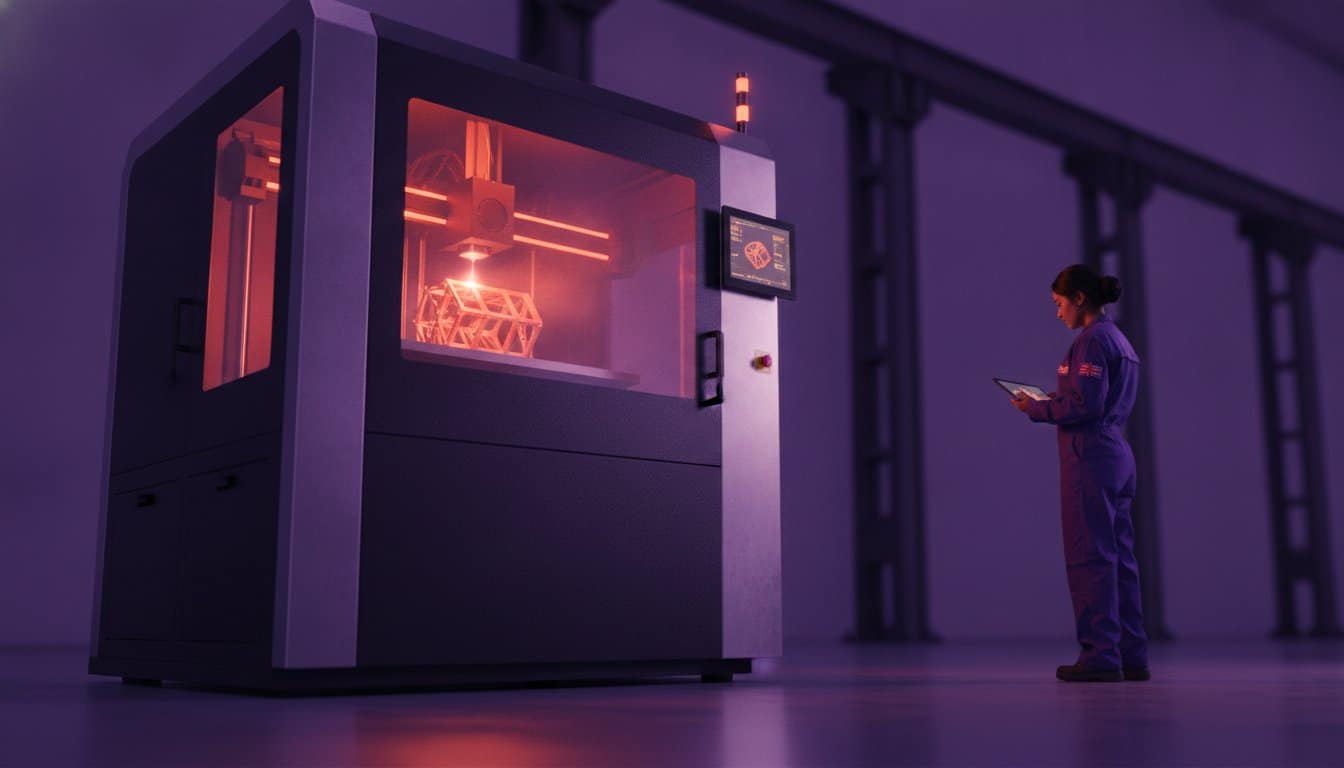
Protomolecule operates as a specialised, independent UK studio. We provide a truly confidential 3d printing service for industries where the cost of data failure is absolute. Unlike faceless manufacturing aggregators that distribute files across global networks, we maintain a closed-loop system. This ensures that your project remains within our secure facility from the initial brief to the final inspection. We don’t gamble with your competitive advantage.
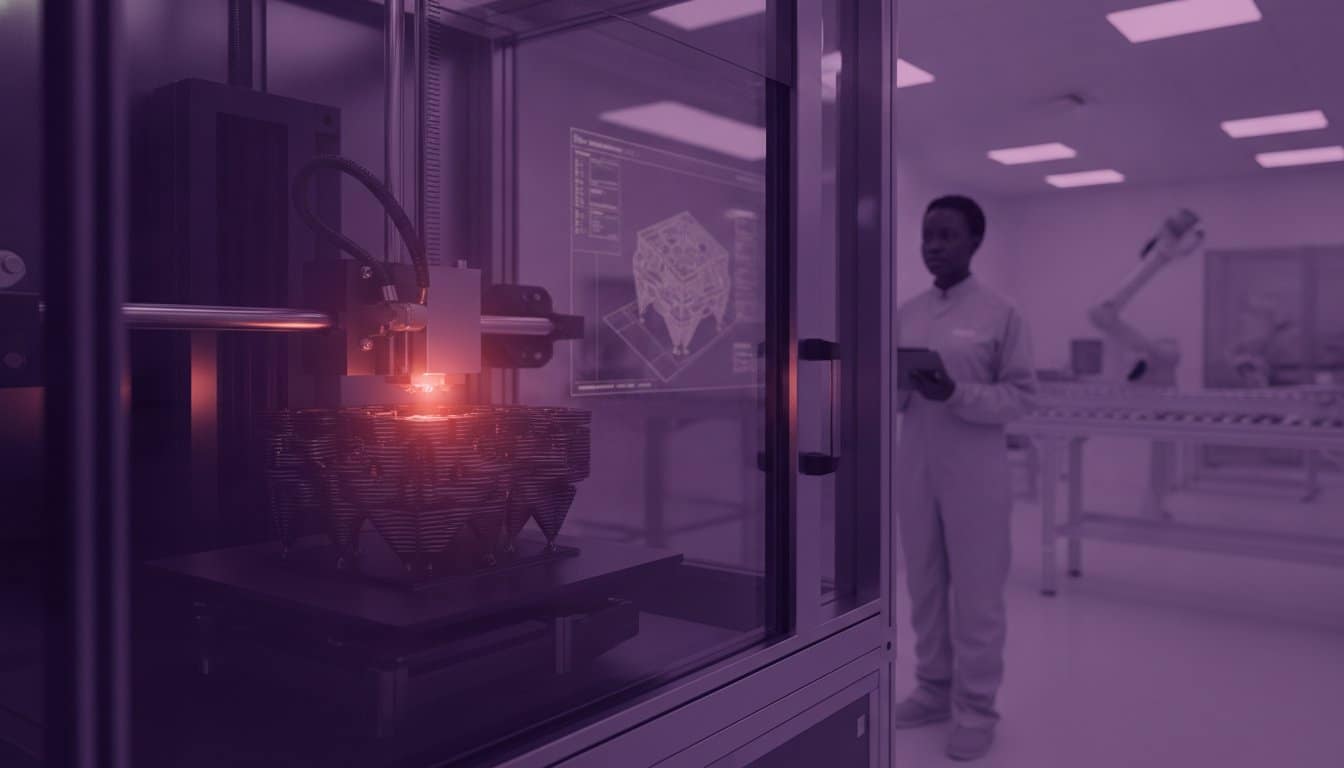
By offering an integrated 3D design and manufacturing workflow, we eliminate the need for external data transfers. Your proprietary geometry stays on our secure local servers rather than being bounced between subcontractors. We organise our facility to ensure strict physical and digital isolation for every project. This prevents any cross-contamination of sensitive data between different client workstations or production cells. Your IP is never visible to unauthorised personnel.
Rapid Prototyping with Uncompromising Standards
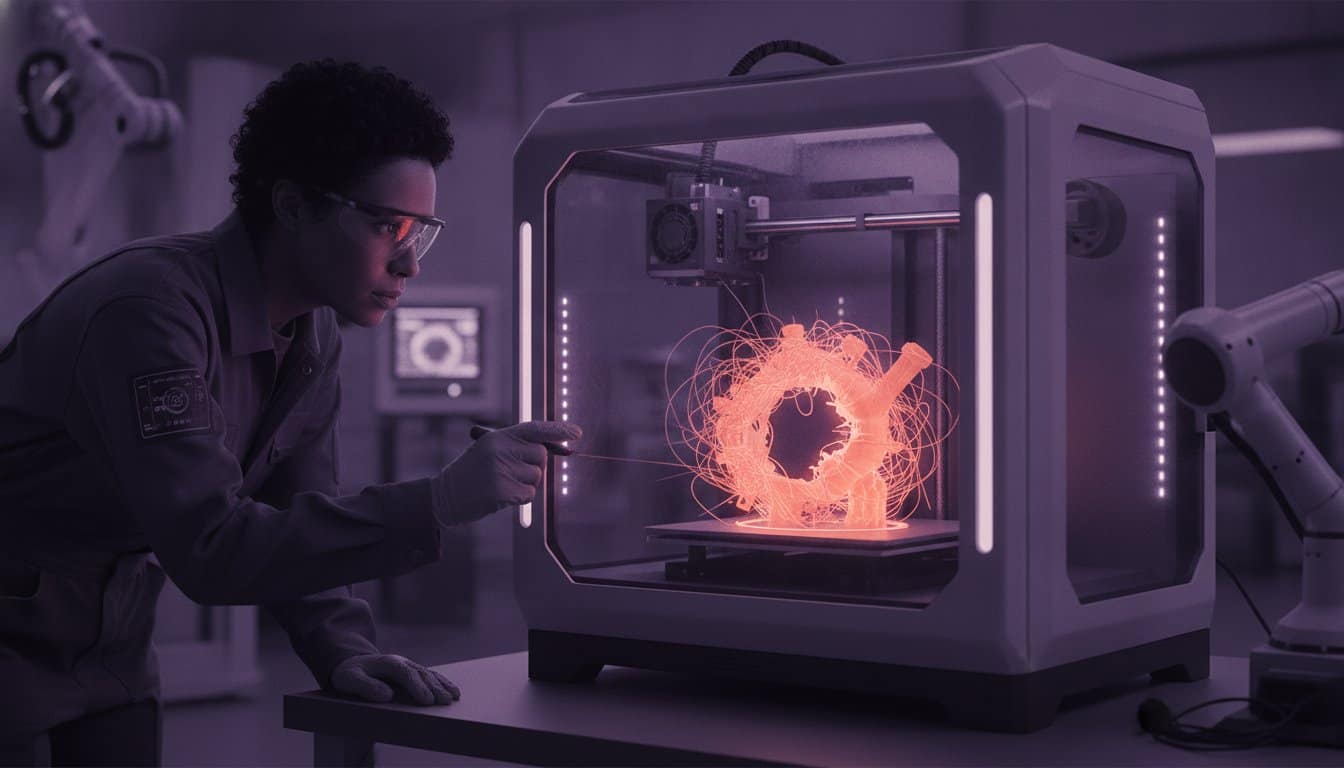
Our rapid prototyping service proves that speed doesn’t have to compromise security. We utilise industrial-grade FDM, SLA, and SLS technologies in a controlled environment to deliver high-precision components for time-critical aerospace and defence applications. All manufacturing is performed exclusively by our vetted, UK-based engineering team. We prioritise results, ensuring that every prototype meets your exact technical specifications whilst remaining entirely confidential.
Get a Secure Quote for Your Next Project
Secure your intellectual property today. We invite you to get a quote through our encrypted channels. Our engineers are available to discuss specific NDA requirements or bespoke security protocols for your most sensitive projects. Whether you’re developing niche automotive components or critical space-grade hardware, Protomolecule provides the uncompromising standards your IP deserves. Reliability is our ultimate brand promise.
Future-Proof Your IP with Secure UK Manufacturing
Protecting your intellectual property in 2026 requires more than a simple legal agreement. It demands a manufacturing partner that integrates security into every stage of the production lifecycle. By choosing an independent UK studio that prioritises in-house production and vetted engineering expertise, you eliminate the risks inherent in global manufacturing networks. True data integrity is built on a foundation of physical isolation and secure, local server management. This approach ensures your proprietary geometry never leaves our sight.
Protomolecule specialises in the military and space sectors, where uncompromising standards are the baseline. Our expert engineering team delivers a confidential 3d printing service that balances rapid turnaround with industrial-grade protection. We don’t just print parts; we safeguard your competitive advantage through a closed-loop system that keeps your most sensitive designs entirely within our controlled facility. This level of dedication is what separates a standard vendor from a true engineering partner.
Secure your IP today—Get a confidential quote from Protomolecule and ensure your next project is delivered with speed, precision, and absolute discretion. We are ready to help you navigate the complexities of secure manufacturing and deliver the results your innovation deserves.
Frequently Asked Questions
Do you sign Non-Disclosure Agreements (NDAs) before I share my files?
Yes, we sign Non-Disclosure Agreements as a standard part of our engagement process before any proprietary files are exchanged. We recognise the legal necessity of protecting your designs, particularly within high-stakes sectors like aerospace and defence. You may provide your own legal documents for our review, or we can provide a robust template to establish the legal framework for your confidential 3d printing service immediately.
How is my data stored and protected during the 3D printing process?
Your data is stored on secure, local servers that are isolated from public cloud access to prevent unauthorised digital footprints. We utilise industry-standard encryption for all file transfers and maintain strict access controls within our engineering team. Unlike automated platforms that process geometry through third-party algorithms, our workflow ensures your CAD data remains within a controlled, audited digital environment throughout the manufacturing lifecycle.
Is my project outsourced to other manufacturing partners?
No, we do not outsource your projects to third-party manufacturing partners or global aggregators. Every stage of your confidential 3d printing service is handled in-house at our UK-based studio by our vetted engineering team. By maintaining a closed-loop manufacturing process, we eliminate the risks associated with distributed supply chains. This ensures that your intellectual property remains within a single, secure facility from design to delivery.
What happens to the digital files and physical waste after the project is finished?
We implement a strict data destruction policy where all digital files are wiped from our local systems once the project is finalised. Physical waste, including support structures or failed prints, is destroyed on-site to prevent any reconstruction of your proprietary geometry. We treat physical IP with the same rigour as digital data, ensuring that no remnants of your design exist after the production run is complete.