
Rapid prototyping is not a manufacturing cost; it is a financial insurance policy that yields significant savings by front-loading error detection. If you’re struggling to justify R&D spend to stakeholders who only focus on the bottom line, you’re not alone. The difficulty of calculating roi on rapid prototyping often stems from the challenge of quantifying “avoided costs” like failed tooling or delayed launches. You need a way to prove that investing in professional additive manufacturing now prevents a much larger financial catastrophe during full-scale production.
We recognise the pressure to reduce time-to-market whilst maintaining the high standards your clients expect. This article provides a master framework to quantify those hidden savings and accelerate your project approval process. We’ll examine how the 2026 merged R&D tax relief scheme, providing a 20% gross credit on qualifying spend, changes the financial landscape for UK firms. From shifting heavy CapEx into flexible OpEx to using 3D printing for batch production, you’ll gain the tools to build a bulletproof business case that secures faster sign-off and slashes manufacturing risk.
Key Takeaways
- Apply the “Rule of Ten” to identify design errors early, preventing costs from escalating 100x after a product launch.
- Master the framework for calculating roi on rapid prototyping by quantifying “avoided costs” to secure faster project sign-off from stakeholders.
- Minimise financial risk by choosing an agile OpEx model that eliminates hidden in-house overheads like material expiration and skilled labour costs.
- Maximise your R&D tax relief by correctly documenting how prototyping cycles resolve technological uncertainties to satisfy HMRC criteria.
- Bridge the gap between initial concept and batch production to ensure your manufacturing journey remains profitable and efficient from day one.
The Core Framework: Shifting from Unit Cost to Lifecycle ROI
Traditional procurement often focuses on the price per part, but calculating roi on rapid prototyping requires a broader view of the entire product lifecycle. You must define ROI as the delta between the cost of iterative testing and the financial fallout of a catastrophic production failure. To understand the scale of this impact, it helps to revisit what a prototype is in a commercial sense; it’s a high-value risk-mitigation tool rather than a mere design draft.
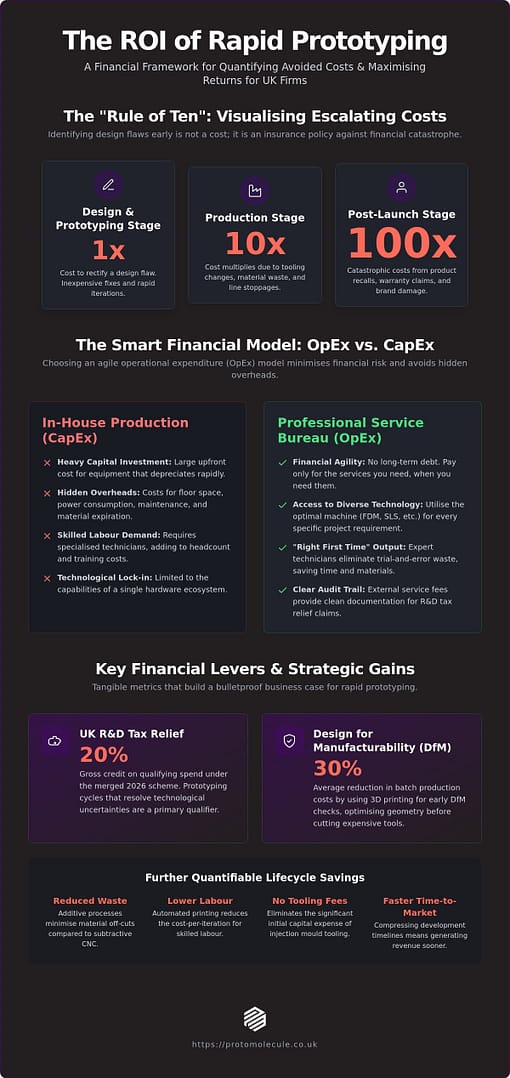
Engineers frequently cite the “Rule of Ten” to justify R&D spend. An unresolved design flaw found during the prototyping stage is relatively inexpensive to fix. However, that same error costs ten times more once you move into production and a staggering 100 times more if it reaches the customer. By front-loading your error detection, you’re not just spending money on a model; you’re buying insurance against a six-figure recall or tooling rebuild.
Precision is the foundation of these savings. Measurement errors during reverse engineering are notorious ROI-killers that lead to misaligned components and wasted material. Integrating professional 3D scanning services into your workflow ensures that your digital models are based on exact physical data. This eliminates the guesswork that leads to expensive re-tooling later in the cycle. Additionally, you must factor in the “Cost of Delay.” Every week spent waiting for traditional CNC or injection-mould tooling represents a week of lost market share. Rapid iterations compress your development timeline and allow you to start generating revenue sooner.
Quantifying Tangible vs Intangible Manufacturing Metrics
Tangible savings are easy to track. These include reduced material waste, lower labour costs per iteration, and the total elimination of initial tooling fees. Intangible benefits are equally vital for project momentum. Improved stakeholder communication and faster validation of your design ensure your project stays on track without the friction of constant revisions.
The Financial Impact of Design for Manufacturability (DfM)
Early DfM checks using industrial 3D printing prevent the need for expensive mould modifications during the final stages of production. Robust DfM processes reduce overall batch production costs by an average of 30% by optimising part geometry before the first tool is cut.
OpEx vs CapEx: Why Professional Service Bureaus Maximise Returns
Choosing between purchasing in-house equipment and outsourcing is a pivotal financial decision. Whilst owning a 3D printer might seem cost-effective on paper, the total cost of ownership (TCO) often tells a different story. calculating roi on rapid prototyping requires you to look beyond the initial purchase price and account for floor space, power consumption, and the constant need for skilled labour. By treating prototyping as an operational expenditure (OpEx), you keep your balance sheet lean and avoid the long-term debt associated with heavy capital investment (CapEx).
Professional rapid prototyping services provide access to a diverse fleet of industrial machines, from large-format FDM to high-resolution SLS. This flexibility allows you to select the optimal technology for every project without being locked into a single hardware ecosystem. Expert-led 3D design further enhances this value by ensuring parts are optimised for manufacture from the start. This strategic approach aligns perfectly with UK R&D tax relief requirements, as external service fees provide a clear, auditable trail of qualifying expenditure.
Avoiding the “Hidden Costs” of In-House Production
Hardware depreciation is a silent ROI-killer. Industrial printers lose value rapidly as newer, more efficient technologies emerge. Partnering with a specialist allows you to bypass this risk whilst benefiting from “Right First Time” manufacturing. Specialist technicians eliminate the trial-and-error waste common with in-house setups, ensuring your budget is spent on results rather than failed prints or expired materials. If you are looking to streamline your development cycle, you can explore our full range of industrial manufacturing solutions.
Strategic Outsourcing for National UK Engineering Firms
Consistency is vital for firms operating across multiple UK sites. Outsourcing ensures that every prototype meets the same uncompromising standards, regardless of where the design team is based. This reliability becomes even more critical when transitioning from a single test part to batch production. Using a single partner for both stages provides a seamless, ROI-positive journey that avoids the friction of switching suppliers. Accurate calculating roi on rapid prototyping must account for this saved time and reduced supplier risk.
Strategic Gains: UK R&D Tax Relief and Production Scaling
Securing project approval requires more than just technical promise; it demands a clear financial narrative. When calculating roi on rapid prototyping, you must account for the substantial tax incentives provided by the UK government. By documenting how each iteration helps in resolving scientific or technological uncertainty, you align your project with HMRC requirements. This documentation transforms your prototyping spend from a simple R&D cost into a qualifying expenditure that supports the company’s broader fiscal health. For a deeper dive into the metrics of justification, consider the industry standards for calculating the investment’s performance.
Leveraging the 2024/25 Merged UK R&D Tax Relief Scheme
The landscape for innovation funding has changed. Under the merged R&D tax relief scheme, most companies now benefit from a 20% gross credit on qualifying expenditure. For profitable firms, this results in a net relief of approximately 15%, whilst loss-making SMEs with high R&D intensity may claim up to 27% back in cash via the Enhanced R&D Intensive Support (ERIS). To maximise these returns, ensure you track all costs related to material waste, software licensing, and external professional services. Integrating expert 3D design at the start of the cycle provides the precise technical evidence HMRC looks for when assessing claims.
From Prototype to Batch Production: Scaling with Confidence
The ultimate proof of a positive ROI is a seamless transition to the factory floor. Iterative validation ensures that when you move to batch production, your first 1,000 units are delivered with a 0% rejection rate. This precision is particularly vital when dealing with legacy components. As a rule, reverse engineering is the financial bridge that turns legacy maintenance liabilities into high-performance, ROI-positive assets. Use the following checklist to present a bulletproof case to your Finance Director:
- Quantified Avoided Costs: Use the “Rule of Ten” to show the cost of failure at launch versus prototyping.
- Tax Credit Forecast: Estimate the 15% to 27% recovery on all qualifying prototyping spend.
- Time-to-Market Gain: Calculate the revenue generated by launching weeks ahead of traditional tooling schedules.
- Risk Mitigation: Document the removal of technological uncertainties before committing to high-cost tooling.
By framing calculating roi on rapid prototyping as a risk-management strategy, you move the conversation from “how much does it cost” to “how much will it save.” This shift is what separates successful engineering leads from those stuck in the approval queue.
This challenge of justifying high-value investment is not unique to R&D; for guidance on securing budget for your wider communication strategy, visit BCM Public Relations to learn how to present a strategic PR framework to the CFO.
Secure Your Project Sign-off with Financial Precision
Mastering the framework for calculating roi on rapid prototyping is what transforms a technical design into a compelling commercial case. You now have the tools to quantify avoided costs, leverage the 2026 R&D tax relief scheme, and transition seamlessly from initial concept to batch production. By prioritising lifecycle value over simple unit costs, you protect your firm from the exponential expenses of late-stage errors whilst maintaining a lean, agile balance sheet. This data-driven approach acts as the ultimate insurance policy for modern engineering teams.
We stand ready to support your next innovation. Protomolecule provides fast turnaround 3D printing services and a comprehensive design-to-production workflow that has delivered results for high-stakes projects in the military and aerospace sectors. Our expertise ensures your prototypes are built to uncompromising industrial standards from day one. Take the final step in your financial justification today. Request a bespoke ROI evaluation and quote for your next project and secure the stakeholder confidence you need to move forward. Your project deadlines and manufacturing success are our primary focus.
Frequently Asked Questions
How much can rapid prototyping actually save on total production costs?
Rapid prototyping typically saves between 25% and 65% on total production costs by front-loading error detection. By identifying fundamental design flaws before you commit to expensive steel tooling, you avoid the “Rule of Ten” where costs escalate tenfold at each production stage. These savings come from reduced material waste and the total elimination of late-stage engineering changes that would otherwise derail your project budget and launch schedule.
Is rapid prototyping worth the investment for small-scale UK engineering projects?
It is absolutely worth the investment for small-scale projects because smaller budgets have less margin for error. For a niche engineering firm, a single failed production run can be financially devastating. Prototyping allows you to validate Design for Manufacture (DfM) principles early. This ensures that when you transition to batch production, your components are right first time, which preserves your capital for growth rather than expensive rework.
What is the quickest way to calculate prototyping ROI for a new product launch?
The fastest method for calculating roi on rapid prototyping is to compare iteration costs against the “Cost of Delay.” Calculate the weekly revenue lost for every week your product remains in development whilst waiting for traditional tooling. If a professional prototype accelerates your launch by several weeks, your ROI is the total margin earned during that saved time minus the cost of the prototyping service.
Can I claim R&D tax relief on 3D printing and scanning services in the UK?
You can claim relief on these services if they help resolve scientific or technological uncertainty. Under the 2026 merged R&D tax relief scheme, UK companies receive a 20% gross credit on qualifying expenditure. This includes the costs for materials, software, and external professional services used during the R&D phase. You must maintain clear documentation to prove to HMRC that your prototyping cycles were essential for technical problem solving.
How does rapid prototyping reduce the “Cost of Delay” in manufacturing?
It reduces the “Cost of Delay” by compressing your development cycle from months into days. Traditional manufacturing methods require long lead times for tooling, whereas professional additive manufacturing provides functional parts almost immediately. This allows your team to test and refine designs in parallel rather than waiting for sequential production steps. Every day saved represents an earlier market entry and a faster return on your development spend.
Is it cheaper to outsource prototyping or buy an industrial 3D printer in 2026?
Outsourcing is generally cheaper because it avoids the high total cost of ownership associated with industrial hardware. When calculating roi on rapid prototyping, you must factor in the costs of skilled labour, maintenance, and the rapid depreciation of 3D printing equipment. Using a service bureau allows you to access the latest industrial technologies as an operational expense, ensuring you only pay for the capacity you actually use.