Paying for a 3D scan only to receive a “dead” mesh file that cannot be edited is a costly mistake that stalls production lines across the UK. You have likely encountered the opaque pricing structures that make it difficult to determine the true cost of 3d scanning a part for your specific project. It’s frustrating to manage a development cycle when you are unsure whether to invest in internal hardware or outsource to a metrology-grade specialist.
This guide eliminates that uncertainty by detailing the precise variables that dictate professional fees in 2026. You will gain a clear understanding of the transition from unpredictable hourly rates to reliable fixed-price models. We provide a practical framework to estimate your project expenses, whilst explaining how the intelligence of the data, rather than just the physical scale of the component, drives the final quote. By learning how to prepare your parts to reduce labour time, you can secure high-resolution results without compromising your budget.
Key Takeaways
- Identify why geometric complexity and surface characteristics, such as dark or reflective finishes, influence professional fees more than the physical dimensions of the part.
- Navigate the UK market by selecting between fixed-price digitisation for budget certainty and hourly rates for fluid R&D projects when assessing the cost of 3d scanning a part.
- Lower your final quote by performing basic physical preparation, such as cleaning and degreasing components, before they reach the scanning studio.
- Avoid unnecessary expenses by defining precise technical specifications to ensure you receive engineering-grade data tailored to your specific application.
- Establish a clear framework for budgeting reverse engineering and inspection projects to guarantee delivery of editable CAD files rather than static mesh data.
Understanding the Key Variables of 3D Scanning Costs
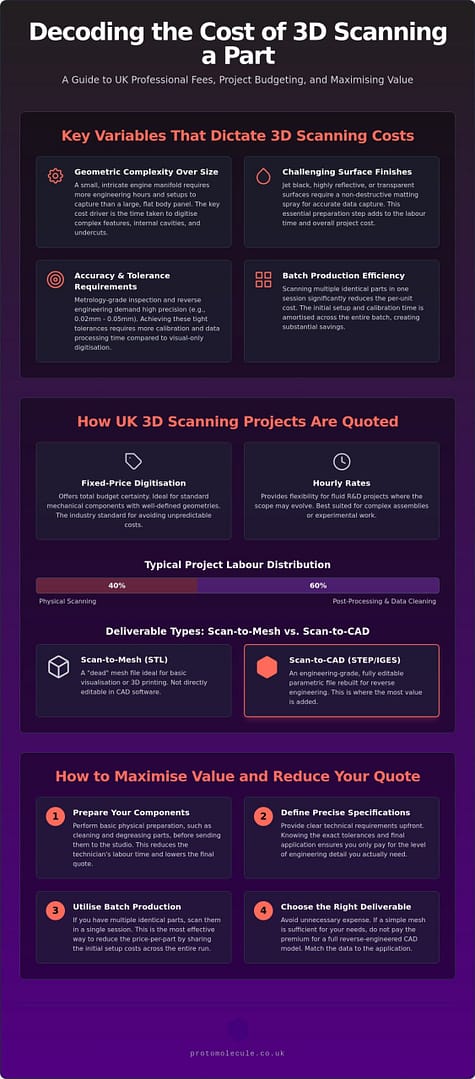
The physical dimensions of a component are rarely the primary driver of price. When calculating the cost of 3d scanning a part, geometric complexity dictates the workload. A large, flat body panel is significantly faster to digitise than a small, intricate engine manifold with deep recesses. Modern 3D scanning technology relies on line-of-sight; if the sensor cannot “see” a feature, it cannot record it. This necessitates multiple setups and data alignment phases, which increases the engineering hours required for a successful capture.
Accuracy requirements also shift the budget. Visual-only digitisation for CGI or basic prototyping is faster than metrology-grade inspection. If your project demands tolerances of 0.02mm to 0.05mm for professional reverse engineering, the calibration and data processing time will rise. However, batch processing offers significant efficiency. Scanning ten identical parts often costs less per unit because the initial setup and calibration are performed only once, allowing for a streamlined workflow.
Object Geometry and Internal Features
Intricate geometry forces the technician to capture dozens of overlapping scans to eliminate “shadows” in the raw data. Internal cavities and undercuts are particularly challenging because they often hide from the scanner’s light source. Capturing these hidden features requires specialised hardware or creative positioning, which directly impacts the project timeline. We prioritise high-resolution capture to ensure every internal radius and obscure mounting point is documented with precision.
Material Challenges and Surface Preparation
Surface finishes are a critical variable that can increase preparation time. Jet black, highly reflective, or transparent materials confuse the light patterns used by professional scanners. To solve this, we apply specialised, non-destructive matting sprays to create a temporary matte surface. This preparation step ensures data integrity but adds to the labour time. For sensitive industrial components, we use sublimating sprays that vanish without residue, ensuring your parts remain clean whilst we secure the 3D scanning data you need.
Service Models: How 3D Scanning Projects are Quoted in the UK
Determining the total cost of 3d scanning a part requires a clear understanding of the specific deliverables you need. UK service providers generally operate under two distinct commercial models. Fixed-price digitisation offers total budget certainty for standard mechanical components with defined geometries. This model is the antidote to industry uncertainty. Conversely, fluid R&D projects often command hourly rates. This flexibility is essential when the scope of work evolves during the measurement phase, particularly for complex assemblies.
The physical scan typically accounts for only 40% of the total labour. The remaining 60% is dedicated to post-processing, data cleaning, and alignment. Logistics also play a role in the final quote. Whilst studio-based scanning is the most cost-effective option, mobile on-site services are necessary for immovable industrial machinery. These site visits include travel and setup fees that must be factored into your initial budget to avoid unexpected costs.
Scan-to-Mesh vs. Scan-to-CAD Pricing
A common industry gap is the price distinction between raw data and usable models. A raw STL mesh is ideal for simple visualisation or 3D printing. However, if you require a parametric STEP or IGES file, the project enters the realm of reverse engineering. This process involves manually rebuilding the geometry to ensure it is fully editable in CAD software. Given the complex industrial applications of 3D scanning, this engineering phase is where the most value is added to your data.
Minimum Project Fees and Batch Production
Most professional studios maintain a minimum project fee to cover equipment calibration and file management. This base cost exists regardless of whether the part is a small bracket or a large casting. You can amortise these initial costs through batch production workflows. Scanning multiple identical units in a single session significantly reduces the price per part, as the setup time is shared across the entire run. If you are ready to move forward, you can request a precise quote for your project today.
Maximising Value: How to Reduce Your 3D Scanning Quote
Reducing the cost of 3d scanning a part doesn’t require cutting corners on quality; it requires technical clarity and physical preparation. Many businesses over-specify their accuracy requirements, requesting metrology-grade precision for simple visual prototypes. By providing clear technical specifications, you ensure the technician only captures the data necessary for your application. Consolidating multiple components into a single project also allows you to benefit from lower per-part digitisation fees, as the studio can organise a continuous workflow.
Physical preparation is another area where you can directly influence the final quote. Clean and degrease your parts before they arrive at the studio. Removing industrial oils or debris prevents labour-intensive cleaning by the scanning team. Whilst DIY phone apps might seem tempting for basic visualisations, they lack the engineering-grade reliability required for manufacturing. The true ROI of professional scanning is found in the elimination of manual measurement errors, which often lead to expensive rework and failed production runs.
Defining Your Data Requirements
Selecting the appropriate file format based on your end-use is the most effective way to eliminate unnecessary engineering costs. You must distinguish between “inspection” workflows, which use deviation maps to compare parts to CAD, and “design” workflows that require full geometric reconstruction. Clearly defining these needs prevents the studio from billing for complex post-processing tasks that your specific project doesn’t require.
While this guide focuses on mechanical parts, the same principles of high-resolution capture apply to historical preservation. For professional heritage digitisation, Semperfidelis offers specialised restoration and archiving services that ensure the integrity of delicate physical records.
Partnering for Rapid Prototyping
Integrating 3D scanning with rapid prototyping services creates a streamlined development loop that saves significant time and logistics costs. By digitising and printing within a single professional ecosystem, you reduce the risk of data translation errors and accelerate your time-to-market. This agile approach ensures your components move from physical part to digital model and back to a physical prototype with uncompromising precision. Ready to move forward? Get an instant quote for your 3D scanning project to secure your delivery slot.
Secure Your Project Precision
Managing the cost of 3d scanning a part requires balancing technical precision with budget certainty. You now understand that geometric complexity and data intelligence are the true drivers of professional fees. By preparing your components and defining your file requirements early, you eliminate the risk of receiving unusable data or incurring unnecessary labour charges. This proactive approach ensures your engineering projects stay within budget whilst delivering the accuracy your manufacturing process demands.
Protomolecule provides the industrial-grade resolution required for the most demanding engineering applications. We specialise in comprehensive Reverse Engineering Service capabilities, transforming raw scans into editable, parametric CAD files that integrate seamlessly into your workflow. Our national UK coverage ensures fast turnaround times for time-sensitive projects, allowing you to maintain momentum whilst meeting strict deadlines. Don’t let opaque pricing or unusable mesh files stall your innovation. Request a Fixed-Price 3D Scanning Quote today to secure the high-resolution data your project deserves. We are ready to help you solve your most complex engineering challenges with speed and uncompromising standards.
Frequently Asked Questions
Is it cheaper to buy a 3D scanner or use a professional service?
Professional services are usually the most economical choice for businesses that don’t require daily digitisation. Whilst consumer-grade scanners are becoming more affordable, they often fail to meet strict engineering tolerances. This leads to measurement errors that significantly increase the overall cost of 3d scanning a part through failed prototypes or rework. By outsourcing, you leverage metrology-grade sensors and expert post-processing without the heavy capital investment in hardware, software licensing, and specialist staff training.
What is the average turnaround time for a 3D scan of a mechanical part?
Most standard mechanical components are digitised and processed within two to five business days. This timeline includes the physical scanning phase and the essential data alignment and cleaning required to deliver a professional mesh or CAD file. For urgent industrial projects, we offer accelerated schedules to ensure your development cycle stays on track. Our efficient workflow is designed to deliver high-resolution data rapidly, allowing you to move from a physical part to a digital model without unnecessary delays.
Does the colour of the part affect the cost of 3D scanning?
The colour and surface finish of a component directly influence the cost of 3d scanning a part because of how light interacts with the surface. Jet black, transparent, or highly reflective finishes are difficult for sensors to record and often require the application of a specialised matting spray. This extra preparation step increases the labour time and material costs compared to scanning a matte-finished, light-coloured part. Using sublimating sprays ensures no residue is left on your component whilst allowing us to capture high-resolution data.
Can you 3D scan a part and 3D print it immediately?
Raw scan data requires digital processing before it is compatible with 3D printing hardware. The initial scan often contains “noise” or holes that must be repaired to create a watertight, manifold mesh. Once our technicians have cleaned the data and closed the geometry, the file can be sent directly to our 3D Printing Service. This integrated workflow allows for the rapid physical reproduction of your original component, though the digital refinement phase is a mandatory step to ensure a successful print.