
Why does a quote for reverse engineering a simple mechanical part fluctuate so wildly between different UK studios? You likely suspect that hidden project “unknowns” are often used to inflate final invoices, and you are right to be cautious. Receiving poor-quality data that looks correct on screen but fails during manufacturing is a costly mistake that halts production lines and wastes valuable development time. High-resolution 3D scanning provides the foundation, but the real investment lies in the technical expertise required to translate that data into a functional, editable CAD model.
This guide demystifies the actual cost to reverse engineer a product, providing you with a professional framework to budget accurately for your next project. You will learn the critical differences between raw scan data and production-ready modelling whilst identifying specific strategies to reduce your total expenditure. We break down the choice between hourly and fixed pricing models to ensure you find a UK partner capable of delivering industrial-grade precision with the rapid turnaround your schedule demands.
Key Takeaways
- Distinguish between prismatic and organic geometries to understand how part complexity dictates total technical labour.
- Learn to navigate professional pricing structures by separating fixed digitisation costs from hourly CAD modelling fees.
- Accurately estimate the cost to reverse engineer a product by accounting for part scale and the specific requirements of your manufacturing process.
- Maximise project ROI by integrating 3D scanning and 3D design to eliminate data silos and accelerate delivery times.
- Utilise rapid prototyping for early validation to ensure your digital files are production-ready without incurring expensive rework.
Key Factors That Determine Reverse Engineering Costs
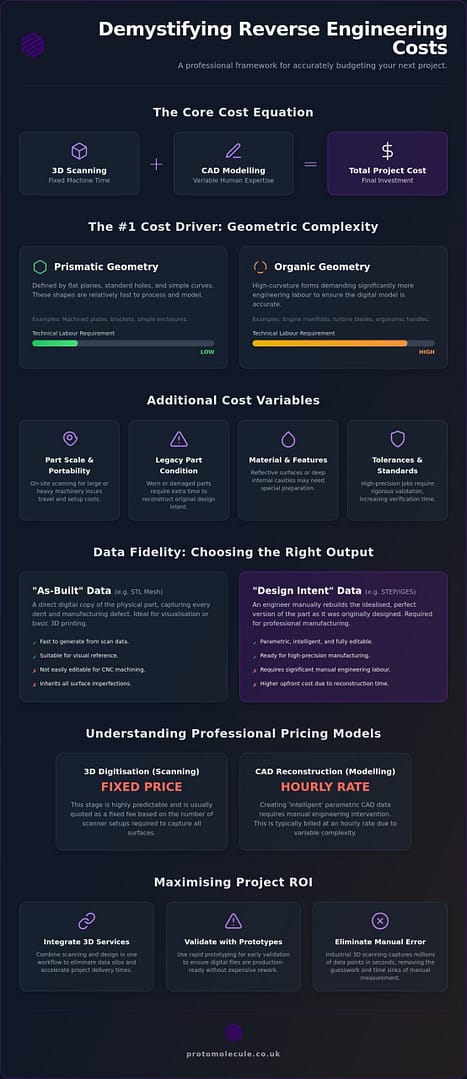
Calculating the investment for a technical project requires more than a cursory glance at the object’s size. The total cost to reverse engineer a product is primarily dictated by the interplay between machine digitisation time and the human engineering hours required for data processing. Every project starts with a physical part, but the path to a production-ready file varies based on the underlying geometry and the condition of the original sample.
Geometric complexity is the most significant cost driver. Prismatic shapes, such as simple brackets or machined plates, are defined by flat planes and standard holes; these are relatively fast to process. Conversely, organic geometries like engine manifolds, turbine blades, or ergonomic handles require complex surfacing. These high-curvature forms demand significantly more engineering labour to ensure the digital model accurately represents the physical reality. Reverse engineering these complex shapes involves meticulous point-cloud alignment and surface lofting to maintain functional integrity.
Consider these additional variables that influence the final quote:
- Part Scale and Portability: Scanning a handheld component at our studio is a streamlined, efficient process. Mobilising industrial-grade hardware for on-site scanning of heavy machinery adds travel and setup costs that reflect the logistical complexity.
- The Legacy Part Challenge: If a component is worn, corroded, or fractured, we cannot simply replicate the scan data. Engineers must reconstruct the “perfect” original geometry by identifying design intent, which adds time for technical analysis and reconstruction.
- Internal Features and Materiality: Transparent, reflective, or deep internal cavities often require physical disassembly or specialised coatings to capture. If a part cannot be fully digitised via non-destructive 3D scanning, manual measurement and teardown hours will apply.
Required Data Fidelity and Final Output
The intended use of your data changes the workflow and the price. A high-resolution STL mesh is suitable for visual reference or basic 3D design, but it is not easily editable for CNC machining. If you require a parametric STEP or IGES file, an engineer must manually rebuild the geometry. You must also choose between “As-Built” data, which captures every dent and manufacturing defect, and “Design Intent,” which recreates the idealised version of the part as it was originally conceived.
Tolerances and Industry Standards
Projects for the aerospace, medical, or military sectors often demand rigorous validation to ensure the digital twin meets strict safety standards. Micron-level accuracy requirements can double the engineering verification phase. Higher precision requires more frequent scanner calibrations and extensive cross-referencing against physical gauges to guarantee that the final CAD file is fit for high-stakes manufacturing.
Understanding Professional Pricing Models and Timeframes
Professional engineering studios usually separate their fees into two distinct categories: digitisation and reconstruction. The initial cost to reverse engineer a product often begins with a fixed price for the 3D scanning service. This stage is highly predictable; it depends on the number of scanner setups required to capture every surface. Conversely, technical reconstruction is typically billed at an hourly rate. This is because creating “intelligent” parametric CAD data requires manual intervention to align geometry with manufacturing intent.
Recognising the value of reverse engineering allows businesses to justify the “Fast Turnaround” premium often applied to urgent projects. When a production line is down, paying for prioritised resource allocation is a strategic decision that prevents mounting losses. Fixed project-based fees are common for standard mechanical parts with well-defined prismatic features, providing budgetary certainty from the outset.
3D Scanning vs. Manual Measurement
Relying on manual measurements with callipers and depth gauges introduces human error and significant time sinks. Industrial 3D scanning eliminates these “unknowns” by capturing millions of data points in seconds. This speed ensures that the cost to reverse engineer a product remains stable; you aren’t paying for an engineer to guess internal radii or complex draft angles manually. It transforms a subjective process into a high-precision digital workflow.
UK Industry Benchmarks for Engineering Rates
In 2026, UK specialist studios maintain competitive rates that reflect high-end hardware overheads and software licensing. When evaluating a quote, check for hidden post-processing or file conversion fees that some providers omit from the initial estimate. Professional partners offer transparent breakdowns that include validation reports. If you need a clear understanding of your specific project requirements, discuss your technical specifications with an expert to secure an accurate timeframe.
Maximising ROI: Reducing Costs Through Integrated 3D Services
To achieve the best return on investment, you must view the cost to reverse engineer a product as the first step in a broader manufacturing lifecycle. Consolidating your workflow within a single studio for 3D scanning and 3D design eliminates the friction of transferring files between different vendors. This integration ensures that the designer understands the nuances of the raw scan data immediately, preventing the data silos that often lead to expensive rework and project delays.
Early validation is your most effective cost-mitigation tool. By utilising rapid prototyping, you can print a low-cost functional version of your component to test fitment and clearance before final CAD sign-off. This physical check confirms the accuracy of the reverse engineering process, allowing for minor adjustments whilst the project is still in the digital phase. It is far cheaper to adjust a digital file than it is to fix a hardened steel tool later.
You can also directly influence the final invoice by preparing the original part before it reaches the studio. Simple actions like cleaning grease, removing thick layers of paint, or disassembling complex components reduce the specialist’s time on-site or in the lab. Clear communication regarding critical dimensions helps the engineer focus their labour on the areas that matter most to your specific application.
From Physical Part to Digital Asset
Creating a high-quality digital twin transforms a vulnerable physical object into a permanent, ownable digital asset. This process secures your IP, turning a legacy component into a file you control and can modify as needed. It prevents future costs associated with sourcing rare replacement parts or relying on defunct suppliers. You are no longer at the mercy of a single physical sample; you have a master file ready for manufacturing at any time.
Streamlining the Path to Production
The most effective way to lower the per-unit cost to reverse engineer a product is to plan for batch production from the start. Amortising the initial engineering investment over a larger run of parts significantly reduces the financial impact of the technical labour. To move forward with precision and speed, get a bespoke quote to understand your specific project requirements and secure an industrial-grade solution.
Secure Your Production Future with Precision Data
Understanding the factors that influence the cost to reverse engineer a product allows you to budget with confidence and avoid the pitfalls of poor-quality data. By prioritising high-resolution 3D scanning and choosing a partner that integrates design with rapid validation, you eliminate the technical “unknowns” that often derail manufacturing timelines. A specialist UK-based 3D studio provides the industrial-grade precision required to transform physical parts into permanent digital assets whilst maintaining the speed your project demands.
Don’t let legacy components or broken parts stall your operations. Protomolecule offers an agile, tech-savvy approach to engineering challenges, ensuring your CAD models are production-ready from the first iteration. Our all-in-one workflow provides the reliability you need to scale production or secure your intellectual property without unnecessary delays. Request a Rapid Reverse Engineering Quote today to access expert technical support and industrial-grade scanning services. We are ready to help you move from physical sample to final part with uncompromising standards.
Frequently Asked Questions
How long does the reverse engineering process typically take?
The timeline depends entirely on the geometric complexity and the required level of data fidelity. Simple prismatic components often reach completion within 48 to 72 hours, whilst complex organic shapes or multi-part assemblies require more extensive engineering hours. We prioritise rapid turnaround to minimise production downtime, providing a clear schedule at the start of every project to ensure your deadlines are met.
Can you reverse engineer a part that is broken or has missing pieces?
You can absolutely reverse engineer broken, worn, or incomplete components by identifying the original design intent. Our engineers use high-resolution scan data as a template to reconstruct missing sections and correct wear patterns digitally. This process ensures the final CAD file represents the part in its ideal, functional state rather than its current damaged condition, making it ready for immediate manufacturing.
What is the difference between a 3D scan and a reverse-engineered CAD file?
A 3D scan produces a raw mesh, typically an STL file, which consists of millions of triangles representing the surface geometry. A reverse-engineered CAD file is a parametric model, such as a STEP or IGES file, which is fully editable and suitable for CNC machining. This conversion is a primary factor in the total cost to reverse engineer a product, as it requires manual technical reconstruction to create “intelligent” geometry.
Do I own the intellectual property (IP) after a product is reverse engineered?
Clients typically own the digital assets and intellectual property resulting from the reverse engineering process once the project is finalised. This ownership allows you to control the manufacturing and modification of your parts without relying on original equipment manufacturers. We recommend consulting with a legal professional regarding specific patent or trademark implications if you intend to commercialise a reverse-engineered design in a competitive market.