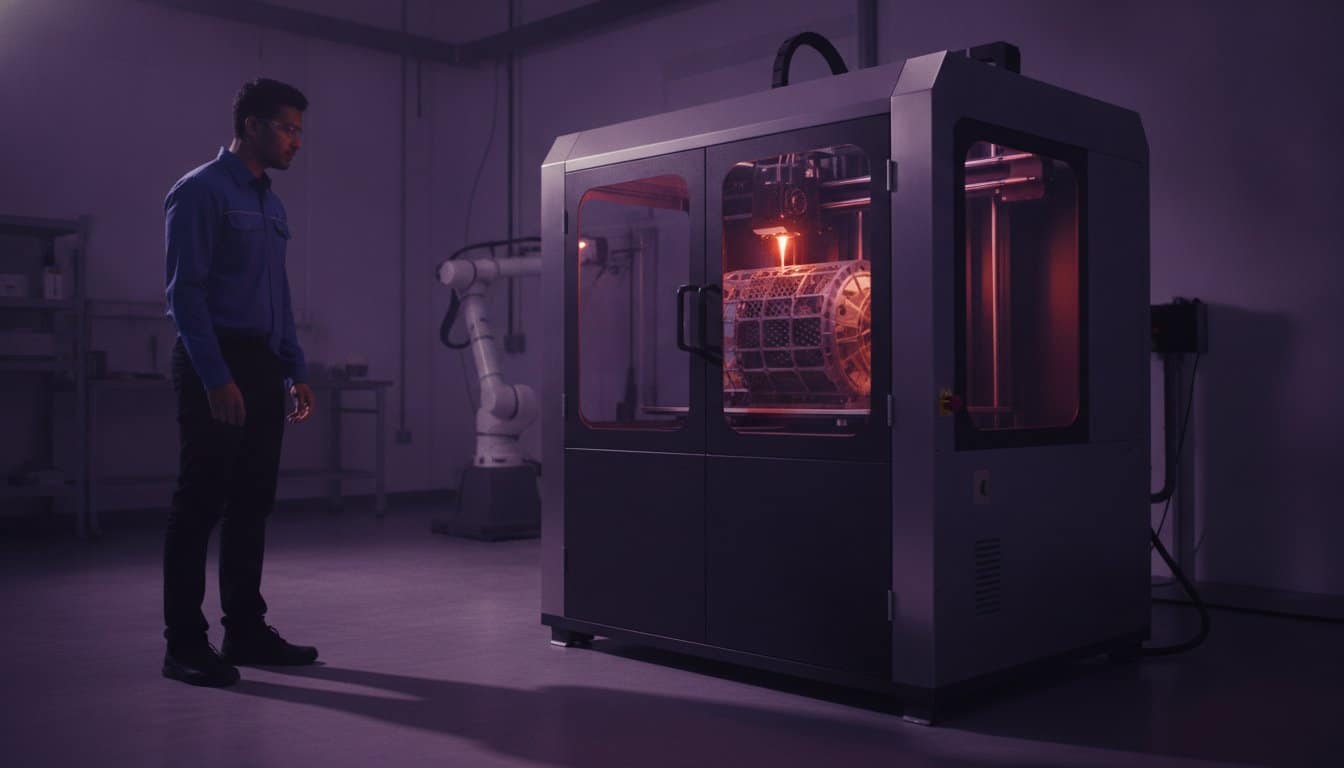
Scaling up a 3D print isn’t just a matter of increasing dimensions in your slicer; it’s a fundamental shift in structural engineering that punishes desktop-level assumptions with catastrophic warping and expensive material waste. You’ve likely realised that moving from a small build plate to a metre-long component introduces massive thermal stresses that smaller parts simply don’t face. Mastering designing for large format 3d printing requires a move away from intricate aesthetic details toward a focus on thermal management and toolpath continuity.
We recognise the pressure to deliver industrial-grade parts on tight deadlines without sacrificing structural integrity. This guide provides the professional strategies you need to transition from desktop prototyping to industrial-scale additive manufacturing with confidence. You’ll learn how to optimise geometry for layer adhesion, reduce print times, and eliminate the failures that plague large-scale projects. We’ll break down the technical shift into actionable steps to ensure your components meet industrial requirements whilst minimising material costs. Get ready to transform your approach and achieve successful, first-time prints at scale.
Key Takeaways
- Define the technical scope of large-format manufacturing and understand how cooling behaviour shifts once components exceed 500mm in dimension.
- Implement self-supporting geometries and the 45-degree rule to eliminate expensive support structures whilst maintaining structural integrity.
- Master professional strategies for designing for large format 3d printing to manage thermal stress and prevent warping in industrial parts.
- Utilise precision 3D scanning to verify tolerances against original CAD files and ensure your large-scale prints meet exacting engineering standards.
- Integrate reverse engineering workflows to efficiently scale legacy components for modern industrial-grade additive manufacturing.
The Technical Shift: From Desktop to Large Format 3D Printing
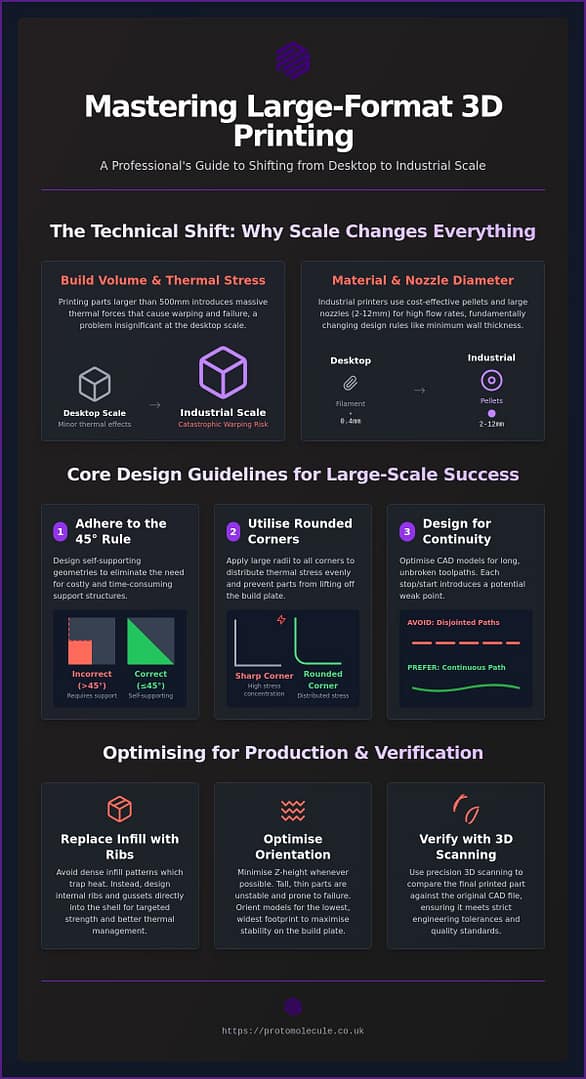
Large-format additive manufacturing begins where desktop systems reach their physical limits, typically defined as any build exceeding 500mm in a single dimension. When you scale up, the physics of the process changes entirely. Thermal contraction is no longer a minor annoyance; it’s a massive force that can rip a part off the build plate or cause structural splitting. This shift requires a fundamental change in how you approach 3D printing processes at an industrial level. Successful designing for large format 3d printing hinges on your ability to predict how large volumes of molten polymer behave as they cool over several hours or even days.
Industrial systems often pivot from standard filament to pellet extrusion to maintain efficiency at this scale. Pellets are significantly more cost-effective for mass production and allow for much higher flow rates, which are essential for completing large builds before thermal stresses become unmanageable. However, this speed dictates your design constraints. Whilst a desktop printer uses a 0.4mm nozzle, industrial machines utilise diameters ranging from 2mm to 12mm. This means your minimum wall thickness is effectively locked to the width of the extruded bead. You must design your geometry to accommodate these wider toolpaths from the outset to avoid unnecessary complexity or print failure.
Understanding Build Volume and Orientation
Reduce your Z-height whenever possible. Tall, thin parts are prone to wobbling and cooling inconsistencies that lead to catastrophic failure mid-print. Orient your components to sit within the “sweet spot” of the build plate, usually the centre, where heat distribution remains most stable. This strategy minimises thermal gradients and ensures better layer adhesion across the entire footprint of the part. If you are unsure of the optimal orientation, our rapid prototyping service can help refine your model for maximum stability.
Layer Height and Surface Resolution
Speed is the primary driver in large-format work. You might choose coarse 5mm layers for internal structural jigs, but visible components require finer resolution to reduce post-processing. Stair-stepping refers to the visual and physical stepping effect on curved or angled surfaces caused by the height of each individual layer. Balance your layer height against the required finish to find the most efficient path for your project.
Core Design Guidelines for Large-Scale Success
Success in designing for large format 3d printing requires a departure from standard prototyping habits. You must prioritise self-supporting geometries by adhering strictly to the 45-degree rule. At this scale, support structures consume excessive material and hundreds of hours of print time. Eliminating them is a financial and operational necessity. Instead of relying on external supports, integrate angles into the part’s geometry to ensure the machine can build upon previous layers without assistance. This approach creates a cleaner finish and reduces post-processing labour significantly.
Adopt a mindset focused on continuous extrusion. Every time the print head stops to retract or travel, it introduces a potential weak point and increases the risk of oozing or under-extrusion. Design your CAD models to allow the nozzle to move in long, unbroken toolpaths. This continuity improves the structural integrity of the component and accelerates the manufacturing process. If you’re struggling to optimise complex geometries for this workflow, our 3D design service can refine your models for industrial-grade performance.
Apply large radii to every corner. Sharp 90-degree angles are magnets for stress concentration and thermal lifting. As the large volume of polymer cools, it contracts and pulls inward. Rounded corners distribute these forces more evenly, keeping the part firmly attached to the build plate. It’s a simple change that prevents the catastrophic warping often seen in large-scale prints.
Eliminating Infill for Structural Continuity
Traditional honeycomb infill is often counterproductive at scale. The high thermal mass of dense infill leads to uneven cooling and internal cracking. Replace generic infill patterns with internal ribs and gussets that are part of the shell geometry itself. This provides targeted strength exactly where the load requires it whilst allowing for better airflow and thermal stability during the build.
Thermal Management in CAD
Manage heat at the design stage by incorporating “mouse ears” or sacrificial brims directly into your 3D model. These circular tabs at the base of the part increase surface area contact and prevent warping. Additionally, use hollow sections to encourage uniform cooling. A consistent wall thickness across the entire part prevents the thick-thin transitions that often cause structural failure in large-scale additive manufacturing.
Optimising for Production and Rapid Turnaround
Efficiency in industrial manufacturing relies on precision verification and smart assembly strategies. You should utilise 3D scanning services to verify large-scale tolerances against your original CAD files immediately after production. Large parts often experience subtle dimensional shifts during the cooling process; scanning provides a high-resolution heat map of these deviations, allowing for rapid adjustments. If your project involves legacy hardware, reverse engineering provides the pathway to digitise and scale these components for modern additive workflows without the need for original technical drawings.
Successful designing for large format 3d printing requires you to plan for the final finish during the initial CAD phase. Always leave an additional 1mm to 3mm of material on critical mating surfaces or bores. This extra “meat” ensures that you can use CNC machining or manual sanding to reach exacting tolerances that the raw print might not achieve. For massive assemblies exceeding several metres, adopt a modular design. Splitting a single oversized component into interlocking sections allows for parallel production across multiple machines, which slashes lead times and reduces the risk of a single-point failure ruining a massive build.
Once production is complete, managing the distribution of these components becomes the next priority. For businesses looking to scale their reach, particularly into the US market, partnering with a logistics specialist like Boost3PL provides the necessary fulfilment infrastructure to handle complex inventory and shipping needs efficiently.
Material Selection for Industrial Applications
Choose your polymer based on the final environment. ABS offers excellent impact resistance, whilst Carbon Fibre reinforced polymers provide the highest dimensional stability by counteracting the material’s natural shrinkage. ASA is often preferred over PLA for large-scale outdoor commercial parts because of its superior UV resistance and weatherability. Selecting the right material at the start prevents structural degradation and ensures your part survives long-term industrial use.
Streamlining the Prototyping Cycle
Professional 3D design services identify potential failure points, such as insufficient wall thickness or poor toolpath continuity, before the first layer is even laid. This proactive approach saves days of wasted machine time. Additionally, rapid prototyping allows you to validate smaller sub-assemblies or scale models quickly. This ensures that every component fits perfectly within the larger assembly, maintaining a brisk and purposeful development pace.
Accelerate Your Large-Scale Manufacturing
Transitioning to industrial-scale production requires more than just bigger machines; it demands a fundamental shift in engineering strategy. You’ve seen how mastering thermal contraction and prioritising continuous toolpaths can prevent the warping that ruins large-scale projects. By adopting these professional strategies for designing for large format 3d printing, you ensure that your components meet industrial structural requirements whilst minimising material waste. Success at this scale is about precision, from the initial CAD geometry to the final post-processing stages.
We provide the specialist industrial FDM expertise needed to bring your most ambitious projects to life. Our workflow integrates advanced 3D scanning for precision verification, ensuring every part matches your CAD data exactly. We deliver fast turnaround for commercial sectors across the UK, maintaining uncompromising standards on every build. Don’t let technical scaling issues delay your production cycle or compromise part integrity. We’re ready to solve your complex engineering problems with speed and reliability.
Get a rapid quote for your large-format project and start building with confidence today. Your next industrial-grade component is ready for production.
Frequently Asked Questions
What is the maximum size for a single-piece large format 3D print?
Single-piece prints can reach dimensions of 1500mm or more depending on the specific industrial system used. Whilst desktop units are severely limited, industrial large-format machines are built for massive footprints and heavy-duty output. If your project exceeds these physical build volume limits, we utilise modular design strategies to print sections that interlock or bolt together perfectly. This ensures structural integrity whilst allowing for virtually unlimited scale across diverse commercial applications.
How do I prevent warping when designing large 3D printed parts?
Prevent warping by implementing large radii on all sharp corners to distribute thermal stress evenly. When designing for large format 3d printing, you should also incorporate sacrificial brims or “mouse ears” at the base to improve bed adhesion. Using hollow sections or internal ribs instead of solid blocks reduces thermal mass and ensures more uniform cooling across the component’s geometry. These design choices are critical for maintaining dimensional accuracy in industrial parts.
Can I use standard 3D printing filaments for large-format industrial projects?
You can use standard filaments, but industrial projects often pivot to pellet extrusion for better efficiency and reduced material costs. Pellets allow for significantly higher flow rates through 2mm to 12mm nozzles, which is essential for maintaining the print’s thermal profile at scale. We recommend engineering-grade materials like ASA or Carbon Fibre reinforced polymers over standard PLA to ensure long-term stability and resistance to environmental stress in demanding industrial environments.
Is large-format 3D printing suitable for end-use batch production?
Large-format 3D printing is highly effective for end-use batch production, particularly for complex industrial components that would be too expensive or time-consuming to mould. It eliminates the need for costly tooling and allows for rapid design iterations without the typical lead times of traditional manufacturing. Our service delivers consistent, high-quality results for commercial sectors requiring durable, large-scale parts produced in low-to-mid volumes with uncompromising standards.