The difference between a hobbyist 3D print and industrial-grade component production isn’t just the price tag; it’s the difference between a part that looks right and a part that actually works. You’ve likely felt the frustration of waiting days for a print only to find it lacks the dimensional accuracy or material durability your engineering project demands. It’s a common bottleneck that stalls innovation and blows budgets. We’ll help you master the technical essentials of fdm so you can transition from basic models to high-performance batch production with total confidence. This guide breaks down material selection, surface finish optimization, and the exact steps to find a reliable UK partner capable of delivering professional-grade output. Whether you’re developing 80s JDM wheel centre caps or passenger train seat arms, you’ll learn how to leverage our Nottingham-based expertise to hit your deadlines every time. Stop settling for “good enough” and start using precision manufacturing to beat the clock on your next project.
Key Takeaways
- Master the technical mechanics of fdm 3D printing to transform thermoplastic filaments into high-performance, industrial-grade components.
- Identify the critical performance gaps between desktop machines and industrial heated chambers to ensure your parts meet professional durability standards.
- Apply essential Design for Manufacturing (DfM) principles, such as the 45-degree rule, to optimize part geometry and minimize material waste.
- Understand the end-to-end workflow from G-code generation to thermal management to achieve high-precision results on every build.
- Learn how to leverage lightning-fast 24-hour turnaround times to accelerate your production cycles and beat the clock on critical project deadlines.
What is FDM 3D Printing? Understanding Fused Deposition Modelling
At its core, Fused Deposition Modeling (FDM) is an additive manufacturing technology that builds physical objects by extruding thermoplastic filament layer by layer. It’s the most widely adopted 3D printing method globally because it offers an unmatched balance of cost efficiency, production speed, and mechanical durability. Since S. Scott Crump patented the technology in 1989, it has evolved from a niche industrial tool into the primary driver of the desktop manufacturing revolution.
The landscape shifted dramatically in 2009 when key patents expired. This triggered the open-source RepRap movement, which slashed equipment costs and accelerated innovation across the industry. Today, fdm technology is used by approximately 70% of engineers for functional prototyping. It’s no longer just for hobbyists; it’s a high-performance solution for aerospace, automotive, and medical sectors throughout the United Kingdom. It provides a reliable pathway from a digital concept to a physical part without the heavy overhead of traditional injection moulding.
The Core Components of an FDM System
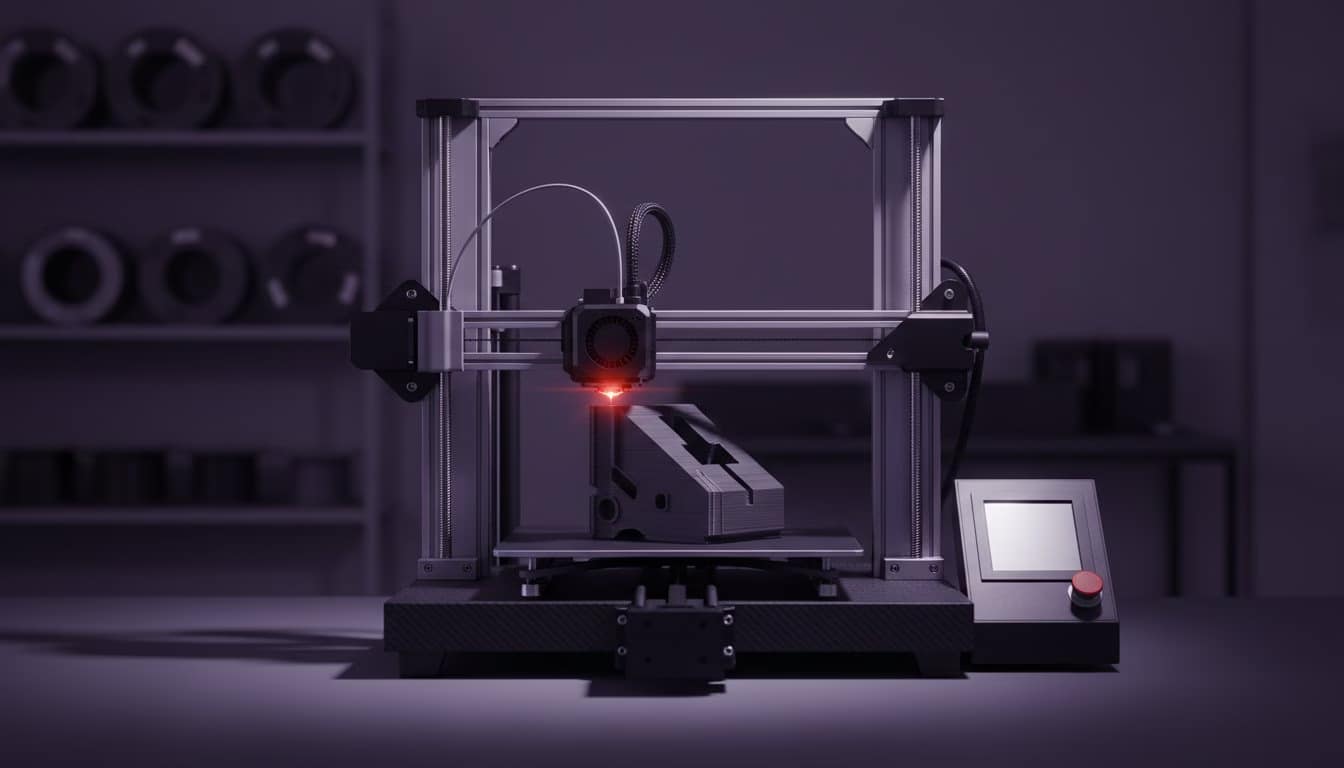
A standard system relies on three critical assemblies to maintain precision and part integrity. The print head and extruder act as the engine. A stepper motor drives the raw filament into a heated “hot end” where it melts into a semi-liquid state. This molten material is forced through a brass or hardened steel nozzle, often with a diameter as small as 0.4mm, to create fine details.
The build plate provides the essential foundation for every print. For materials like ABS or Polycarbonate, a heated bed is mandatory to prevent the plastic from cooling too quickly and warping. Finally, the X, Y, and Z gantry system uses high-torque motors and precision belts to move the print head with extreme accuracy. This motion control dictates the final part’s dimensional accuracy, which can reach tolerances of +/- 0.1mm in professional-grade setups.
Why FDM is the Backbone of Rapid Prototyping
Speed is the most significant advantage in modern product development. You can turn a digital CAD model into a physical, tactile part in under 24 hours. This rapid iteration allows engineering teams to test fit, form, and function without waiting weeks for traditional tooling. Don’t let slow supply chains stall your project. Explore our 3D printing services to see how we maintain lightning-fast turnarounds for UK businesses.
Material versatility sets fdm apart from resin-based alternatives. You aren’t limited to brittle photopolymers. Instead, you use real-world engineering plastics like PETG, Nylon, and Carbon Fibre reinforced filaments. These materials provide the impact resistance and thermal stability required for end-use components. Whether you’re producing 80s JDM wheel centre caps or industrial passenger train seat arms, this technology delivers results with zero compromise on quality. It’s the fastest way to beat the clock and get your product to market.
How FDM Works: From Thermoplastic Filament to Functional Parts
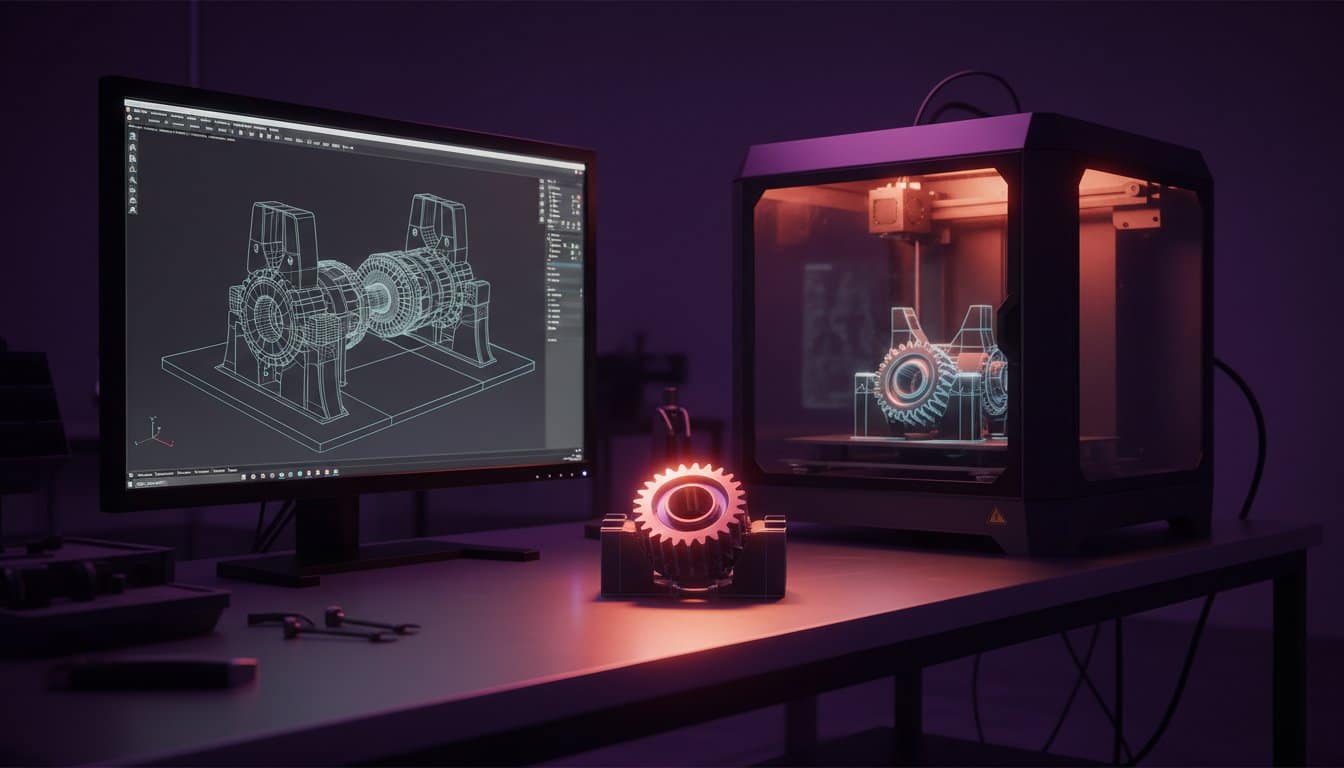
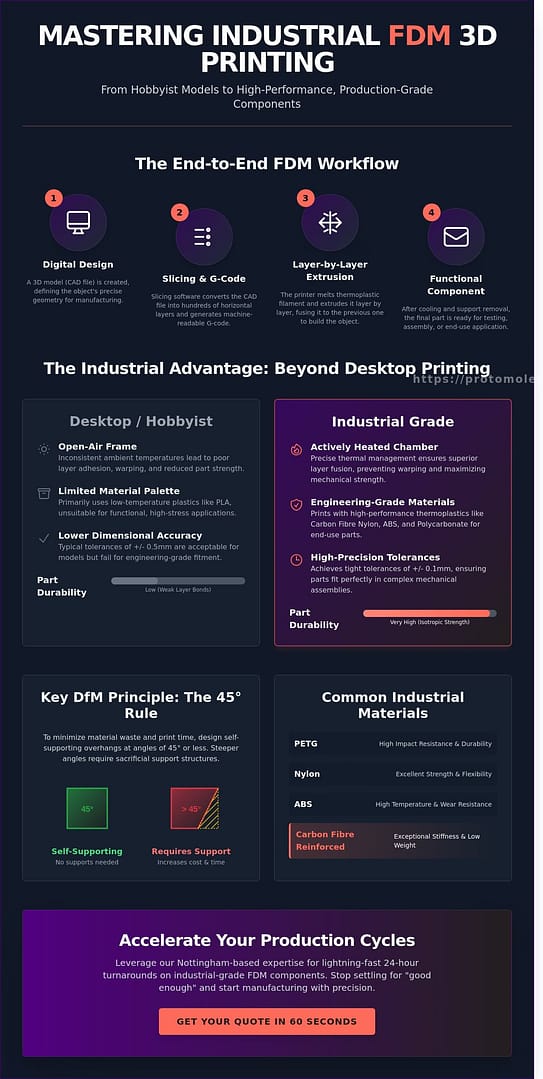
Success in fdm printing starts long before the nozzle heats up. It begins in the pre-processing stage with slicing software, where your digital CAD file is partitioned into horizontal layers and converted into G-code. This machine code dictates every movement, temperature setting, and extrusion rate for the specific hardware. Once the file is loaded, the printer heats the thermoplastic filament to its precise glass transition temperature. This state allows the material to flow through the nozzle while retaining enough viscosity to hold its shape upon deposition.
The print head moves with sub-millimetre precision, extruding the semi-liquid plastic onto the build plate. As each layer is laid down, it thermally bonds to the one beneath it. This fusion is critical for the part’s final structural integrity. For complex designs with overhanging geometries exceeding 45 degrees, the slicer generates sacrificial support structures. These prevent the molten plastic from sagging during the cooling process and are removed after the print is complete, ensuring zero compromise on quality for complex engineering components.
Common FDM Materials and Their Applications
Choosing the right material determines the success of your final part. We match material properties to your specific mechanical requirements to ensure reliability.
- PLA (Polylactic Acid): The standard for rapid visual prototypes. It offers excellent dimensional accuracy and low warp, making it perfect for models where aesthetic detail is the priority.
- PETG and ABS: These materials are essential for functional testing. ABS provides high impact resistance and heat stability, while PETG offers a balance of strength and chemical resistance for industrial components.
- High-Performance Polymers: For demanding environments, we utilise ASA for UV stability, Nylon for low-friction mechanical parts, and Carbon Fibre reinforced filaments for high-stiffness applications in the automotive and aerospace sectors.
The Importance of Layer Height and Infill
Your choice of layer height directly impacts both part resolution and production speed. A 0.1mm layer height provides a smooth finish but takes significantly longer to produce than a 0.3mm setting. Finding the sweet spot ensures you meet your deadline without sacrificing the required surface finish. If your project is time-sensitive, our rapid prototyping services are designed to beat the clock without losing precision.
Infill is the internal structure that provides rigidity without solid-part weight. By adjusting infill density, typically between 15% and 100%, you can optimise the part for lightweight agility or maximum crush resistance. Using complex internal geometries like gyroid or honeycomb patterns allows for even stress distribution across the part’s interior, providing industrial-grade strength where it matters most.
Industrial FDM vs. Desktop Printing: Quality, Scale, and Durability
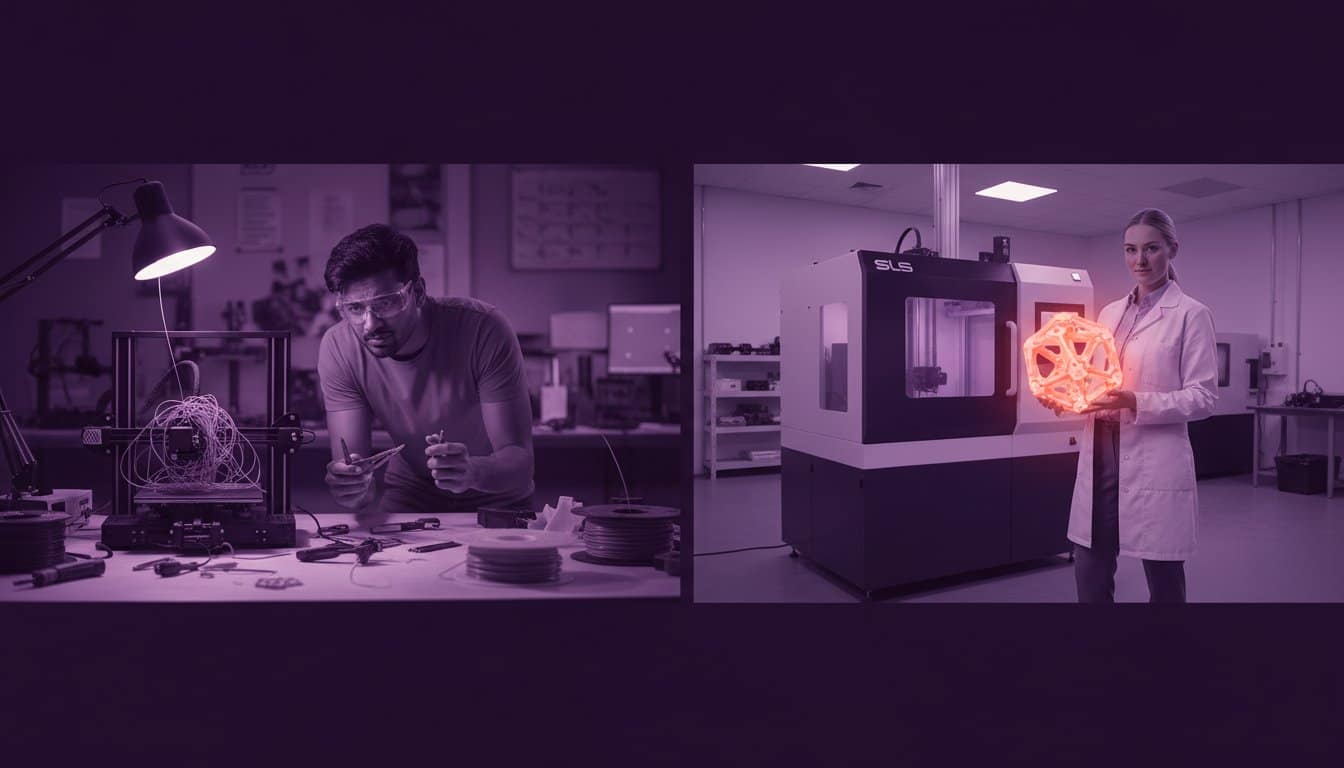
A common misconception suggests that all fdm technology delivers the same results regardless of the hardware used. This isn’t the case. While a £300 hobbyist machine can produce visual models, it lacks the thermal stability required for engineering-grade components. Professional systems utilize actively heated chambers that maintain constant temperatures throughout the build. This control eliminates the internal stresses that cause parts to warp or delaminate during long print cycles.
Precision defines the gap between these tiers. Industrial systems consistently achieve dimensional tolerances of +/- 0.1mm, whereas desktop alternatives often drift by 0.5mm or more as the stepper motors heat up. For aerospace jigs or automotive housings, this deviation makes the part useless. We focus on delivering parts that fit the first time. Our fleet operates with a reliability that hobbyist setups can’t match, ensuring your project stays on track without the delays of failed prints.
Why Professional Services Outperform Home Setups
Reliability starts long before the machine begins moving. We store all engineering filaments in humidity-controlled environments using industrial desiccants. Just 24 hours of exposure to UK humidity can degrade a roll of Nylon or Carbon Fibre PETG, leading to brittle parts and surface defects. Our rigorous calibration schedules ensure that every machine produces identical results across a 100-part run. Don’t risk your project on uncalibrated hardware. Learn about our batch production capabilities to see how we maintain consistency at scale.
Large Format FDM: Scaling Beyond the Desktop
Printing large components introduces massive thermal challenges. As a part grows, the temperature differential between the base and the nozzle increases, leading to significant warping. Industrial large-format systems solve this with high-wattage heated beds and managed air currents. This allows us to print massive assemblies, such as passenger train seat arms or custom automotive ducting, as single, unified pieces.
Single-piece construction increases structural integrity by removing weak points found in bonded assemblies. It’s a faster, more reliable way to produce heavy-duty tooling and fixtures. We provide the scale you need with lightning-fast turnaround times. Turn your complex designs into functional reality today. Beat the clock and secure your production slot now. We offer zero compromise on quality.
Design for Manufacturing (DfM): Optimising Your Parts for FDM
Precision engineering starts before the nozzle moves. Design for Manufacturing (DfM) ensures your fdm components transition from CAD to reality without wasting material or time. When you design specifically for the extrusion process, you eliminate common failure points and reduce production costs. Efficiency is the priority; every design choice should aim for a balance between structural integrity and print speed.
Gravity is your primary constraint. Follow the 45-degree rule: any overhang steeper than 45 degrees requires support structures to prevent sagging or “spaghetti” prints. Minimising these supports reduces post-processing labour and lowers your final invoice. If your design features steep angles, consider using chamfers instead of fillets to keep the geometry self-supporting.
Part orientation dictates performance. FDM parts are inherently anisotropic, meaning they’re weaker across the Z-axis because layer adhesion is mechanical rather than chemical. Always orient your part so the primary tensile loads run along the X and Y axes. A part printed flat on the bed is often 30% to 40% stronger than the same part printed vertically, according to standard ISO 527-2 tensile tests. Use this logic to beat the clock on part failure.
- Wall Thickness: Set walls to a multiple of your nozzle diameter. For a standard 0.4mm nozzle, use 1.2mm or 1.6mm walls for maximum rigidity.
- Hole Diameters: Small holes often print undersized due to plastic shrinkage during cooling. Increase your CAD hole diameters by 0.1mm to 0.3mm to ensure bolts fit without drilling.
- Infill Density: Don’t default to 100% infill. A 20% “Gyroid” infill provides excellent multi-directional strength while cutting print time by half.
Managing Tolerances and Clearances
Industrial fdm systems deliver reliable tolerances within +/- 0.2mm. You must design with these margins in mind to avoid assembly delays. For “Press Fits,” where components stay together through friction, aim for a 0.05mm offset. For “Slip Fits” used in hinges or sliders, more room is required. “Always allow for a 0.2mm to 0.5mm clearance for interlocking 3D printed parts to ensure smooth mechanical movement.” This precision ensures your prototype functions immediately upon delivery, with zero compromise on quality.
Post-Processing Techniques for FDM Parts
Post-processing transforms a raw print into a professional-grade component. Support removal is the first step. While manual removal is fast, soluble support options like PVA or BVOH allow for complex internal geometries that are otherwise impossible to clean. If your project requires a “Class A” finish, use progressive sanding from 80 to 400 grit followed by chemical vapour smoothing. This process melts the outer layer of materials like ABS to create a mirror-like finish.
For high-performance applications, heat treating and annealing are essential. By baking materials like Carbon Fibre Nylon or specialised PLA in a controlled environment, you reorganise the molecular structure. This can increase the heat deflection temperature (HDT) by up to 25%, making the parts suitable for engine bay environments or industrial machinery. Don’t let material limitations slow you down; use these techniques to push your parts further.
Ready to turn your optimised designs into high-performance reality? Get an instant quote for our professional fdm services and see the Protomolecule difference.
Professional FDM Services: Accelerating Your Production Cycles
Protomolecule serves as the premier UK partner for businesses requiring lightning-fast, high-precision fdm production. We eliminate the traditional bottlenecks of manufacturing by offering a guaranteed 24-hour turnaround on qualifying projects. Our promise is simple: zero compromise on quality. We understand that a 0.1mm deviation can stall a production line; therefore, we apply rigorous inspection standards to every part that leaves our facility. Our expert consultancy helps you navigate material selection and design tweaks, ensuring your geometry is optimised for strength and speed.
From Concept to Batch Production
We support your entire product lifecycle, moving seamlessly from initial CAD design to final manufacturing. For reverse engineering projects, we often transition from high-resolution 3D scanning directly into fdm production. This allows us to recreate obsolete components with modern durability. We’ve successfully delivered diverse projects, including custom 80s JDM Wheel Centre Caps for automotive restorers and industrial-grade Passenger Train Seat Arms for rail maintenance firms. Our process ensures that whether you need a single prototype or a batch of 500 units, the result remains consistent. Get an instant quote for your FDM project and see how we can streamline your workflow.
The Protomolecule Advantage: Precision and Speed
Our commitment to excellence starts with our materials. We use only high-performance, industrial-grade filaments such as Carbon Fiber Nylon, ASA, and Polycarbonate. These aren’t hobbyist plastics; they’re engineering-grade materials designed for the toughest environments. Based in Nottingham and Mansfield, our national UK service ensures your project stays on track without the international shipping delays or customs headaches associated with overseas suppliers. We’ve reduced lead times for our clients by an average of 65% compared to traditional injection moulding routes.
- 24-Hour Turnaround: Rapid dispatch for time-sensitive engineering parts.
- Expert Consultancy: Direct access to engineers who understand your technical requirements.
- Reverse Engineering: Seamless transition from physical part to digital twin to printed component.
- Industrial Materials: High-strength filaments capable of withstanding heat, impact, and UV exposure.
Don’t let manufacturing delays slow you down; beat the clock with our professional FDM service. We provide the reliability you need to meet your deadlines and the precision your engineering demands. Whether you’re in aerospace, automotive, or heavy industry, Protomolecule is the agile partner your business deserves. Reach out today to discuss your specifications and experience a service built on speed, accuracy, and technical expertise.
Accelerate Your Production with Precision FDM
Protomolecule doesn’t just print parts; we solve complex engineering bottlenecks. By leveraging industrial-grade heated chamber technology, we eliminate the warping and delamination issues common in standard desktop setups. Our team specializes in high-performance engineering thermoplastics, ensuring your components withstand the rigours of real-world application. Whether you’re refining a prototype or launching a batch production run, optimizing your design for fdm remains the fastest route to market. We’ve streamlined our workflow to support the UK’s most demanding sectors, including automotive and aerospace firms requiring rapid iteration. Don’t let manufacturing delays derail your project timeline. We provide national UK delivery with 24-hour turnaround options to keep your development cycle moving at pace. You get industrial-grade durability without the lead times of traditional tooling. Our commitment is simple: zero compromise on quality and a focus on results that matter. It’s time to stop waiting for parts and start testing them. Beat the clock and get your project back on track today.
Get a 24-hour quote for your FDM project
Frequently Asked Questions
What does FDM stand for in 3D printing?
FDM stands for Fused Deposition Modelling. It’s the most common additive manufacturing process where a thermoplastic filament is melted and extruded layer by layer to build a part. This technology powers everything from rapid prototypes to end-use industrial components. By melting material at temperatures between 190°C and 300°C, fdm creates durable items with reliable mechanical properties. It remains the industry standard for speed and cost-effectiveness. Turn your ideas into reality today.
Is FDM 3D printing strong enough for functional parts?
Yes, Fused Deposition Modelling is robust enough for functional parts when you select high-performance filaments like Carbon Fibre Nylon or Polycarbonate. These materials offer tensile strengths exceeding 70 MPa. We’ve used this process to produce heavy-duty components like passenger train seat arms that withstand constant daily use. While parts are anisotropic, meaning they’re weaker in the Z-axis, proper orientation ensures they meet rigorous mechanical demands without failure. Get a quote for your functional parts now.
What is the difference between FDM and SLA 3D printing?
What are the most common materials used in FDM?
The most common materials include PLA for rapid prototyping, PETG for moisture resistance, and ABS for impact strength. For industrial applications, 40% of our clients now opt for high-performance polymers like ASA or Carbon Fibre reinforced Nylon. These materials provide the thermal stability and chemical resistance required for harsh environments. Every material choice impacts the final part’s durability, so matching the filament to your specific application is critical for project success.
How accurate is FDM 3D printing for engineering tolerances?
Industrial systems achieve dimensional accuracies of +/- 0.2mm or 0.002mm per mm, whichever is greater. While 3D printing doesn’t match the +/- 0.01mm precision of CNC machining, it’s sufficient for 95% of prototyping needs. For tighter tolerances, we recommend printing parts slightly oversized and post-machining critical features. This hybrid approach ensures your components fit perfectly while benefiting from the lightning-fast turnaround times of additive manufacturing. Don’t let delays slow your development down.
Can FDM be used for batch production?
The process is highly effective for batch production of 10 to 500 units. It eliminates the £5,000 to £20,000 upfront cost of injection mould tooling, making it the fastest way to get products to market. We use print farms to run multiple machines simultaneously, delivering hundreds of parts like custom 80s JDM wheel centre caps in just 48 hours. Beat the clock and avoid traditional manufacturing bottlenecks when speed and precision are essential.
How much does an FDM 3D printing service cost in the UK?
In the UK, professional 3D printing services typically start with a minimum order value between £25 and £50. Small, simple prototypes might cost £15 to £30 per unit, while large, complex industrial parts can exceed £200. Pricing depends on material volume, print time, and post-processing requirements. Get an instant quote to see how our efficient workflows keep costs low without compromising on the industrial-grade quality your project deserves for its final application.
Does FDM 3D printing require support structures?
This technology requires support structures for any part features with an overhang angle greater than 45 degrees. These sacrificial structures prevent the molten plastic from sagging during the print process. We use soluble supports or breakaway materials to ensure clean surface finishes. Smart design choices, such as adding chamfers or orienting the part strategically, can reduce support material by up to 30%. This saves you both time and money with zero compromise on quality.