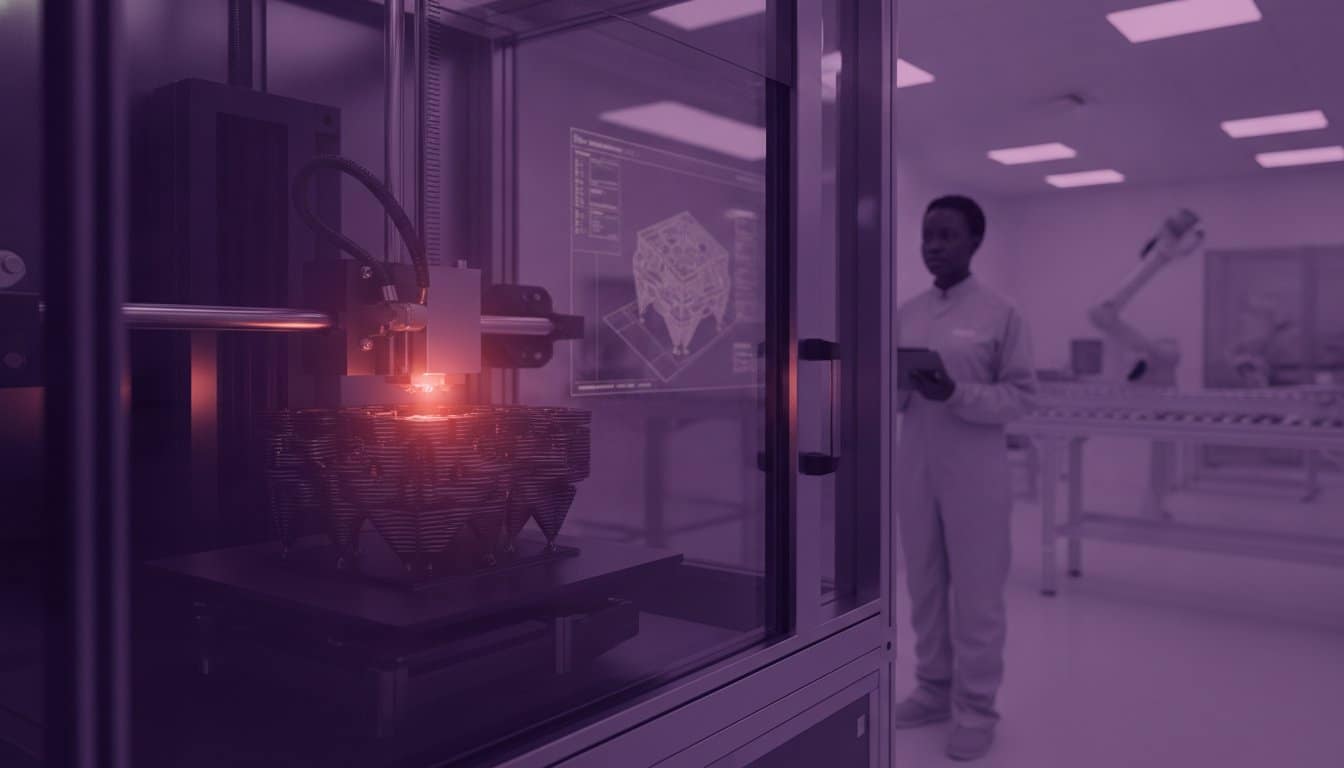
Did you know that AI-driven generative design can now produce industrial components that are 70% lighter than their traditionally manufactured counterparts? You’re likely all too familiar with the spiralling transport costs and the sheer material waste inherent in subtractive CNC machining. It’s frustrating to watch expensive alloys turn into scrap just to achieve a specific geometry; it’s an inefficient approach that modern engineering no longer requires.
This guide demonstrates how lightweighting parts with 3d printing transforms that waste into generative efficiency, allowing you to maintain uncompromising structural standards whilst drastically reducing component mass. We’ll provide a clear framework for your transition to additive manufacturing, detailing the technical distinctions between topology optimisation and complex lattice design. You’ll gain the insights needed to navigate the complexity of internal structures and identify a reliable UK partner for your next high-performance batch production run. It’s time to stop over-engineering for weight and start designing for performance.
Key Takeaways
- Overcome the geometric constraints of traditional CNC machining to achieve superior mass reduction through additive manufacturing.
- Master the strategic application of topology optimisation and generative design to remove material from non-critical load paths.
- Implement the process of lightweighting parts with 3d printing to improve fuel efficiency and lower your transport overheads.
- Transition from heavy metals to high-performance engineering polymers, such as Carbon-Fibre reinforced Nylon, without compromising on strength.
- Use rapid prototyping to physically test lightweighted iterations in days, ensuring every component meets your rigorous structural standards.
The Fundamentals of Lightweighting via Additive Manufacturing
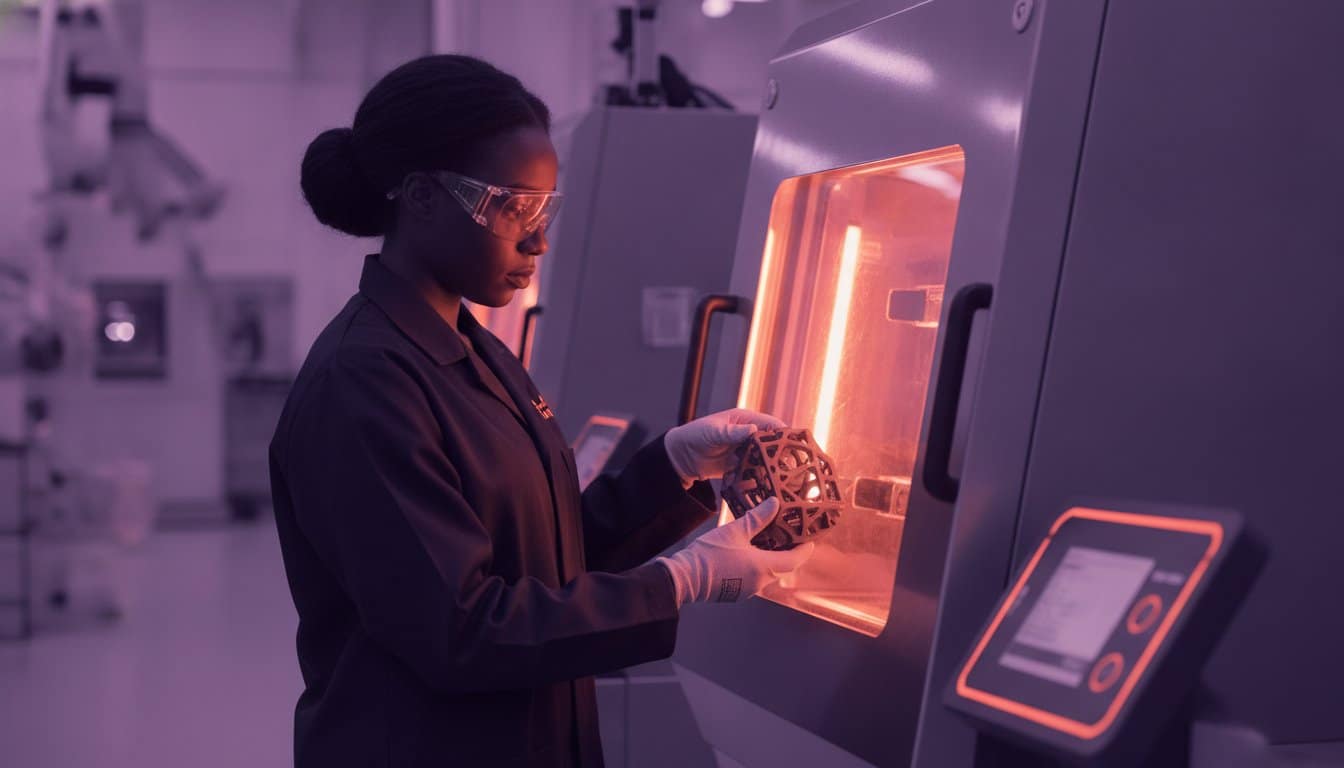
Lightweighting is the strategic process of reducing a component’s mass without sacrificing its structural integrity or mechanical behaviour. Traditionally, engineers were shackled by the limitations of subtractive manufacturing. CNC machining requires tool access, which often forces designers to leave unnecessary material in place simply because a cutting bit cannot reach the part’s core. Lightweighting parts with 3d printing breaks these constraints by building components layer-by-layer, allowing for internal voids and complex geometries that were previously impossible to manufacture.
Adopting a Design for Additive Manufacturing (DfAM) mindset is the essential first step. This approach prioritises function over form, ensuring material is only placed where it is mechanically required. Beyond the technical advantages, the economic benefits are immediate. Reducing part weight lowers shipping costs and fuel consumption in transport applications, whilst simultaneously minimising material waste. By modernising your approach, you turn subtractive waste into generative efficiency.
Why Traditional Methods Fail to Optimise Weight
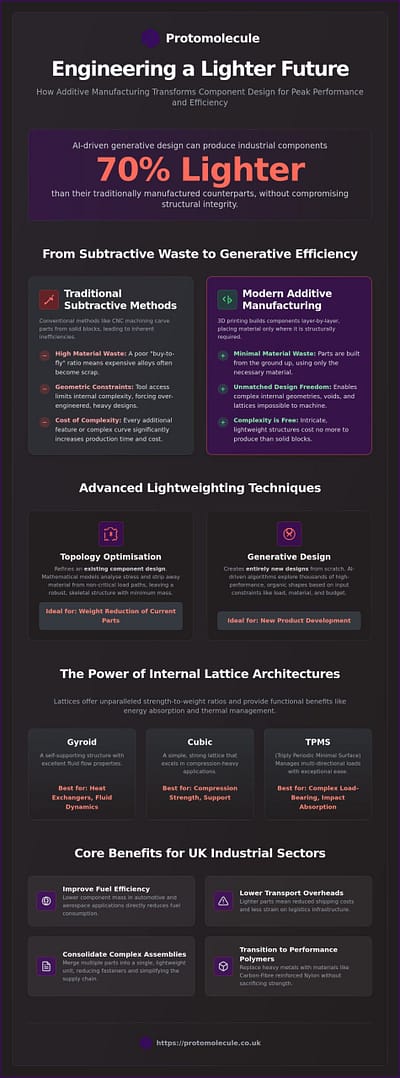
Subtractive processes often suffer from a poor “buy-to-fly” ratio, where a large percentage of the initial raw material is machined away as scrap. This is both expensive and environmentally taxing. In contrast, additive manufacturing uses only the material needed for the part itself. There is also a “cost of complexity” paradox to consider. In traditional manufacturing, every additional feature or complex curve increases the price. With 3D printing, complex, lightweight structures cost no more to produce than solid blocks, making high-performance design accessible for any project.
Core Benefits for UK Industrial Sectors
In the UK automotive sector, reducing unsprung mass through lightweighted components leads to better handling and superior fuel efficiency. Aerospace firms rely on processes like Selective Laser Melting to create high-strength metal parts that maximise payload capacity. For commercial machinery, lightening end-of-arm tooling reduces wear on robotic joints, extending the lifespan of the equipment and increasing cycle speeds. Our 3D Design Service helps you identify these optimisation opportunities early in the development cycle to ensure your parts are as light as they are strong.
Advanced Techniques: Topology Optimisation and Lattice Structures
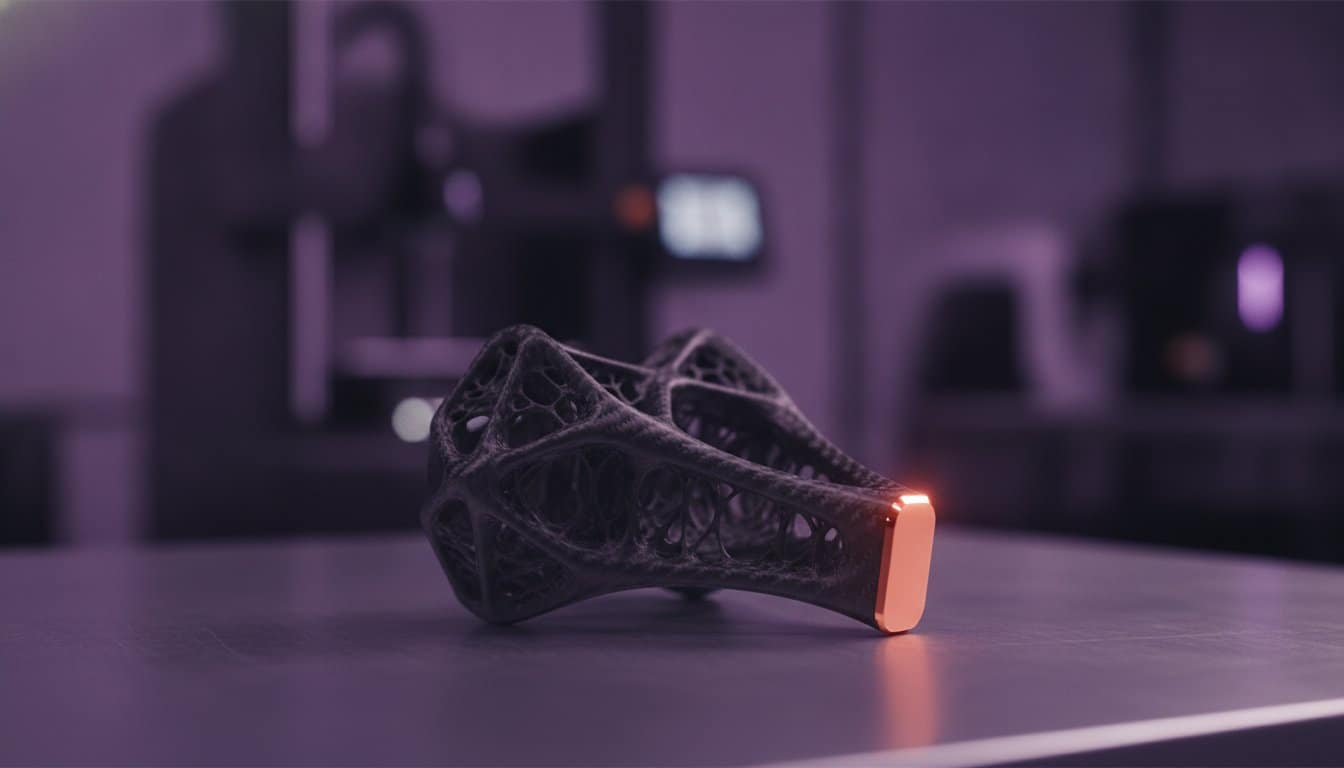
Moving beyond basic design adjustments, lightweighting parts with 3d printing relies on sophisticated software to dictate where material is essential. Topology optimisation is the primary tool here. It uses mathematical models to strip away material from non-critical load paths, leaving behind a structure that meets every mechanical requirement with the absolute minimum mass. This isn’t just about making things thinner. It is about intelligent removal based on real-world stress data to ensure your component remains robust under pressure.
When lightweighting parts with 3d printing, generative design takes this a step further by using AI-driven algorithms. Instead of refining a single idea, you input your constraints; such as load, material, and budget. The software then suggests thousands of high-performance “organic” shapes that a human designer might never conceive. We also utilise material consolidation to merge complex assemblies into a single, lightweight unit. This reduces the need for heavy fasteners and simplifies your supply chain, delivering a more reliable end product.
Topology Optimisation vs. Generative Design
The choice between these methods depends on your project’s starting point. Topology optimisation is ideal for refining an existing component to reduce weight whilst keeping the original footprint. Generative design is better suited for new product development where you want to explore radically different, high-efficiency geometries. If your CAD resources are limited, our 3D design services provide the technical lead necessary to navigate these complex digital workflows and secure the best possible outcome.
The Power of Internal Lattice Architectures
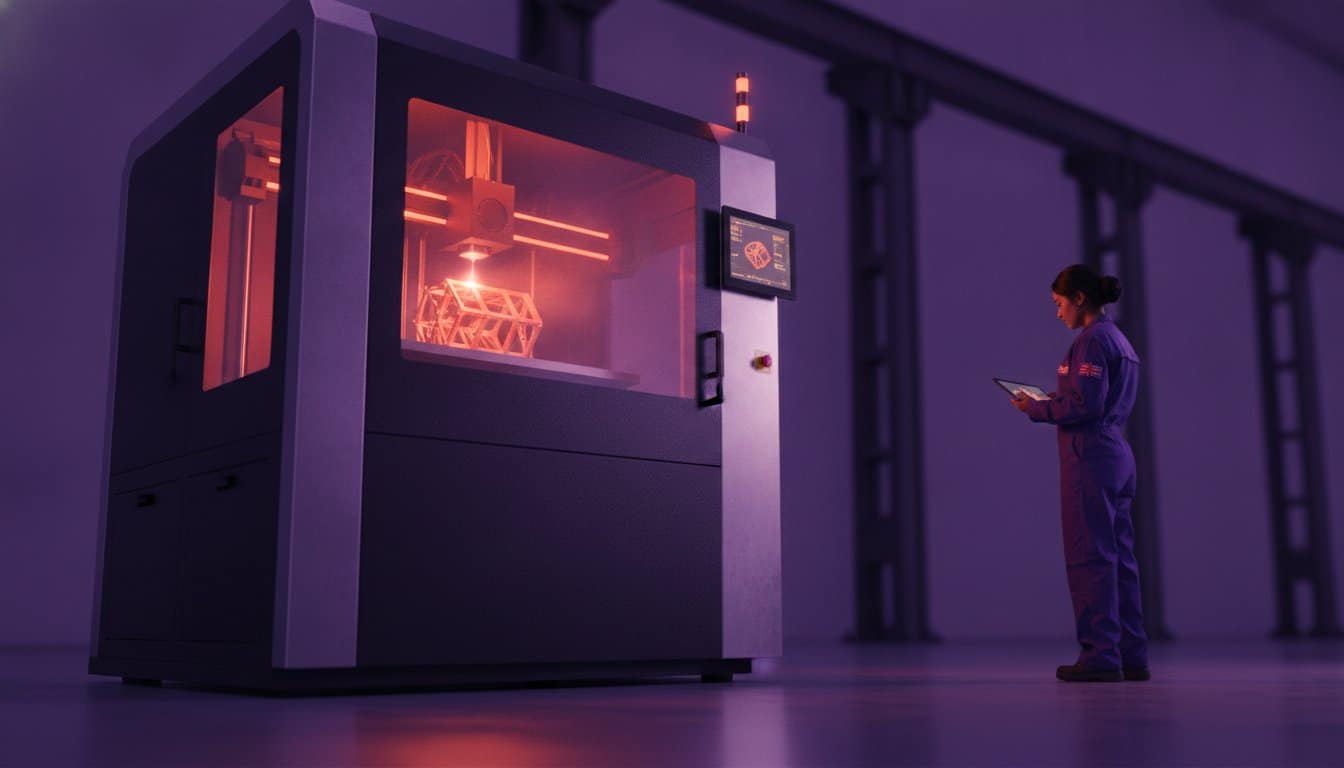
Internal lattices, such as honeycomb, gyroid, or cubic structures, offer unparalleled strength-to-weight ratios. These architectures don’t just reduce mass; they provide specific functional benefits like energy absorption and superior thermal management. For example, a gyroid lattice is self-supporting and offers excellent fluid flow, making it ideal for high-performance heat exchangers. Choosing the right cell type is vital. Cubic lattices excel in compression-heavy applications, whilst triply periodic minimal surface (TPMS) structures handle multi-directional loads with ease. Integrating these features into your industrial machinery ensures peak performance. If you’re ready to modernise your components, consider how a batch production service can scale these complex designs for your business.
Implementing Lightweighting: Material Selection and Production
Successful lightweighting parts with 3d printing requires more than just clever geometry; it demands a deep understanding of material science. Moving from heavy alloys to high-performance engineering polymers is the most direct path to mass reduction. Materials like Carbon-Fibre reinforced Nylon offer exceptional rigidity, often allowing you to replace aluminium components whilst cutting weight by significant margins. This transition isn’t just about weight; it is about choosing materials that handle specific environmental stresses, such as the chemical resistance of TPU or the thermal stability of Nylon.
Speed is your greatest competitive advantage in modern manufacturing. Our rapid prototyping service allows you to physically test lightweighted iterations in days, not weeks. This accelerated cycle ensures you can verify structural integrity through real-world testing before committing to a full production run. It eliminates the guesswork often associated with complex internal structures, providing the data needed to move forward with confidence.
Material Substitution: Moving Beyond Metal
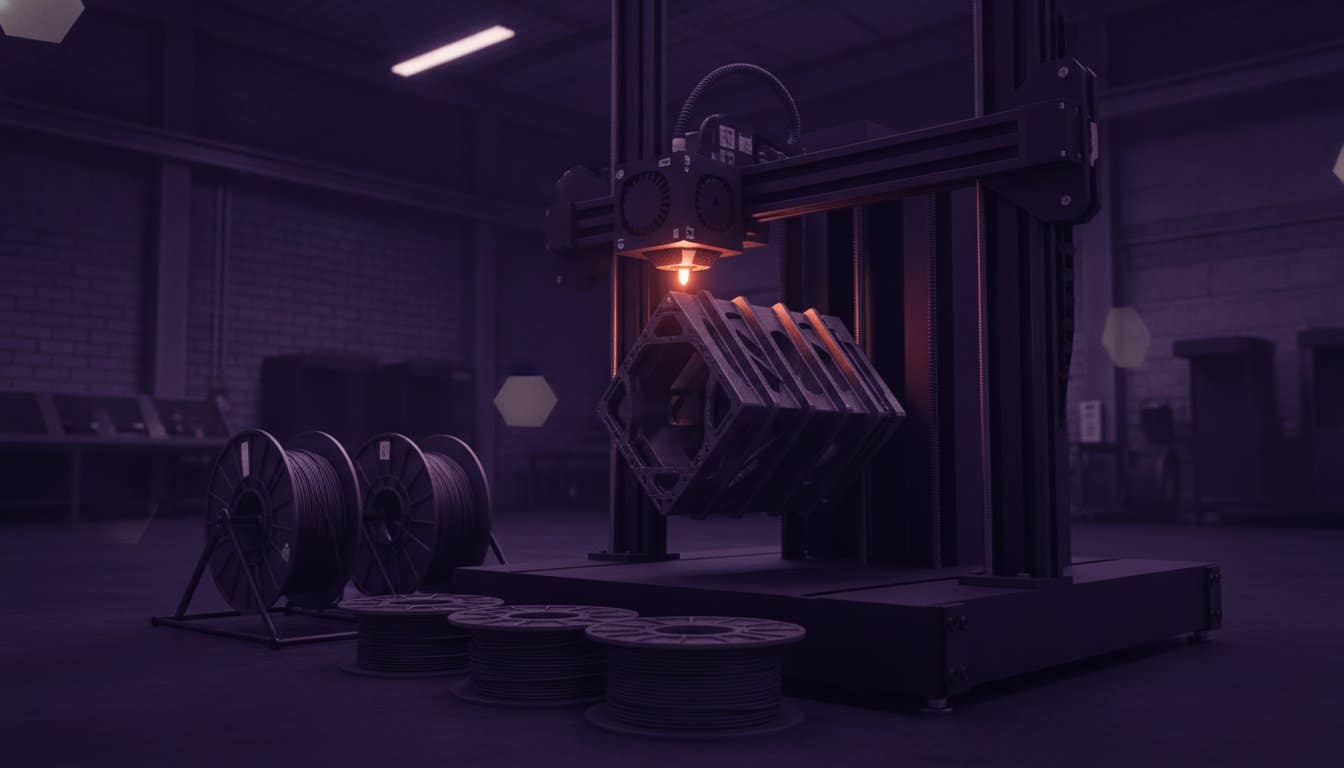
Aluminium has long been the default for lightweight industrial parts, but carbon-fibre reinforced FDM filaments now challenge that status with superior specific strength. Specific strength is defined as the ratio of a material’s strength to its density, representing how much load it carries per unit of weight. For functional components, Selective Laser Sintering (SLS) produces isotropic parts that maintain consistent mechanical properties in all directions. This makes it a reliable choice for critical lightweight assemblies where performance cannot be compromised.
The Design-to-Manufacturing Workflow
To implement these changes effectively, follow a structured workflow. Start with 3D scanning of original heavy components to capture precise dimensions. Follow this with advanced reverse engineering to create a clean CAD model, then apply the lightweighting optimisation techniques discussed earlier. Partnering with a 3D printing service that understands the intersection of design and material science is vital. Post-processing is essential for thin-walled parts to ensure surfaces are sealed and stress concentrations are minimised. For those scaling these solutions, professional batch production provides the consistency needed for industrial supply chains. Start with a small, non-critical component to prove the ROI before scaling your lightweighting strategy.
Accelerate Your Path to Lightweight Performance
Adopting an additive mindset is no longer a luxury reserved for niche aerospace projects; it is a commercial necessity for any UK firm looking to reduce transport costs and material waste. By transitioning from subtractive constraints to generative design, you unlock geometries that maximise strength whilst minimising mass. Mastering lightweighting parts with 3d printing allows you to deliver superior components that outperform traditional alternatives in every mechanical metric.
Protomolecule acts as your dedicated technical partner, providing expert 3D design and manufacturing from our UK studio. We specialise in fast turnaround for rapid prototyping and high-performance batch production, utilising advanced materials like carbon-fibre reinforcements to modernise your legacy parts. Our team ensures that every thin-walled structure and complex lattice meets uncompromising industrial standards. Don’t let heavy, outdated designs slow your progress or inflate your overheads.
Get a professional quote for your lightweighting project and see how quickly we can transform your engineering challenges into tangible results. We’re ready to help you build lighter, faster, and more efficiently.
Frequently Asked Questions
Does lightweighting a part make it more fragile?
Lightweighting does not inherently make a component more fragile. When executed correctly through topology optimisation, material is only removed from non-critical areas that don’t contribute to the part’s structural performance. The resulting geometry is specifically engineered to handle your required loads; often distributing stress more evenly than a solid, traditionally manufactured part. This approach ensures you maintain or even enhance mechanical durability whilst stripping away unnecessary mass.
Which 3D printing material is best for lightweight, high-strength parts?
Carbon-fibre reinforced Nylon is frequently the superior choice for industrial applications requiring high specific strength. It offers a remarkable strength-to-weight ratio that rivals some aluminium alloys whilst remaining significantly lighter. For more demanding environments, high-performance polymers like PEEK provide exceptional thermal stability. Selecting the right material for lightweighting parts with 3d printing depends entirely on your project’s specific mechanical loads and environmental exposure.
How much weight can realistically be saved using 3D printing?
You can realistically expect weight savings between 30% and 70% depending on the original component’s geometry and function. AI-driven generative design typically achieves the highest reductions by creating high-efficiency, organic shapes that are impossible to machine. Even a simple transition from a solid metal assembly to a consolidated, hollowed 3D printed polymer unit can result in immediate and substantial mass reduction for your machinery.
Do I need special software for topology optimisation?
Yes, specialised CAD tools are essential for performing advanced topology optimisation and generating complex lattice structures. Software platforms like Autodesk Fusion 360 or nTopology allow engineers to simulate real-world stress loads and automatically generate the most efficient material layout. If your team doesn’t have access to these specialised tools, our 3D Design Service can handle the entire optimisation workflow for you; ensuring your parts are engineered for peak performance.