Last Tuesday, a lead engineer at a manufacturing facility discovered that a critical 1988 cast iron housing had cracked, triggering a £4,200 hourly loss with no original blueprints in sight. This is the reality of managing legacy hardware in a high-speed digital age. Our professional reverse engineering services eliminate this risk by capturing every complex geometry with sub-millimetre accuracy. We turn your physical headaches into high-performance digital solutions, often providing the precision data you need within a 24-hour window.
You already understand that manual measurements often lead to costly errors and failed assemblies. We agree that your operations shouldn’t be held hostage by obsolete parts or missing documentation. This article demonstrates how industrial-grade 3D scanning transforms worn components into precision CAD data for immediate CNC machining or 3D printing. You’ll learn how to bypass supply chain delays, reduce downtime, and bring your 20th-century hardware into a 2026 digital workflow with zero compromise on quality. Don’t let old drawings or missing files slow you down when the solution is just a scan away.
Key Takeaways
- Transform legacy hardware into precision digital twins to eliminate physical storage costs and future-proof your UK industrial operations.
- Master the 3-step industrial workflow for converting raw physical data into high-resolution, manufacturing-ready CAD frameworks.
- Identify when to use “as-built” models for wear analysis versus “design intent” models for perfected, modernized component manufacturing.
- Discover how professional reverse engineering services can reconstruct damaged parts and provide a cost-effective, high-speed alternative to traditional 2D design.
- Accelerate your path to market by integrating industrial-grade scanning with our lightning-fast 24-hour turnaround for rapid batch production.
The Strategic Role of Reverse Engineering Services in 2026
Professional reverse engineering services turn physical hardware into versatile digital assets. This shift allows UK businesses to replace slow, expensive supply chains with on-demand manufacturing. When you possess the digital data, you control the lead time. You aren’t waiting weeks for a part to arrive from overseas; you’re printing or machining it in 24 hours. This agility accelerates the R&D cycle, allowing engineers to benchmark competitors or iterate on existing designs with lightning-fast precision. Don’t let delays slow you down when the technology exists to bypass them entirely.
Overcoming the Obsolete Parts Crisis
Machinery downtime costs UK manufacturers an average of £180,000 per hour in lost productivity. This risk is highest when original equipment manufacturers (OEMs) go bust or stop supporting legacy systems. We recover critical data for machines where the original plans no longer exist, ensuring your production line stays active. By digitizing components before they fail, you eliminate the frantic search for replacements. A Digital Inventory is a risk-mitigation strategy where physical parts are replaced by secure CAD files ready for immediate production. It’s about being proactive rather than reactive. Beat the clock by securing your data today.
Modern Applications Across UK Industry
The demand for precision spans every major sector in Britain. In Nottingham and across the Midlands, we see diverse projects that require zero compromise on quality. Our reverse engineering services provide the foundation for several high-stakes applications:
- Aerospace and Space: Capturing complex internal geometries to optimize component weight, which is critical for reducing fuel consumption and launch costs.
- Automotive Heritage: Recreating rare, discontinued components for classic and performance vehicles, such as 80s JDM wheel centre caps or engine housings.
- Commercial Manufacturing: Modifying existing equipment, like passenger train seat arms, to improve ergonomics or performance without starting from scratch.
Whether you’re a local specialist or a national tier-one supplier, having access to accurate 3D data is your competitive edge. Get a quote now to see how we can digitize your workflow and protect your assets from obsolescence.
The 3-Step Reverse Engineering Workflow: From Physical to Digital
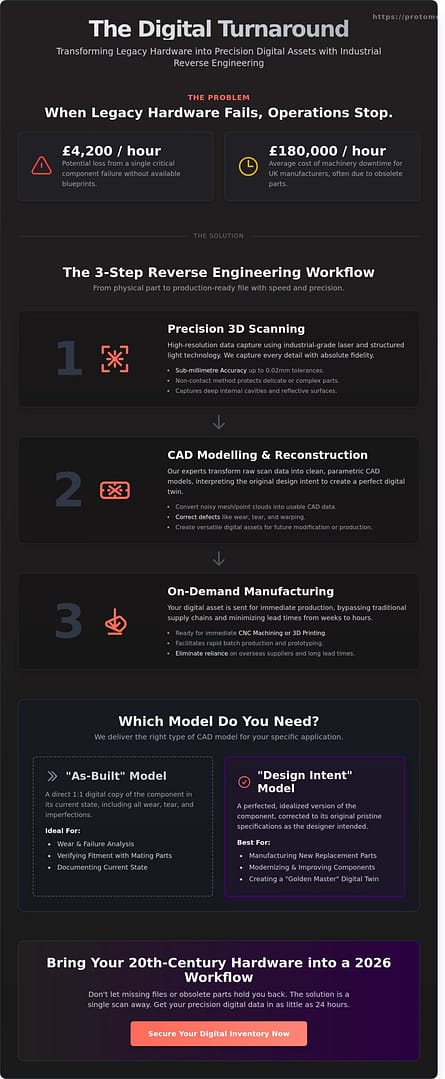
Speed and precision define our reverse engineering services. We don’t just copy parts; we capture their engineering essence. Our workflow ensures zero compromise on quality, moving from a physical object to a production-ready file with lightning-fast turnaround times. We eliminate the guesswork by using a disciplined, three-stage process designed for industrial reliability.
Step 1: Precision 3D Scanning
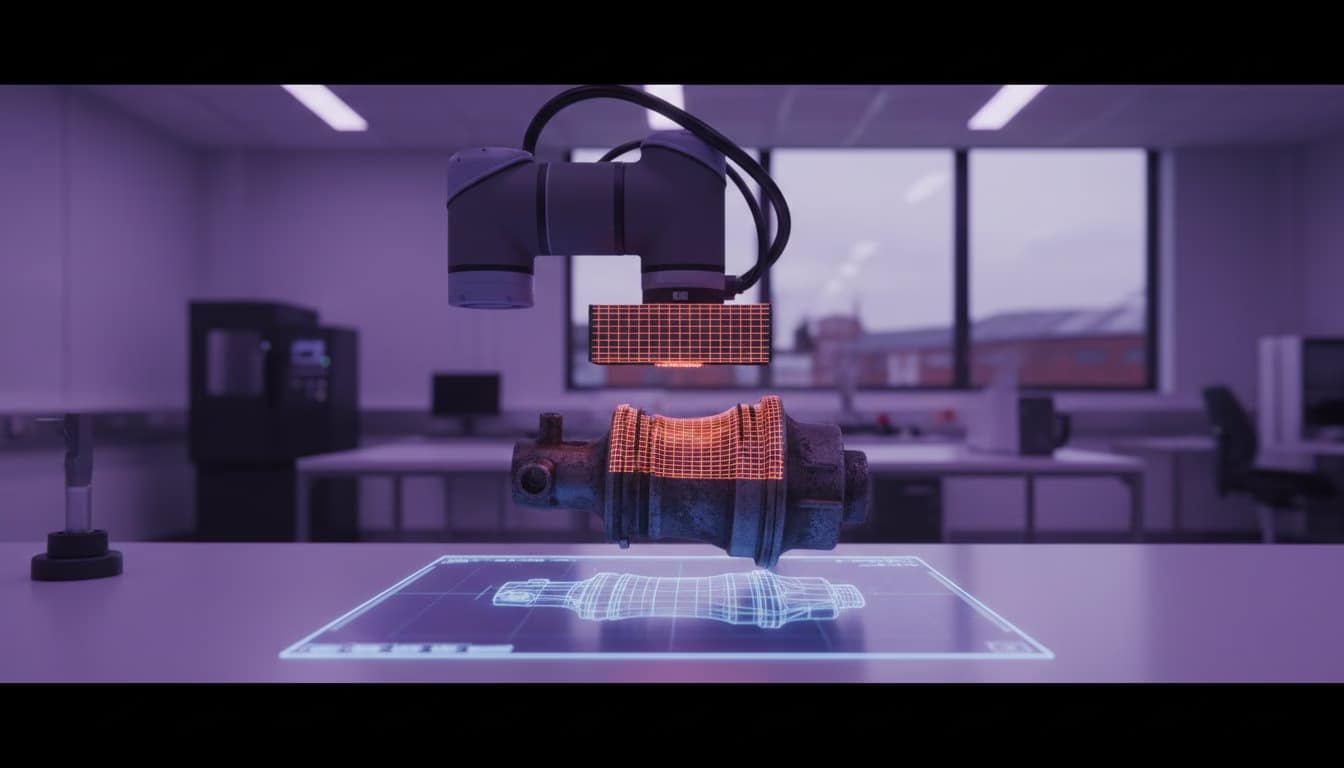
The process begins with high-resolution data capture. We use industrial-grade laser and structured light technology to achieve sub-millimetre accuracy, often reaching tolerances as tight as 0.02mm. This non-contact 3D scanning method is vital for delicate or complex parts where manual measurement fails. Our hardware handles challenging scenarios, including deep internal cavities and reflective surfaces that standard consumer scanners cannot process. Whether it’s a legacy component for a passenger train or a bespoke automotive part, we capture every geometric detail with absolute fidelity.
Step 2: CAD Modeling and Reconstruction
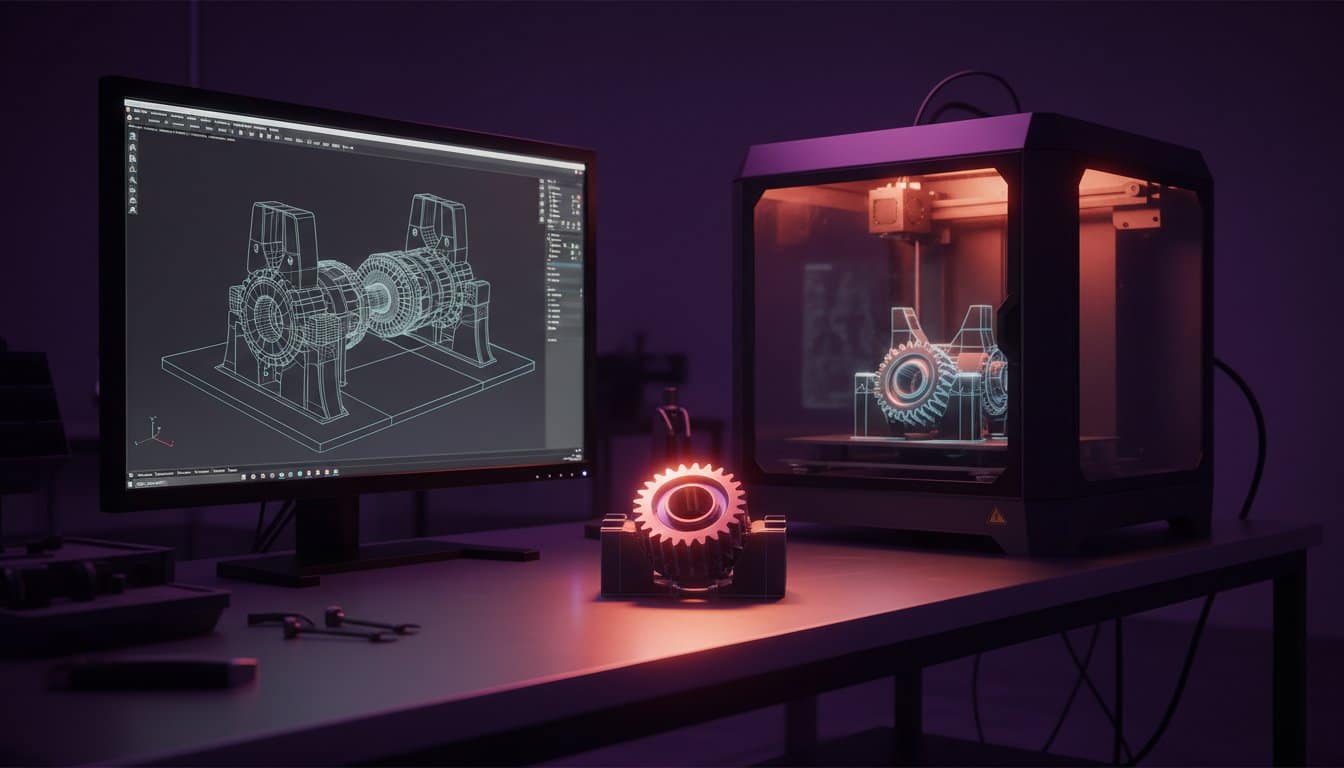
Raw scan data exists as a point cloud or a “noisy” mesh. To make this data useful for manufacturing, our team performs a complete digital reconstruction. This is where 3D design expertise becomes critical. We don’t just trace the scan; we interpret the original design intent. This means identifying where a part has worn down or warped over time and correcting those defects in the digital model. We align the reconstruction with standard engineering tolerances, ensuring the final CAD framework is clean, mathematical, and ready for the next stage of development.
Step 3: Verification and Export
Validation is the final safeguard. We perform a digital “overlay” comparison, checking the new CAD model against the original scan data to confirm 100% accuracy. Once verified, we export the files into industry-standard formats like STEP, IGES, or Parasolid. These files are optimized for immediate use in 3d printing, CNC machining, or injection mould toolmaking. We focus on delivering production-ready assets that slot directly into your existing supply chain without delay.
Our agile approach allows us to bypass the weeks of lead time usually associated with traditional measurement. If you need to digitise a critical component to prevent production downtime, you can get a quote and start the process today. We provide the technical clarity required to turn legacy hardware into modern digital assets, helping UK firms maintain their competitive edge through superior reverse engineering services.
Design Intent vs. As-Built: Which Model Do You Need?
When you commission reverse engineering services, the first decision determines the entire trajectory of your project: do you want the part as it exists on your desk, or as it was originally drawn on the drafting board? This choice impacts everything from your final lead times to manufacturing compatibility. At Protomolecule, we don’t just scan; we translate physical reality into actionable engineering data that fits your specific production workflow.
The distinction between “as-is” and “perfected” geometry is fundamental. An as-built model is a forensic snapshot of the physical object, including every millimetre of wear, deformation, or manufacturing defect. Conversely, design intent modeling is a restorative process. It involves stripping away the history of the part to uncover the original engineering logic. Choosing the wrong path can lead to assembly issues or costly tool corrections later in the cycle.
Capturing Design Intent
Design intent modeling is about recreating the part as it was meant to be. If a component has 0.05mm of surface wear or a slight casting warp, our engineers normalise these dimensions. A bore measured at 9.98mm is restored to a nominal 10mm. This approach is the industry standard for creating new injection moulds, dies, or CNC-machined replacement parts. You need the idealised geometry to ensure that new batch production runs integrate perfectly with existing assemblies.
A 2023 industry survey by the Institution of Mechanical Engineers found that 64% of reverse engineering projects for legacy machinery focus on design intent to overcome the total lack of original CAD data. By using our 3d design expertise, we ensure your replacement parts aren’t just copies, but improvements. We eliminate original manufacturing errors, such as draft angles that were slightly off or non-concentric holes, providing you with a “gold standard” digital master.
As-Built and NURBS Modeling
Sometimes, the “flaws” are the most valuable data you have. As-built modeling creates a high-fidelity digital wrap of the physical object. This is critical for inspection reports, forensic failure analysis, or when you need to design a custom interface for a worn component. In the aerospace and medical sectors, where a 0.02mm deviation can compromise safety or fitment, capturing the exact physical state is non-negotiable.
For organic or complex surfaces, we utilise Non-Uniform Rational B-Splines (NURBS). This allows us to map intricate, non-linear shapes without forcing them into rigid geometric boxes. It’s the preferred method for:
- High-precision fitment in aerospace turbine housings.
- Medical implants tailored to specific patient anatomy.
- Restoring 80s JDM car components where aesthetic curves are paramount.
- Capturing artistic or ergonomic shapes where parameters aren’t fixed.
Your manufacturing method dictates the model. If you’re heading for 3D printing or rapid prototyping, design intent is usually superior. If you’re performing high-end metrology, as-built is the only way forward. Protomolecule delivers both with the speed and precision required to beat the clock. Don’t let technical indecision slow you down. Get a professional assessment of your project through our reverse engineering services and ensure zero compromise on quality.
Addressing Common Objections in Reverse Engineering
Choosing reverse engineering services is a strategic decision to reclaim lost data and secure your supply chain. If you’re comparing this to traditional 2D design, consider that manual drafting for a complex industrial casting can often take 25 hours or more. Our digital workflow cuts that timeline by approximately 60%. This isn’t just about speed; it’s about the cost of error. In the UK manufacturing sector, roughly 12% of project delays stem from incorrect manual measurements of legacy parts. We eliminate that risk by capturing the exact geometry of the physical object in minutes.
Intellectual property is a common concern for many firms. We operate within the UK Intellectual Property Office (UKIPO) frameworks, specifically focusing on “must-match” and “must-fit” exceptions for replacement parts. We don’t just replicate; we provide the technical clarity needed to ensure your project remains compliant while you maintain your machinery. We turn the obstacle of a missing blueprint into a digital asset you own forever.
Accuracy and Tolerance Standards
By 2026, industrial laser scanning has reached a baseline precision of ±0.02mm, or 20 microns. This level of accuracy is vital for aerospace or high-end automotive components where a hair’s breadth determines the difference between a perfect fit and a mechanical failure. Material choice also dictates the final outcome. While CNC-machined steel holds incredibly tight tolerances, polymers used in rapid prototyping require specific offsets to account for thermal shrinkage. Zero compromise on quality is a technical requirement because even a 0.1% deviation in a high-speed assembly leads to accelerated mechanical wear and expensive system downtime.
Working with Damaged Components
You don’t need a perfect original to get a perfect digital twin. We use engineering logic and geometric symmetry to fill in the gaps left by snapped structural arms or heavily worn gear teeth. Through predictive modeling, our team reconstructs the original design intent of components like passenger train seat arms or vintage 80s JDM wheel centre caps even if 30% of the original surface area is missing. The role of reverse engineering in failure analysis is vital. It allows us to identify exactly why a part failed and reinforce the new digital model to prevent future fatigue. We don’t just copy the flaw; we engineer the solution.
Don’t let a broken part or a lost drawing stall your production. Get a quote now and let our expert team restore your components with lightning-fast precision.
Lightning-Fast Manufacturing with Protomolecule
Speed is the ultimate competitive advantage in UK manufacturing. Protomolecule closes the gap between a broken component and a functional replacement in as little as 24 hours. We don’t just provide digital data; we deliver physical solutions. Our reverse engineering services are designed for sectors where downtime costs thousands of pounds per hour. We eliminate the wait times of traditional supply chains by digitising and manufacturing in one seamless workflow.
Once the geometry is captured and refined, we can move straight into batch production to scale your solution rapidly. Whether you need a single replacement gear or 500 bespoke brackets, our workflow removes the weeks of lead time typically associated with new tooling. We use industrial-grade technology to solve complex problems for clients ranging from independent restorers to national transport firms.
The Protomolecule advantage lies in our team of expert problem solvers. We’ve successfully delivered projects including 80s JDM wheel centre caps and passenger train seat arms, proving our versatility across diverse industries. We operate from our studio in the Nottingham and Mansfield area, providing a national reach with a local, hands-on dedication. We value your deadlines as much as you do. Zero compromise on quality is our brand promise.
From Scan to 3D Print
Precision scanning is only half the battle. We leverage rapid prototyping to test fitment and function immediately. This allows us to catch design flaws before they reach the production floor. Our facility offers multiple technologies to suit your specific needs:
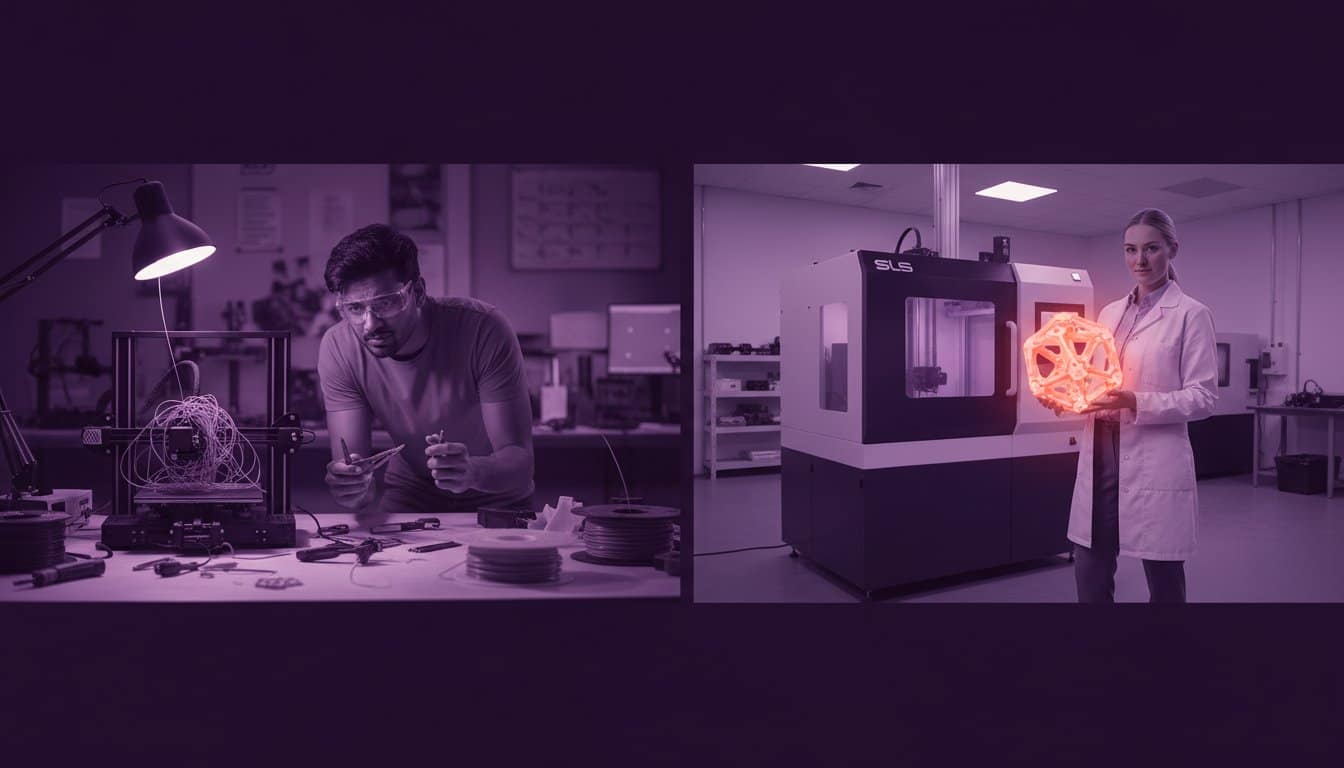
- FDM: Best for durable, functional parts using industrial-grade filaments.
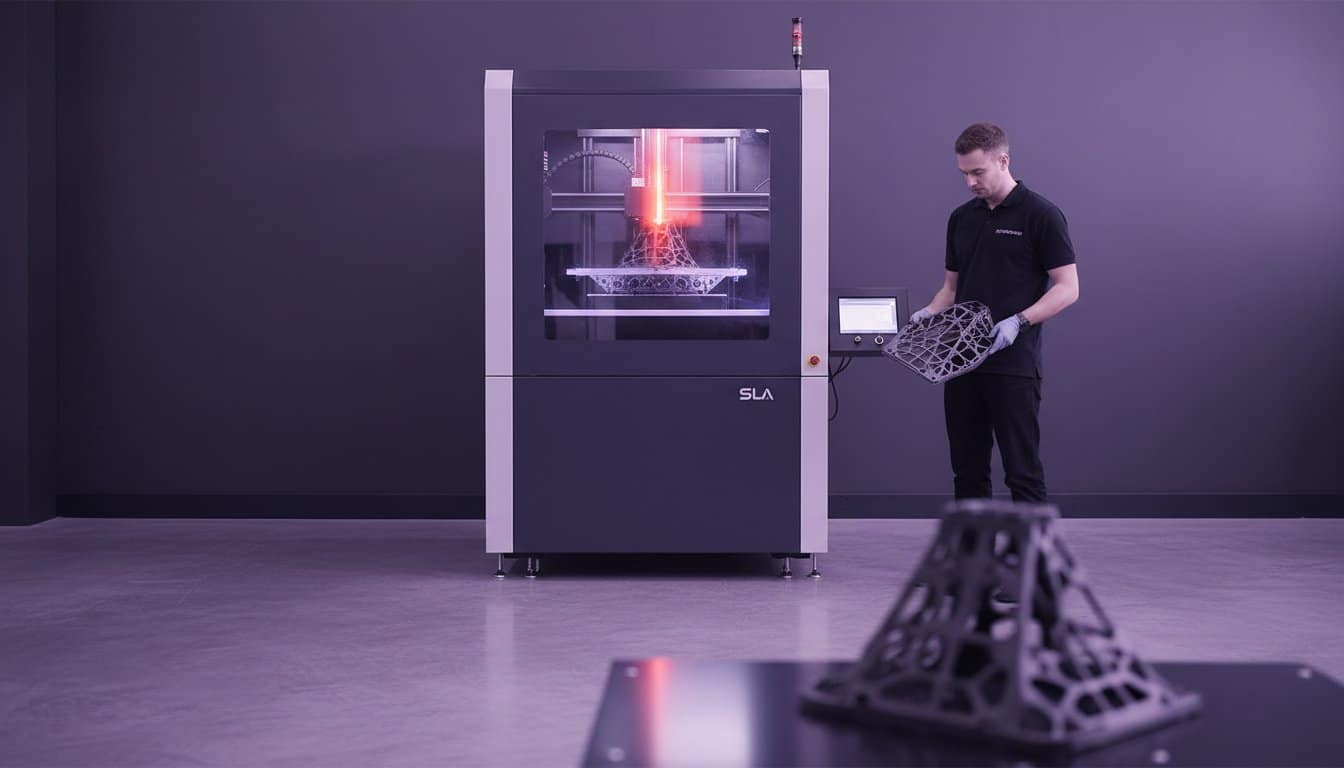
- SLA: Ideal for high-detail components requiring smooth surface finishes.
- SLS: Perfect for complex geometries and rugged, end-use parts without the need for supports.
Material selection is critical for industrial performance. We help you choose between carbon-fibre reinforced nylon, chemical-resistant resins, or high-temperature plastics to ensure your reverse engineered part outperforms the original.
Get Started with Protomolecule
Ready to beat the clock? A clear project brief is the fastest way to get your part into production. Provide us with the part’s environment, its mechanical stress points, and any required tolerances. You can get a quote online for a same-day project assessment. Our streamlined process is designed to reduce friction and get you moving again. We provide engineering excellence across the UK, ensuring your project stays on track. Don’t let delays slow you down; start your project today for ultra-fast delivery.
Future-Proof Your Legacy Hardware Today
Legacy hardware shouldn’t be a liability in 2026. Converting physical components into precise digital assets eliminates the risk of part obsolescence and supply chain failure. Protomolecule provides high-performance reverse engineering services that bridge the gap between 20th-century machinery and modern manufacturing standards. We utilize industrial-grade 3D scanning to ensure there’s zero compromise on quality for clients in the Space, Military, and Commercial sectors.
Speed is our signature. We offer 24-hour rapid turnaround options to keep your projects moving at the pace of the UK market. Don’t let a missing drawing or a discontinued part stall your production line. Our team has delivered results for complex projects ranging from 80s JDM wheel centre caps to passenger train seat arms. This track record proves that no engineering challenge is too complex for our agile Nottingham and Mansfield based studio. We value your deadlines as much as our own and focus on delivering results that beat the clock every time.
Turn your physical parts into precision CAD data. Get a Quote from Protomolecule today.
The path from physical part to digital perfection is shorter than you think. Let’s get your project back on track.
Frequently Asked Questions
How accurate are your reverse engineering services?
We deliver industrial-grade precision with tolerances as tight as 0.02mm using high-performance metrology hardware. Our reverse engineering services ensure that every geometric feature is captured with absolute fidelity. We use Tier 1 laser scanners to eliminate guesswork, providing a digital twin that matches your physical component exactly. Zero compromise on quality is our standard for every project we handle in our Nottingham studio.
Can you reverse engineer a part that is broken or has missing pieces?
Yes, we specialize in digital reconstruction for damaged or incomplete components. Our engineers use geometric intent to “heal” the 3D model, recreating missing sections based on the part’s original design logic. We’ve successfully restored everything from 80s JDM wheel centre caps to vintage machinery parts. We don’t just scan what’s there; we rebuild what should be there to ensure full functionality.
What file formats will I receive at the end of the project?
You’ll receive industry-standard files ready for immediate manufacturing or further design work. For parametric CAD models, we typically provide STEP, IGES, or Parasolid formats. If you require mesh data for 3D printing, we deliver high-resolution STL or OBJ files. We ensure your data is compatible with major software packages like SolidWorks and Autodesk Fusion 360 to keep your project moving fast.
Do I need to send the physical part to your studio, or do you offer on-site scanning?
We offer both options to maximize your project’s efficiency. You can ship your components directly to our secure facility in the East Midlands for rapid processing. For large-scale industrial machinery or immovable assets, our mobile team provides on-site scanning across the UK. This flexibility allows us to capture data without disrupting your production line, keeping your downtime to a minimum.
How long does the reverse engineering process typically take?
We pride ourselves on a rapid response, often delivering initial scan data within 24 hours of receiving the part. Complex parametric modelling projects generally conclude within 3 to 5 business days. We understand that delays cost money, so we work with a sense of urgency to beat the clock. Contact our team today for an instant quote to lock in your delivery schedule.
Can you provide 2D technical drawings alongside the 3D CAD model?
Yes, we produce fully detailed 2D technical drawings that include all necessary dimensions, tolerances, and material specifications. These drawings are essential for traditional CNC machining or quality control inspections. By pairing a 3D model with a professional 2D draft, you get a complete engineering package. This approach streamlines the transition from a physical prototype to full-scale batch production without any data gaps.
Is reverse engineering legal for replacement parts in the UK?
Reverse engineering is generally legal in the UK for the purposes of repair, maintenance, and ensuring interoperability. Under the Copyright, Designs and Patents Act 1988, “must-match” and “must-fit” exceptions often apply to spare parts for complex products. You should always verify that your project doesn’t infringe on active patents. We focus on helping you maintain legacy equipment where original manufacturer support no longer exists.
What is the difference between a mesh file and a parametric CAD model?
A mesh file, like an STL, consists of millions of flat triangles that define the surface shape but lack editable geometry. It’s perfect for 3D printing but difficult to modify. A parametric CAD model is a “smart” file built from geometric features like holes and fillets. This format allows you to change dimensions instantly. Our reverse engineering services convert raw scan meshes into these high-performance, editable CAD files.