
Scaling up your additive manufacturing isn’t just about a bigger build plate; it’s a calculated gamble where the stakes are measured in kilograms of wasted material and weeks of lost machine time. You’ve likely experienced the frustration of unpredictable quotes or the sting of a 70-hour build failing at the final hurdle. For many industrial firms exploring large format 3d printing applications uk, the transition from desktop prototyping to oversized engineering parts often reveals hidden complexities that can derail a project’s budget and timeline.
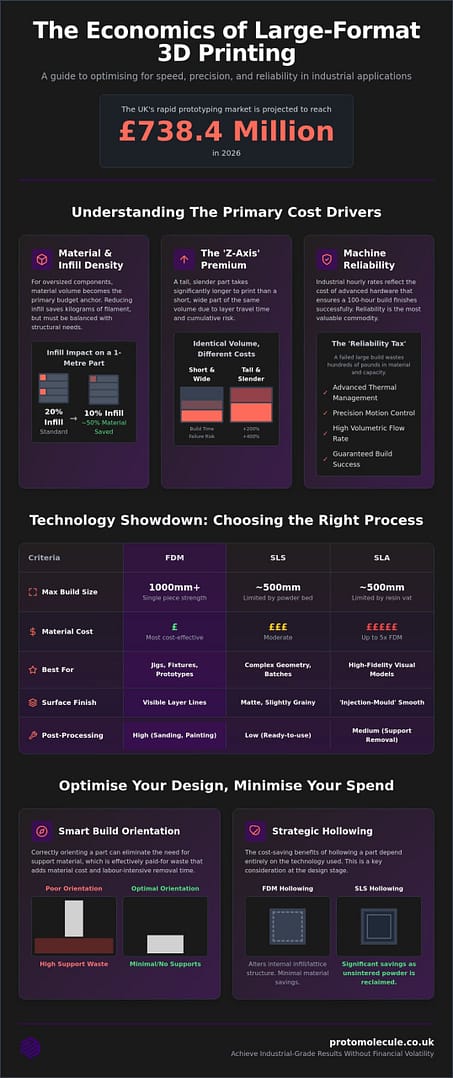
This guide empowers you to master the economics of large-format additive manufacturing, ensuring you achieve industrial-grade results without the financial volatility. With the UK’s rapid prototyping market projected to reach £738.4 million in 2026, staying competitive requires a precise understanding of your manufacturing overheads. We’ll break down the primary cost drivers for the current year, provide a technical framework for choosing between FDM, SLS, and SLA for your specific geometry, and show you how to eliminate the ‘time-at-risk’ that often plagues in-house production. Expect a direct look at how to optimise your workflow for speed, precision, and reliability.
Key Takeaways
- Identify how internal geometry and infill density directly influence the total material volume and final cost of oversized components.
- Account for the Z-axis premium by understanding why vertical height increases build time and impacts layer stability risks.
- Select the most efficient technology for various large format 3d printing applications uk to ensure your project meets industrial standards.
- Mitigate the financial risk of failed builds by factoring in the ‘reliability tax’ associated with complex in-house large-scale production.
- Optimise your CAD files early in the design phase to reduce material waste and accelerate your project’s turnaround.
The Primary Drivers of Large Scale 3D Printing Costs
Costs for industrial-scale builds are rarely linear. In standard 3D printing, material is often a minor factor; in large-scale production, it becomes the primary anchor for your budget. The interplay between material volume and infill density dictates your final invoice. Reducing infill from 20% to 10% on a 1-metre component can save kilograms of filament. However, you must balance these savings against the structural integrity required for large format 3d printing applications uk.
The ‘Z-Axis’ Premium is the most overlooked cost driver in the industry. A tall, slender part takes significantly longer to manufacture than a short, wide part of the identical volume. Every additional layer requires a travel cycle and stabilization time. More layers increase the probability of thermal contraction causing a catastrophic delamination. Professional services price height at a premium to account for this cumulative ‘time-at-risk’.
Machine hourly rates reflect the reliability of industrial-grade hardware. You aren’t just paying for the plastic. You are paying for the advanced thermal management and motion control that ensures a 100-hour build finishes successfully. Failed builds on large-scale machines represent hundreds of pounds in wasted material and lost capacity, making reliability the most valuable commodity.
Material Selection and its Impact on the Bottom Line
Standard thermoplastics like PLA or PETG offer cost-effective prototyping. Engineering grades such as ASA or Carbon Fibre Nylon are essential for UV resistance and mechanical strength but carry a higher price point. Large-scale SLA printing carries a significant material premium because liquid resins are priced per litre, often costing five times more than FDM filaments for the same volume. Volumetric flow rate is the specific measurement of how much material a printer can extrude per second, which directly determines the total machine hours billed to your project.
Geometric Complexity and Build Orientation
Smart orientation reduces the need for support material, which is effectively paid-for waste. For FDM and SLA, supports add material cost and require labour-intensive post-processing. Understanding these 3D printing processes allows engineers to use professional 3D design services to optimise parts before they reach the build plate. Hollowing parts for SLS saves significant costs by allowing unsintered powder to be reclaimed, whilst hollowing an FDM part merely alters the internal lattice structure.
Comparing Large Format FDM with Industrial Alternatives
Choosing the right technology for large format 3d printing applications uk involves balancing geometric complexity against physical scale. While Fused Deposition Modelling (FDM) is the industry standard for oversized jigs, fixtures, and aesthetic prototypes, other technologies offer niche benefits. Selective Laser Sintering (SLS) excels when part complexity or batch quantity is high, yet it’s often constrained by the physical dimensions of the powder bed. If you need a component exceeding one metre, FDM typically remains the most pragmatic choice. The growth of the UK’s 3D printing industry has led to more refined hybrid approaches, such as using 3D printed masters to create traditional casting moulds.
Stereolithography (SLA) provides an ‘injection-mould’ finish that FDM cannot replicate without significant manual intervention. However, the premium for large-scale resin builds is substantial. For many industrial firms, the decision rests on whether the part is a functional tool or a high-fidelity visual model. These considerations are vital for the diverse range of large format 3d printing applications uk currently seen in the automotive and aerospace sectors. If you’re unsure which process fits your project, exploring a professional rapid prototyping service can clarify the trade-offs before you commit to a build.
The Scale Factor: When FDM Becomes the Only Viable Option
Build volumes for SLS and SLA machines are often limited to 300mm to 500mm cubes. When parts exceed these dimensions, they must be split and joined, which compromises structural integrity and increases labour costs. FDM machines with 1-metre build plates eliminate these seams. This makes them the only economic option for large-scale industrial transport parts or architectural components where single-piece strength is non-negotiable.
Post-Processing and Finishing Requirements
Hidden costs often reside in the post-processing phase. Large surface areas require hours of manual sanding, priming, and painting to achieve a professional look. Whilst SLS parts come off the printer ‘ready-to-use’ in a matte finish, large FDM prints show layer lines that may require vapour smoothing or filling. Reviewing the technical specifications of different 3D printing services helps you factor these labour-intensive tasks into your initial project budget.
Maximising Value: Outsourcing Large Scale Production in the UK
Managing large format 3d printing applications uk in-house often introduces a hidden ‘reliability tax’ that stakeholders overlook. While desktop machines are simple to operate, industrial-scale printers require constant environmental monitoring and specialised calibration. A failed 72-hour build represents more than just wasted material; it’s a three-day delay in your development cycle. Outsourcing to a professional partner transfers this risk, ensuring you only pay for successful, industrial-grade results. This shift is supported by the UK Defence Advanced Manufacturing Strategy, which emphasises the need for agile, reliable supply chains in high-stakes sectors.
Professional 3D design services add value long before the print head moves. Expert engineers optimise your geometry for the specific stresses of large-scale builds, reducing the likelihood of warping or layer separation. This technical oversight saves money by lowering the total material volume and machine time required. When you move into batch production, these efficiencies compound, allowing you to trigger quantity discounts that make additive manufacturing competitive with traditional low-volume tooling.
Hidden Costs of In-House Large Format Printing
Running industrial machines requires significant facility investment. Beyond the initial purchase price, you must account for high power consumption, dedicated ventilation systems, and the floor space required for oversized build envelopes. Maintenance is another variable; a machine sitting idle while waiting for a specialised repair technician is a drain on your capital. Professional services absorb these overheads, providing you with industrial capacity on demand.
Streamlining Your Quote Process
Clean CAD data is the fastest way to reduce project costs. Providing watertight files without mesh errors eliminates manual review fees and accelerates the transition to production. For legacy components without digital files, using professional 3D scanning ensures a first-time fit for large-scale reverse engineering projects. Ready to scale your production? Get an instant quote for your large-scale project and secure a reliable manufacturing partner today.
Secure Your Industrial Manufacturing Lead
Mastering the economics of large-scale additive manufacturing requires a shift from simple volume calculations to a focus on reliability and lead-time ROI. You’ve seen how internal geometry and build orientation dictate your budget; you also understand why FDM remains the industrial standard for components exceeding 500mm. By eliminating the reliability tax associated with in-house build failures, you can redirect your resources toward innovation rather than troubleshooting.
As the landscape of large format 3d printing applications uk matures, technical expertise becomes your most valuable asset. Protomolecule provides the specialist Large Format FDM capability and ISO-aligned quality standards required for mission-critical sectors like space and military. We ensure your oversized components are delivered with the engineering precision your project demands. Don’t let unpredictable quoting or high failure rates stall your development.
Leverage our fast turnaround services across the UK to move from CAD to functional part in record time. Request a Professional Quote for Large Scale 3D Printing and secure a manufacturing partner dedicated to your results. Your next large-scale project starts here.
Frequently Asked Questions
How much does a typical 500mm 3D print cost in the UK?
Pricing for a 500mm component depends on the total material volume and the specific thermoplastic or resin selected. A part of this size is billed based on the weight of the filament and the total machine hours required to complete the build. Because large-scale projects occupy industrial machines for days, the machine’s hourly rate and the complexity of the support structures are the primary factors that determine your final quote.
Is large scale 3D printing cheaper than CNC machining for big parts?
Additive manufacturing is generally more cost-effective for complex, hollow, or lightweight geometries that would require significant material waste in a subtractive process. For many large format 3d printing applications uk, the absence of expensive tooling and the ability to print consolidated assemblies make it the superior financial choice for low-volume production. CNC machining remains more competitive for simple geometries or when specific metal alloys are required in high volumes.
This flexibility in low-volume production is also vital when developing high-performance mechanical components for niche sectors. To see how Race@Home applies precision engineering to specialised hardware such as sim racing pedals, read more.
What is the cheapest material for large-format 3D printing?
Standard PLA is the most economical material for large-scale visual models and prototypes that don’t require high thermal resistance. It offers excellent dimensional stability and ease of printing, which reduces the risk of expensive build failures. For functional industrial parts, PETG or ASA provide a cost-effective step up in durability and UV resistance without the significant price premium associated with high-performance engineering filaments like PEEK or Carbon Fibre Nylon.
How does build time affect the final price of a large 3D print?
Build time is a direct multiplier for the cost because it dictates the machine’s occupancy and the labour required for monitoring. Professional services charge an hourly rate that covers power, maintenance, and facility overheads. You can reduce these costs by selecting thicker layer heights or using high-flow nozzles, which accelerate the deposition process at the expense of a coarser surface finish that might require more post-processing labour.
Can I reduce costs by hollowing out my large 3D model?
Hollowing your model is a highly effective way to reduce material costs, especially for powder-based technologies like SLS where unsintered material is reclaimed. In large-format FDM, you achieve similar savings by optimising the internal infill density. Reducing a part’s internal lattice from 20% to 10% can save several kilograms of material on a metre-long build, provided the shell thickness is sufficient to maintain the part’s structural integrity under its own weight.
What are the lead times for large-scale batch production in the UK?
Standard lead times for large-scale batch production typically range from 6 to 12 working days for economy orders. If your project has a time-sensitive deadline, express services can often deliver finished components within 2 to 4 working days. These timelines are influenced by the total volume of the parts and the current capacity of the industrial print farm. Professional partners prioritise rapid turnaround to ensure your manufacturing schedule remains uninterrupted.