The twelve-week lead time for industrial components is officially dead. You’ve likely faced the frustration of a project stalling while waiting for a custom part to clear a bottlenecked supply chain or received a £4,000 tooling quote for a simple batch of fifty units. These delays don’t just cost money; they kill your competitive edge in the fast-moving uk 3d printing market. Relying on traditional manufacturing for small volumes is no longer a viable strategy for engineers who value precision and speed.
This guide shows you how to harness agile manufacturing to deliver industrial-grade parts with guaranteed 24-hour turnarounds. You’ll learn how modern services eliminate the high costs of injection moulding and solve the technical headache of translating physical parts into digital CAD files. We will break down the exact processes used to achieve zero compromise on quality while maintaining a lightning-fast production rhythm that keeps your business ahead of the clock.
Key Takeaways
- Learn how reshoring with uk 3d printing allows British businesses to bypass supply chain friction and secure agile batch production.
- Master the technical nuances between FDM, SLA, and SLS to ensure your chosen manufacturing process matches your project’s mechanical requirements perfectly.
- Discover how industrial 3D scanning and reverse engineering can resurrect legacy machinery by creating micron-perfect data from physical objects without original CAD files.
- Optimise your production costs and part strength by applying Design for Additive Manufacturing (DfAM) principles tailored for industrial-grade hardware.
- Find out how to achieve 24-hour turnarounds on critical projects through a “Zero Compromise” approach that blends expert human oversight with lightning-fast execution.
The Landscape of UK 3D Printing in 2026
The UK manufacturing sector has reached a definitive turning point in 2026. Professional uk 3d printing has moved beyond basic prototyping into the era of agile batch production. British businesses no longer view additive manufacturing as a tool for one-off models; it’s now a primary solution for low-to-medium volume manufacturing. This shift was accelerated by the supply chain friction experienced between 2021 and 2024, which prompted a massive reshoring movement. By bringing production back to British soil, companies eliminate the volatility of international logistics.
Aerospace and Defence firms lead this charge, using advanced systems to produce flight-certified components on demand. Similarly, the automotive restoration sector relies on these technologies to recreate obsolete parts for high-value heritage vehicles, often using reverse engineering to bypass missing original blueprints. In this environment, speed is your most potent weapon. A 24-hour turnaround is the new baseline for maintaining a competitive edge. Don’t let delays slow you down. Beat the clock by leveraging local facilities that turn digital designs into physical parts in a single day.
Current Trends in Additive Manufacturing
Material science has seen a significant leap. High-performance polymers and carbon-fibre reinforced filaments now offer strength-to-weight ratios that rival traditional alloys. These 3D printing technologies are essential for meeting the UK’s 2050 Net Zero targets, as they reduce material waste by up to 90 percent compared to traditional CNC machining. Professional studios now utilise AI-driven design optimisation to create complex geometries that were previously impossible to manufacture. This ensures every part is as light and strong as the physics allow.
Why Local UK Production Trumps Overseas Sourcing
Choosing a local partner eliminates the headache of international shipping delays and the rising costs of customs complexities. You gain the ability to communicate directly with engineers to refine part geometry in real-time, ensuring the final product matches your exact specifications. Overseas sourcing often leads to a “fire and forget” mentality that results in expensive errors. Local production guarantees zero compromise on quality through adherence to UK-standard certifications. Get a quote from a domestic partner and keep your project on track. This proximity allows for rigorous quality control and the agility to iterate designs within hours rather than weeks.
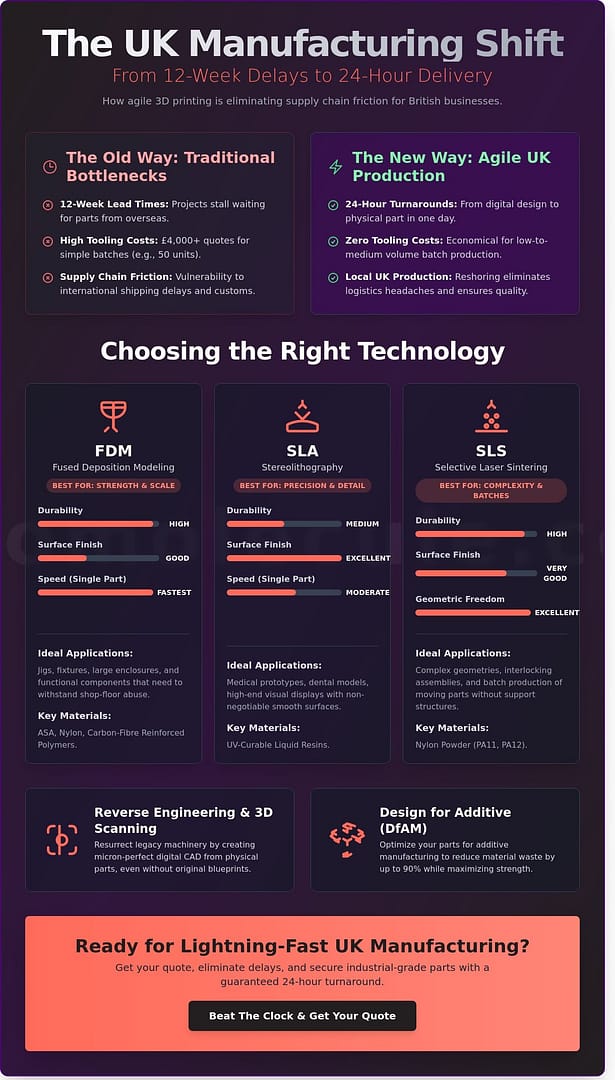
Choosing the Right Technology: FDM, SLA, and SLS Compared
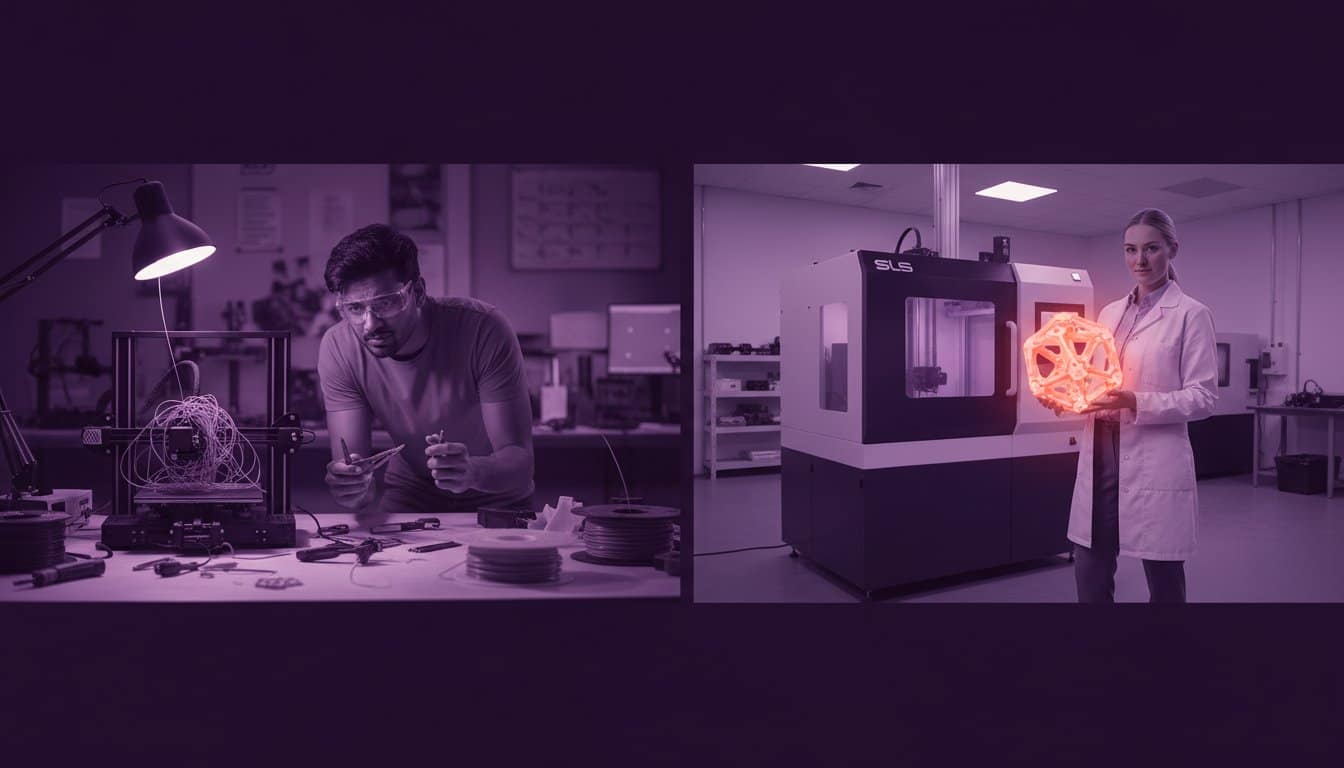
Selecting the correct platform for uk 3d printing projects isn’t about finding the most expensive machine. It’s about matching mechanical requirements to the specific strengths of FDM, SLA, or SLS. Your choice dictates the part’s durability, surface finish, and lead time. Don’t let the wrong tech choice stall your production cycle. Every project has a unique stress profile; we ensure the technology you choose can handle it.
FDM: Strength and Scale
Fused Deposition Modelling (FDM) remains the industrial workhorse for durable, functional components. It’s the go-to for jigs, fixtures, and large-format enclosures that must withstand shop-floor abuse. By using industrial filaments like ASA and Nylon, you achieve heat resistance up to 90°C and superior UV stability. Recent UK research in additive manufacturing highlights how large-format FDM reduces assembly time by printing oversized components as single, cohesive units. This eliminates weak points at joins and slashes labour costs. If you need a robust part delivered via our 24-hour turnaround, FDM is your fastest route to success. It’s reliable, scalable, and handles everything from standard PLA to high-performance polymers with ease.
SLA and SLS: Precision and Complexity
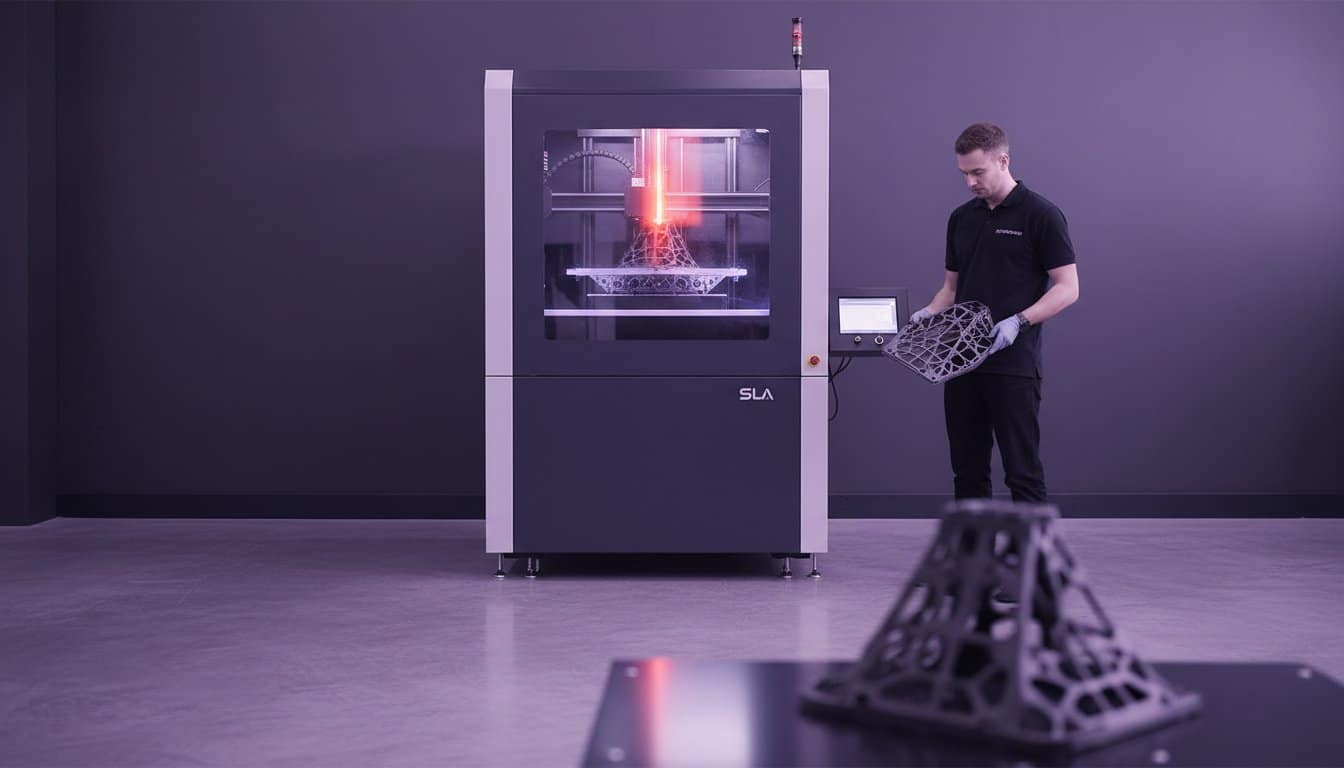
When your project demands ultra-high resolution, Stereolithography (SLA) is the answer. It uses a UV laser to cure liquid resin, producing parts with layer heights as fine as 25 microns. This precision is vital for dental models, medical prototypes, and high-end visual displays where a smooth surface finish is non-negotiable. This level of detail often bridges the gap between engineering and fine art; to see how originality is celebrated in other high-quality formats, visit Aleph Contemporary. However, SLA requires support structures that must be manually removed, which adds a layer of post-processing time.
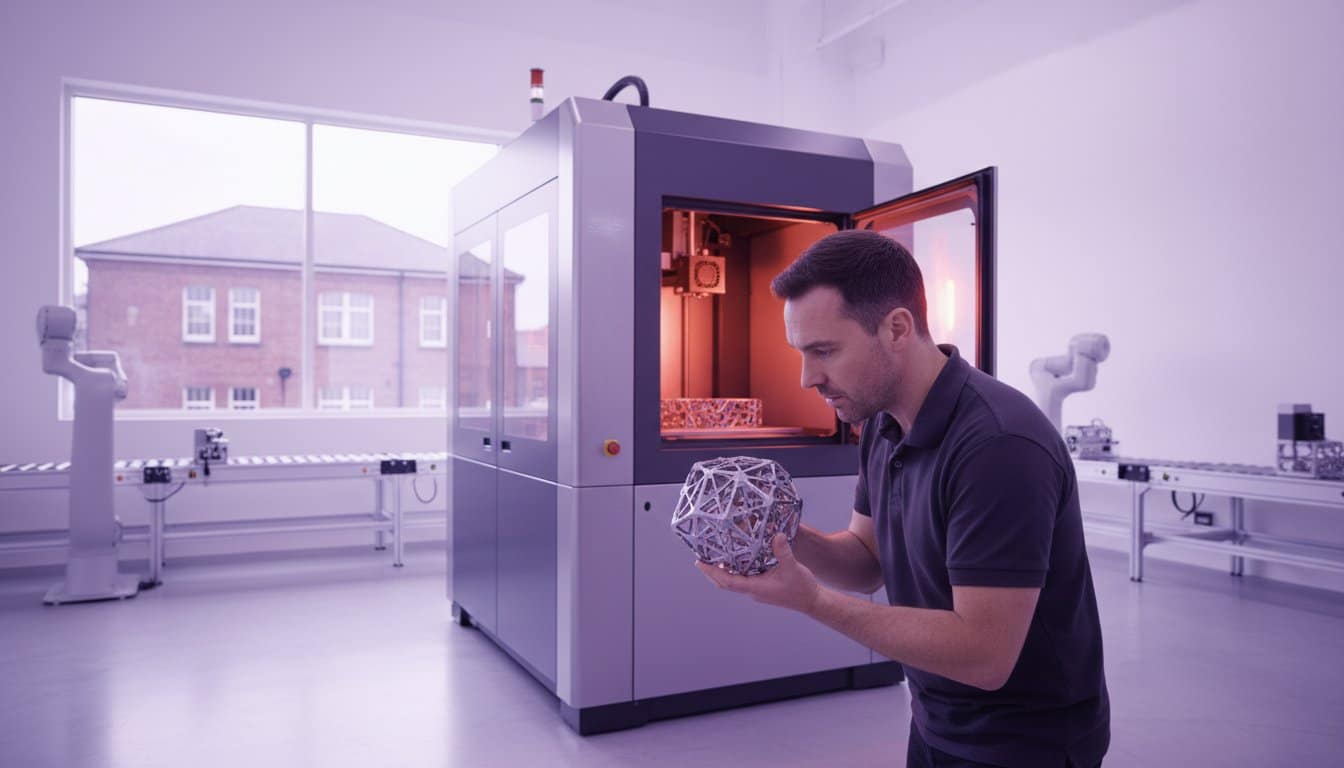
Selective Laser Sintering (SLS) offers a different advantage. It uses a high-powered laser to fuse nylon powder. Because the unsintered powder supports the part during the build, you can design complex geometries and interlocking assemblies without any support structures. This makes SLS the gold standard for batch production of moving parts and intricate internal channels. While SLS parts have a slightly grainy texture compared to SLA, their mechanical integrity is superior for functional testing. You can get an instant quote to see which process fits your timeline and budget. We focus on delivering results that beat the clock without compromising on engineering standards.
Post-processing requirements vary significantly between these three technologies. FDM parts might need simple support removal; SLA requires chemical washing and UV curing; SLS needs bead blasting to remove excess powder. We handle these technical hurdles in-house at our Nottingham and Mansfield facilities, ensuring your components arrive ready for immediate use. Zero compromise on quality is our baseline.
Beyond Printing: The Power of Reverse Engineering and 3D Scanning
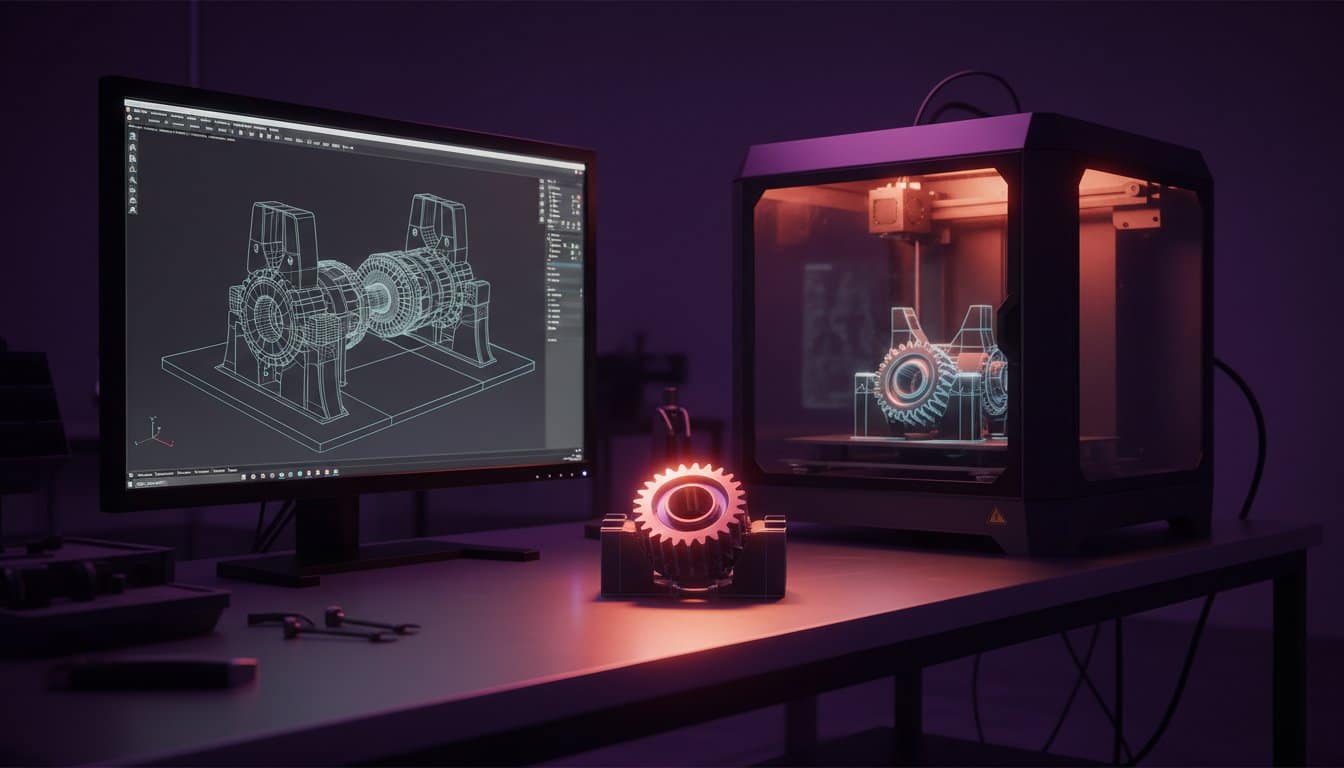
Manufacturing stops when a legacy component fails and the CAD file is nowhere to be found. This “missing CAD file” crisis is a frequent bottleneck for UK businesses maintaining vintage vehicle fleets or decades-old industrial machinery. Without digital blueprints, traditional replacement methods involve weeks of lead time and exorbitant costs. We eliminate this friction by integrating high-resolution 3D scanning with advanced uk 3d printing workflows to resurrect obsolete parts in days, not months.
Industrial 3D scanning captures micron-perfect data from physical objects, creating a high-density point cloud. This process identifies every wear pattern and geometric nuance. Whether it’s a cracked 80s JDM wheel centre cap or a structural passenger train seat arm, we translate physical geometry into a manufacturable digital asset. This isn’t just about copying; it’s about engineering a solution that often outperforms the original part.
High-Resolution 3D Scanning Services
Precision begins with the right hardware. While hobbyist handheld scanners struggle with reflective surfaces or complex internal pockets, our industrial-grade metrology tools deliver accuracy within 0.02mm. We prepare parts using non-permanent sublimating sprays to ensure maximum data density on dark or polished surfaces. This level of detail is essential for digital archiving. By digitising your physical inventory, you protect your intellectual property against future hardware failures. We turn your warehouse of “dead” stock into a lean, digital library ready for instant production.
The Workflow from Physical Part to Batch Production
We’ve streamlined the transition from a broken physical component to a finished batch. Our process is designed for speed and reliability, ensuring you beat the clock on every project.
- Step 1: Non-destructive scanning. We capture the original component’s geometry without causing further damage, even if the part is currently in multiple pieces.
- Step 2: CAD clean-up and optimisation. Our engineers transform raw scan data into a clean STEP file. We can correct original design flaws or reinforce high-stress areas at this stage.
- Step 3: Rapid prototyping for fitment testing. We produce a functional prototype within 24 hours to verify tolerances and mechanical fitment.
- Step 4: Final batch production. Once validated, we move to full-scale production using the optimal uk 3d printing technology for your application, such as SLS for durability or MJF for high-detail industrial parts.
Our commitment to zero compromise on quality means every reverse-engineered part meets modern industrial standards. From our hubs in Nottingham and Mansfield, we provide a national service that keeps British industry moving. Don’t let a missing drawing hold your production line hostage. Turn your physical challenges into digital certainties today.
Design for Additive Manufacturing (DfAM): Optimising for Success
Traditional manufacturing relies on subtraction or moulding. You can’t apply CNC logic to uk 3d printing without wasting resources. Success requires an additive mindset. You’re building layer by layer, which introduces unique variables like anisotropy. If you orient a part incorrectly, it will fail under stress because the Z-axis bonds are typically 20% to 30% weaker than the X and Y axes. Professional engineers must align the part so that critical loads don’t pull these layers apart.
Managing wall thickness and infill density is your primary lever for balancing performance and budget. Most industrial parts don’t need 100% infill. A 20% gyroid infill combined with four perimeter walls often provides 80% of the strength of a solid part at 40% of the cost. You must also design for the 45-degree rule. By using chamfers and self-supporting angles, you eliminate the need for support structures. This reduces material waste and slashes post-processing time, ensuring you beat the clock on tight deadlines.
Common Pitfalls in 3D Design
Precision is often lost in the “hole” problem. 3D printed holes frequently shrink by 0.1mm to 0.3mm as the thermoplastic cools and contracts. Don’t expect a perfect fit straight off the bed; design holes slightly undersized and use a drill for final tolerances to ensure zero compromise on quality. Large-format parts face significant thermal contraction. In a 500mm part, a 1% shrinkage rate results in a 5mm deviation. Use fillets at sharp corners to distribute stress and prevent the corners from warping or lifting off the build plate.
Cost-Saving Design Tips
Efficiency drives profitability. Stop printing solid blocks. Hollow out your geometries and add internal lattice structures to maintain rigidity while cutting material volume by up to 60%.
- Batch production: Fill the entire build plate. Machine setup time is a fixed cost; printing 50 units at once is significantly cheaper per unit than multiple single runs.
- Standardise inserts: Use heat-set threaded inserts rather than printing plastic threads. They are more durable and allow for repeated assembly without stripping.
- Consolidate assemblies: Turn a five-part bracket into a single complex geometry. You’ll eliminate fasteners and assembly labour in one move.
Don’t let poor design slow your production cycle. Get a quote
Protomolecule: Your Partner for Lightning-Fast UK Manufacturing
Speed defines the competitive edge in 2026. Protomolecule organises its Nottingham and Mansfield studio to eliminate the traditional bottlenecks of the supply chain. We deliver 24-hour turnarounds on critical projects because we understand that a single day of downtime can cost a firm thousands in lost productivity. Our workflow is designed for urgency; we move from file upload to machine calibration in under 60 minutes.
Our “Zero Compromise” quality promise ensures that speed never degrades precision. We combine industrial-grade hardware with expert human oversight. Every component undergoes a rigorous multi-point inspection by our engineering team before it leaves the facility. Just as professional verification is critical in legal or personal matters—such as the services provided by Morgan Polygraph—this hybrid approach allows us to maintain the tight tolerances required for aerospace and medical applications while meeting the “lightning-fast” demands of modern uk 3d printing.
We support your business through every stage of growth. We don’t just print one-off prototypes; we manage full-scale batch production. Our facility is equipped to scale from a single functional test part to 1,000 end-use components without skipping a beat. This flexibility allows UK firms to adopt a “just-in-time” manufacturing model, reducing warehouse costs and eliminating the risk of obsolete stock.
The Protomolecule Advantage
We house FDM, SLA, and SLS technologies under one roof, providing the right tool for every specific engineering challenge. Our in-house 3D design and scanning experts bridge the gap from a physical idea to a digital object, often reverse-engineering complex parts in a single afternoon. We specialise in solving difficult problems, such as creating high-performance components for 80s JDM wheel centre caps or durable passenger train seat arms. Our focus remains on delivering technical excellence at a pace that keeps your project on track.
Next Steps: Turn Your Ideas into Reality
Starting your project is simple and direct. To ensure the best results, prepare your STL or STEP files with a high mesh density to preserve intricate details. If you’re unsure about the best approach, you can consult with our engineers on material selection. We offer expert advice on everything from the chemical resistance of polypropylene to the UV stability of ASA. We also provide comprehensive post-processing options, including media blasting and chemical vapour smoothing, to give your parts a professional, injection-moulded finish.
Don’t let manufacturing delays hold your business back. Beat the clock and get your 3D printing quote now to experience the future of uk 3d printing with a partner that values your deadlines as much as you do.
Accelerate Your Engineering Cycle Today
The manufacturing landscape is shifting toward extreme agility. By 2026, successful firms won’t just use additive technology; they’ll master the integration of DfAM and high-precision reverse engineering to slash development cycles. Selecting the right process, whether SLS for industrial strength or SLA for intricate detail, remains the cornerstone of high-performance engineering. Protomolecule stands as your dedicated partner in this evolution, offering specialist expertise across the military, space, and industrial sectors. We operate a full-service studio that handles everything from 3D scanning to final batch production with zero compromise on quality.
Don’t let legacy lead times stall your innovation. We provide a 24-hour rapid prototyping turnaround to ensure your projects stay on track and ahead of the competition. Our team understands the pressures of the modern market and delivers the technical precision required for the most demanding uk 3d printing applications. We’re ready to solve your most complex engineering problems with lightning-fast results and absolute reliability.
Get an Instant 3D Printing Quote and Beat the Clock
Let’s build the future of British manufacturing together.
Frequently Asked Questions
How much does 3D printing cost in the UK?
Professional uk 3d printing costs start from approximately £15 for basic FDM prototypes, though final pricing depends on material volume and geometry. Industrial SLS or metal components can range from £100 to over £1,000 for complex aerospace or medical parts. We provide instant quotes based on your CAD data to ensure you get accurate pricing without any hidden fees.
What is the fastest 3D printing service turnaround available?
The fastest turnaround currently available is 24-hour dispatch for urgent engineering projects. While many providers take 3 to 5 days, our agile manufacturing hub in Nottingham prioritises speed to help you beat the clock. We offer same-day collection or next-day delivery on most functional prototypes to ensure your development cycle never slows down.
Can 3D printed parts be used for functional engineering applications?
Functional 3D printed parts are now standard in high-performance industries, including automotive and rail sectors. We’ve successfully produced everything from 80s JDM wheel centre caps to passenger train seat arms using reinforced polymers. These materials offer the mechanical strength and heat resistance required to replace traditional machined components in 92% of industrial applications.
What file formats do I need for professional 3D printing?
You should provide STL or STEP files for the most reliable results. STL is the industry standard for mesh geometry, while STEP files offer the mathematical precision necessary for high-end engineering tasks. We also accept 3MF and OBJ formats. Always ensure your export resolution is high to avoid visible faceting on curved surfaces during the uk 3d printing process.
Is 3D printing cheaper than injection moulding for small batches?
3D printing is more cost-effective than injection moulding for production runs under 500 units. Traditional moulding requires aluminium or steel tooling that typically costs between £2,000 and £15,000 before production starts. By choosing 3D printing, you eliminate these massive upfront investments and only pay for the parts you actually need.
Can you 3D print a part from a physical sample without a digital file?
We can recreate any physical object using high-precision 3D laser scanning and reverse engineering. Our scanners capture surface data with 0.02mm accuracy to create a perfect digital twin of your sample. This is the ideal solution for replacing obsolete machinery parts or modifying existing components when original CAD drawings are no longer available.
What is the maximum size you can 3D print in the UK?
Industrial printers in the UK can produce single-piece components up to 1000mm x 1000mm x 1000mm. For projects that exceed these dimensions, we use modular construction and high-strength chemical bonding. This technique allows us to build full-scale automotive panels and large architectural models with zero compromise on structural integrity or precision.
How do I choose between PLA, ABS, and PETG for my project?
Your choice depends entirely on the part’s environment. PLA is best for rapid visual prototypes due to its 0.05mm detail accuracy. ABS is the professional choice for heat-resistant automotive interiors, while PETG offers the chemical resistance needed for functional outdoor components. Don’t let the wrong material choice ruin your project; use ABS for toughness and PLA for aesthetics.