You already know that traditional CNC machining and injection moulding carry frustrating lead times and tooling costs that make low-volume, high-performance production feel out of reach. That friction is real, and it slows down development cycles that can’t afford to wait.
This article cuts straight to what actually drives mechanical strength in additive manufacturing: the three-way synergy of industrial-grade composite materials, load-aware CAD design, and large-format FDM technology. Whether you’re developing functional prototypes, lightweight aerospace components, or batch-production parts that need to perform in demanding environments, you’ll leave with a clear framework for specifying and sourcing 3D printed components that genuinely rival traditional manufacturing in strength and durability.
Key Takeaways
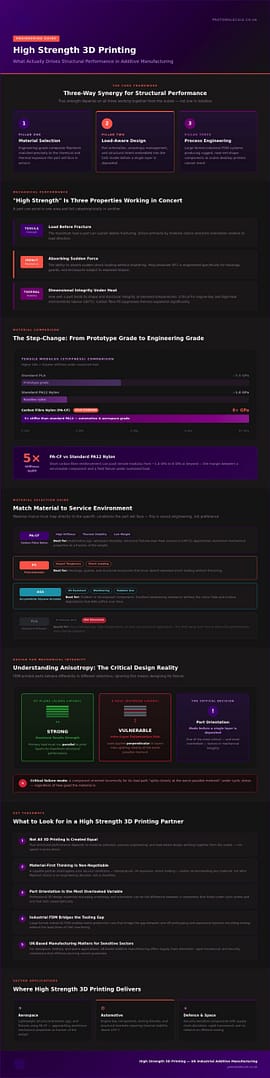
- Not all 3D printing is created equal — true structural performance depends on material selection, process engineering, and load-aware design working together from the outset.
- Sourcing a high strength 3D printing service UK engineers rely on means looking beyond speed and cost to find a partner who understands anisotropy, thermal stability, and tensile performance at a material level.
- Part orientation during printing is one of the most critical — and most overlooked — factors in mechanical integrity; professional 3D design expertise can be the difference between a component that holds and one that fails.
- Industrial FDM technology enables large-format, batch-production runs that bridge the gap between one-off prototyping and expensive injection moulding tooling.
- UK-based additive manufacturing offers distinct advantages for security-sensitive sectors, including aerospace, military, and space, where supply chain discretion and rapid turnaround are non-negotiable.
Engineering-Grade Materials for High Strength 3D Printing in the UK
“High strength” in additive manufacturing isn’t a single metric. It’s the intersection of three mechanical properties working in concert: tensile strength (the load a part can bear before fracturing), impact resistance (its ability to absorb sudden force without shattering), and thermal stability (how well it holds dimensional accuracy and structural integrity under elevated temperatures). A part can excel in one area and fail catastrophically in another, which is precisely why material selection isn’t a checkbox; it’s an engineering decision.
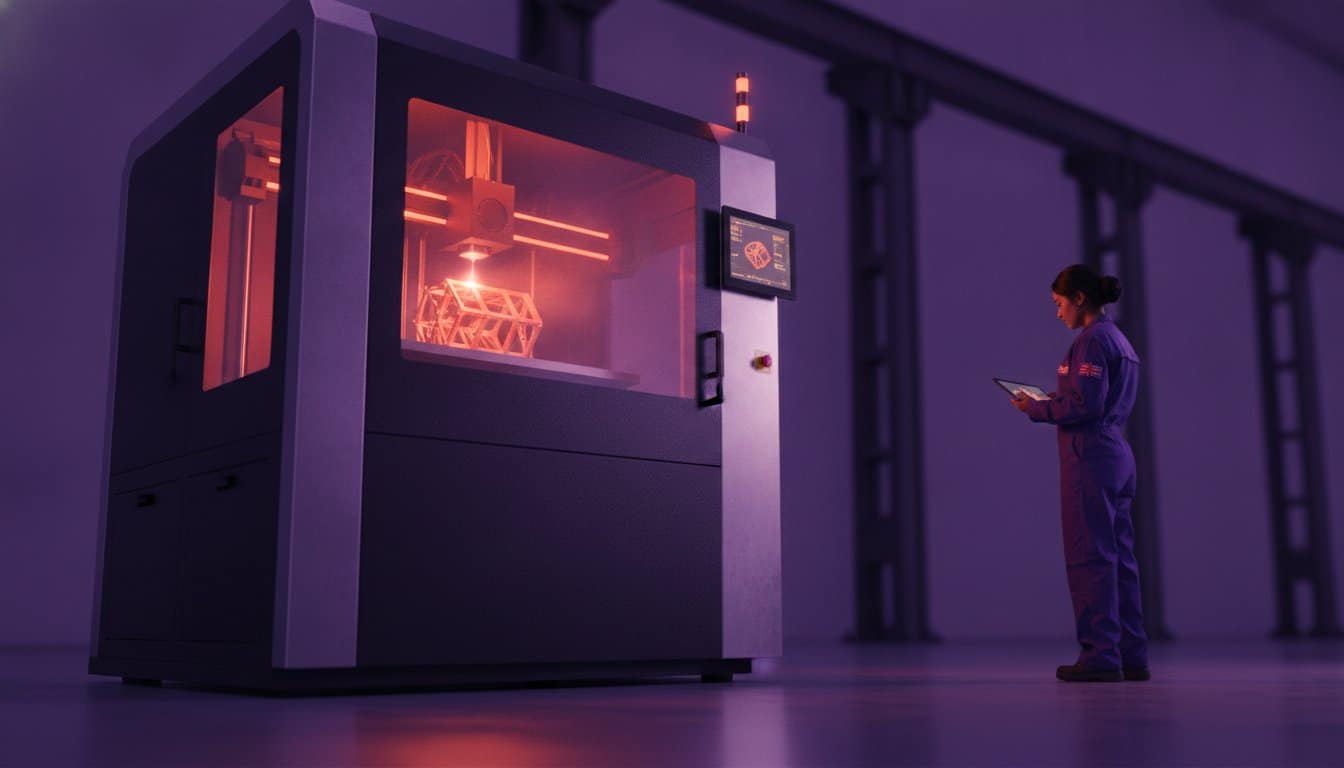
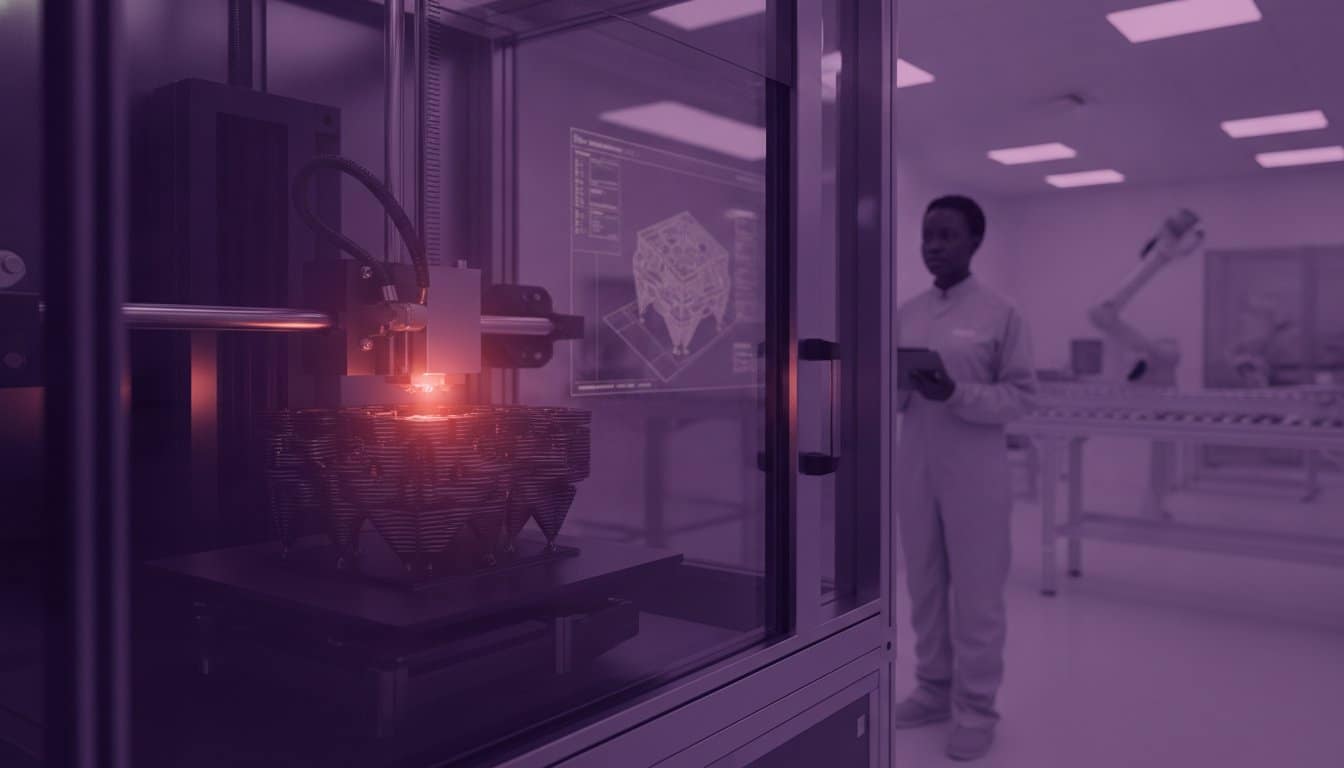
Industrial FDM has fundamentally changed what’s achievable here. Large-format FDM systems produce rugged, near-net-shape components at a scale that desktop printers simply cannot reach, making them the practical choice for structural brackets, tooling fixtures, and functional end-use parts. The shift from prototype-grade PLA to genuine engineering-grade polymers is where the performance step-change happens. Carbon Fibre-filled Nylon (PA-CF) has become the gold standard for UK automotive and aerospace jigs precisely because it combines the processability of thermoplastic printing with mechanical properties that approach those of aluminium at a fraction of the weight and lead time. When specifying a high strength 3D printing service UK engineers can rely on, this material-first thinking is non-negotiable.
The Power of Composite Filaments
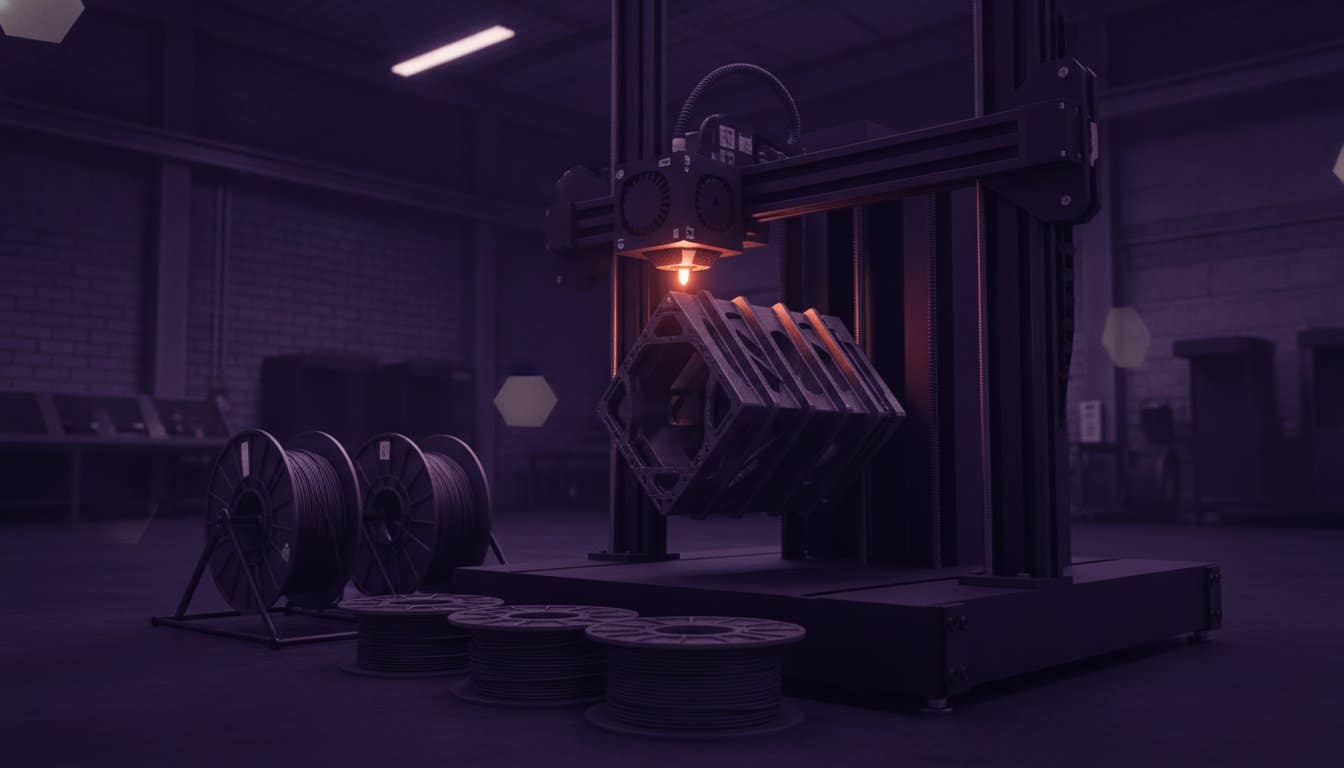
Carbon fibre and glass fibre reinforcements do two critical things: they dramatically increase stiffness (measured as tensile modulus) and they suppress thermal expansion, which matters enormously for parts operating in fluctuating temperature environments. Standard Nylon (PA12) typically delivers a tensile modulus in the region of 1.6 GPa. Short carbon fibre-reinforced variants push that figure to 8 GPa or beyond, depending on fibre loading and print parameters. For load-bearing brackets that would otherwise creep or deflect under sustained stress, that difference is the margin between a serviceable component and a field failure. Processes like selective laser sintering also exploit nylon-based materials for isotropic strength, but continuous and chopped fibre reinforcement in industrial FDM delivers stiffness gains that powder-bed processes currently can’t match.
High-Performance Polymers for Harsh Environments
Not every application demands maximum tensile strength. Some demand resilience. ASA (Acrylonitrile Styrene Acrylate) is the correct choice for outdoor or UV-exposed components, offering excellent weathering resistance without the colour fade and surface degradation that ABS suffers over time. Polycarbonate (PC) takes a different approach, prioritising extreme impact toughness for housings, guards, and structural enclosures that must absorb shock loading repeatedly without fracturing.
The critical principle is this: material choice must map directly to the specific chemical and thermal exposure the part will face in service. A component running near an engine bay needs thermal stability above 100°C. A bracket mounted externally on ground support equipment needs UV resistance. Selecting PA-CF for the first application and ASA for the second isn’t a preference; it’s sound engineering. A capable high strength 3D printing service UK partner will interrogate these conditions before recommending any material, not after.
This focus on material performance and structural integrity is a standard shared by other sectors; for example, you can learn more about Composites Construction UK to see how specialist engineering contractors use similar advanced materials for structural strengthening and concrete repair.
Overcoming Structural Weakness: Designing for Mechanical Integrity
Anisotropy is the engineering reality that separates informed additive manufacturing from expensive guesswork. Unlike machined metal, which behaves consistently in all directions, FDM-printed parts are inherently directional: they’re strongest along the XY plane and most vulnerable to inter-layer delamination along the Z axis. Ignore this, and you’re designing for failure. Address it deliberately, and you unlock structural performance that genuinely rivals traditional manufacturing.
The solution begins at the orientation stage. A part that will experience primary tensile loads in service must be oriented so those loads run parallel to the print layers, not perpendicular to them. This single decision, made before a single layer is deposited, can be the difference between a component that holds under cyclic stress and one that splits cleanly at the worst possible moment. Professional 3D design expertise exists precisely to make these calls correctly, informed by load-path analysis rather than printing convenience. Organisations researching additive manufacturing standards and research through bodies like NIST confirm that build orientation remains one of the most significant variables affecting mechanical output in FDM processes.
Infill strategy is equally nuanced. Counter-intuitively, 100% infill doesn’t always produce the strongest part. Gyroid and honeycomb infill patterns distribute stress more evenly across three-dimensional load paths, whilst a targeted approach of high infill density in load-bearing zones combined with reduced density elsewhere can improve the strength-to-weight ratio without adding unnecessary material or print time. Specifying a high strength 3D printing service UK engineers trust means working with partners who understand these trade-offs, not simply running default slicer settings.
Iterative validation matters too. Rapid prototyping allows engineering teams to stress-test successive design revisions under real loading conditions before committing to batch production, compressing the feedback loop that would otherwise take weeks through traditional tooling routes.
Optimising Geometry for Load-Bearing Parts
Sharp internal corners are stress concentrators. Under cyclic loading, they initiate crack propagation long before the bulk material reaches its theoretical limit. Fillets and chamfers redistribute those stress peaks across a broader surface area, dramatically extending fatigue life. Beyond geometry, designing integrated snap-fit features, press-fit bores, and interlocking profiles eliminates reliance on mechanical fasteners entirely. Fastener holes introduce localised stress concentrations and create potential delamination points; removing them from the design removes the failure mode.
The Role of Reverse Engineering in Strength
Legacy metal components often carry decades of over-engineering: wall thicknesses sized for casting constraints, geometries dictated by machining tool paths, and features that simply don’t translate efficiently into additive manufacturing. Reverse engineering changes that equation. High-resolution scanning digitises the original part with dimensional fidelity, then the resulting model is redesigned with additive-native geometry: organic load-path optimisation, reduced mass, and features that exploit what FDM does well rather than mimicking what CNC did. The result isn’t just a printed copy of a metal part; it’s a structurally superior replacement built for the process producing it. If you’re replacing ageing tooling or obsolete components, 3D scanning combined with design-for-additive expertise is the fastest route from legacy part to production-ready geometry.
Industrial Batch Production and Rapid Turnaround in the UK
Injection moulding demands tooling investment that only makes economic sense at high volumes. One-off prototyping delivers a single data point. Batch production via industrial FDM sits precisely in the gap between those two extremes, making it the practical choice for low-to-medium volumes of high-strength components where neither route is financially justifiable. For engineering teams running development programmes or fulfilling operational requirements in the tens to low hundreds of units, additive batch production removes the tooling barrier entirely whilst maintaining the material performance that critical applications demand.
Speed is where UK-based manufacturing earns its premium. When a programme requires parts from CAD to the field in days rather than the weeks that overseas supply chains routinely consume, geography matters. For sectors operating under non-disclosure requirements, including defence, military, and space, working with a national 3D printing service eliminates the supply chain exposure that international subcontracting inevitably creates. Sensitive geometries and programme-specific components stay within jurisdiction. That’s not a minor operational detail; it’s a procurement requirement for many of these programmes.
Quality Assurance for Critical Components
Batch consistency demands more than repeatable print parameters. Post-processing techniques including vapour smoothing, annealing, and controlled cooling cycles consolidate inter-layer bonds and reduce residual stress, directly improving structural performance across every unit in a run. Dimensional verification against the original CAD specification confirms that each component meets tolerance before it leaves the facility. For a high strength 3D printing service UK engineers can trust with flight-adjacent or load-critical parts, this verification step isn’t optional.
Streamlining Your UK Supply Chain
Reducing dependence on overseas logistics isn’t just a cost decision; it’s a resilience strategy. A project typically moves from initial 3D scan or supplied CAD file through design validation and material specification, into batch production with verified output. That sequence, managed domestically, compresses timelines significantly and keeps programme control where it belongs. If you’re ready to specify a high strength 3D printing service UK partner for your next production run, request a quote and move from brief to batch without delay.
Specify With Confidence: Your Next High-Strength Part Starts Here
Structural performance in additive manufacturing isn’t accidental. It’s the product of engineering-grade composite materials chosen for specific load conditions, design geometry that accounts for anisotropy from the outset, and industrial batch production processes that maintain consistency across every unit in a run. Get those three elements working together, and additive manufacturing doesn’t just approximate traditional manufacturing; it competes with it directly.
For programmes operating in military, space, or other security-sensitive sectors, a UK-based partner with specialist expertise and comprehensive in-house capabilities, spanning advanced FDM, SLA, and SLS technology alongside design and scanning, removes the supply chain risk that overseas subcontracting introduces. That’s a meaningful operational advantage, not a marginal one.
If your parts need to perform under real load, in real environments, don’t settle for a service that treats material selection as an afterthought. Work with the high strength 3D printing service UK engineers trust and move from brief to batch-production components without compromising on the mechanical integrity your application demands.
Frequently Asked Questions
How strong is 3D printing compared to traditional CNC machining?
The honest answer is: it depends on the material and process. CNC-machined aluminium or steel will outperform most 3D printed polymers in raw tensile strength, but that comparison misses the point for many applications. Carbon fibre-reinforced nylon printed on industrial FDM equipment delivers a tensile modulus exceeding 8 GPa at a fraction of the weight, making it genuinely competitive for structural brackets, jigs, and load-bearing fixtures where mass matters.
Where additive manufacturing closes the gap further is in geometric complexity. CNC toolpaths impose design constraints that additive processes don’t share, meaning a well-designed printed component can achieve superior strength-to-weight performance precisely because it’s not constrained by what a cutting tool can reach.
What is the strongest 3D printing material available for UK industrial use?
For most structural applications, carbon fibre-filled nylon (PA-CF) is the strongest practical choice available through a high strength 3D printing service UK engineers currently specify. It combines high stiffness, low thermal expansion, and excellent fatigue resistance in a material that industrial FDM systems can process reliably. For impact-critical applications, polycarbonate offers superior toughness where PA-CF might fracture under sudden shock loading.
There’s no single “strongest” material because strength requirements differ: a bracket resisting sustained tensile load needs different properties than a housing absorbing repeated impacts. The correct answer starts with understanding your specific load case, operating temperature, and chemical exposure before any material is selected.
Can 3D printed parts be used for functional, end-use components?
Yes, provided the right materials, process parameters, and post-processing steps are applied from the outset. Industrial FDM using engineering-grade polymers routinely produces end-use components for automotive tooling, aerospace ground support equipment, and defence applications. The distinction between a prototype and a production component isn’t the technology; it’s the process discipline behind it.
Post-processing techniques such as annealing and controlled cooling directly improve inter-layer bond strength and reduce residual stress, lifting a printed part’s mechanical performance closer to its theoretical material limits. Dimensional verification against CAD confirms each component meets tolerance before it enters service.
How does part orientation affect the strength of a 3D print?
Part orientation is one of the most consequential decisions in the entire production process. FDM parts are strongest in the XY plane and most vulnerable to delamination along the Z axis, where inter-layer bonds are inherently weaker than the surrounding polymer. A component oriented incorrectly relative to its primary load direction can fail at a fraction of the stress it would otherwise tolerate.
Getting this right requires load-path analysis before printing begins, not after. Professional 3D design expertise maps anticipated forces to build orientation so that tensile loads run parallel to print layers rather than perpendicular to them. It’s a decision made in software that determines whether a physical component holds or splits under service conditions.
What industries benefit most from high-strength 3D printing in the UK?
Aerospace, defence, automotive, and space sectors see the most significant operational benefits. These industries share common requirements: tight tolerances, demanding mechanical performance, low-to-medium production volumes, and, in many cases, supply chain security requirements that make domestic UK manufacturing a procurement necessity rather than a preference. Additive batch production removes the tooling investment that makes low-volume runs prohibitively expensive through conventional routes.
Beyond those sectors, motorsport, industrial automation, and medical device development all benefit from the combination of rapid turnaround and genuine structural performance that industrial FDM delivers. Any application requiring complex geometry, lightweight load-bearing components, or fast iteration between design revisions is a strong candidate.
How quickly can I receive high-strength 3D printed parts?
Turnaround depends on part complexity, material selection, and batch size, but UK-based production removes the weeks that overseas supply chains routinely add. Working with a domestic service means your CAD file moves directly into production without international logistics delays, customs exposure, or the programme security risks that offshore subcontracting introduces for sensitive applications.
The fastest route from brief to batch-production components is to supply a verified CAD file alongside a clear specification of load conditions and material requirements. That combination allows a capable service to move immediately into process planning rather than spending time on back-and-forth clarification. If you’re ready to proceed, requesting a quote is the most direct next step.