Your choice of manufacturing partner shouldn’t be a gamble on a website’s promises. If you treat your additive manufacturing provider like a simple vending machine, you’re likely risking your project’s critical path. You’ve probably felt the frustration of a prototype arriving days late or a batch of parts with tolerances so wide they require a costly redesign. In the high-stakes world of British manufacturing, these delays are expensive bottlenecks that stall innovation. Selecting a reliable industrial 3d printing service uk requires a shift from transactional buying to a strategic engineering partnership.
We understand that precision and speed are non-negotiable. This guide helps you master the technical and commercial criteria for vetting a partner who can handle complex geometries and deliver functional parts. You’ll learn how to secure fast turnaround times for prototypes whilst ensuring your production is scalable from one-offs to full batches. We’ll preview the essential standards for industrial materials, including high-temp thermoplastics, and show you how to eliminate the friction between initial design and final delivery.
Key Takeaways
- Identify the optimal additive technology for your project, choosing FDM for functional engineering prototypes or SLA for high-resolution aesthetic models.
- Select engineering-grade polymers and industrial materials that meet the rigorous performance standards of the aerospace and automotive sectors.
- Ensure project deadlines are met by vetting an industrial 3d printing service uk for lead time transparency and integrated CAD optimisation support.
- Bridge the gap between initial prototyping and market launch by assessing a provider’s capacity for scalable, high-quality batch production.
- Minimise commercial risk by prioritising the speed and quality control of UK-based manufacturing over the hidden costs of overseas shipping.
Technical Capabilities: Evaluating Technology and Material Suitability
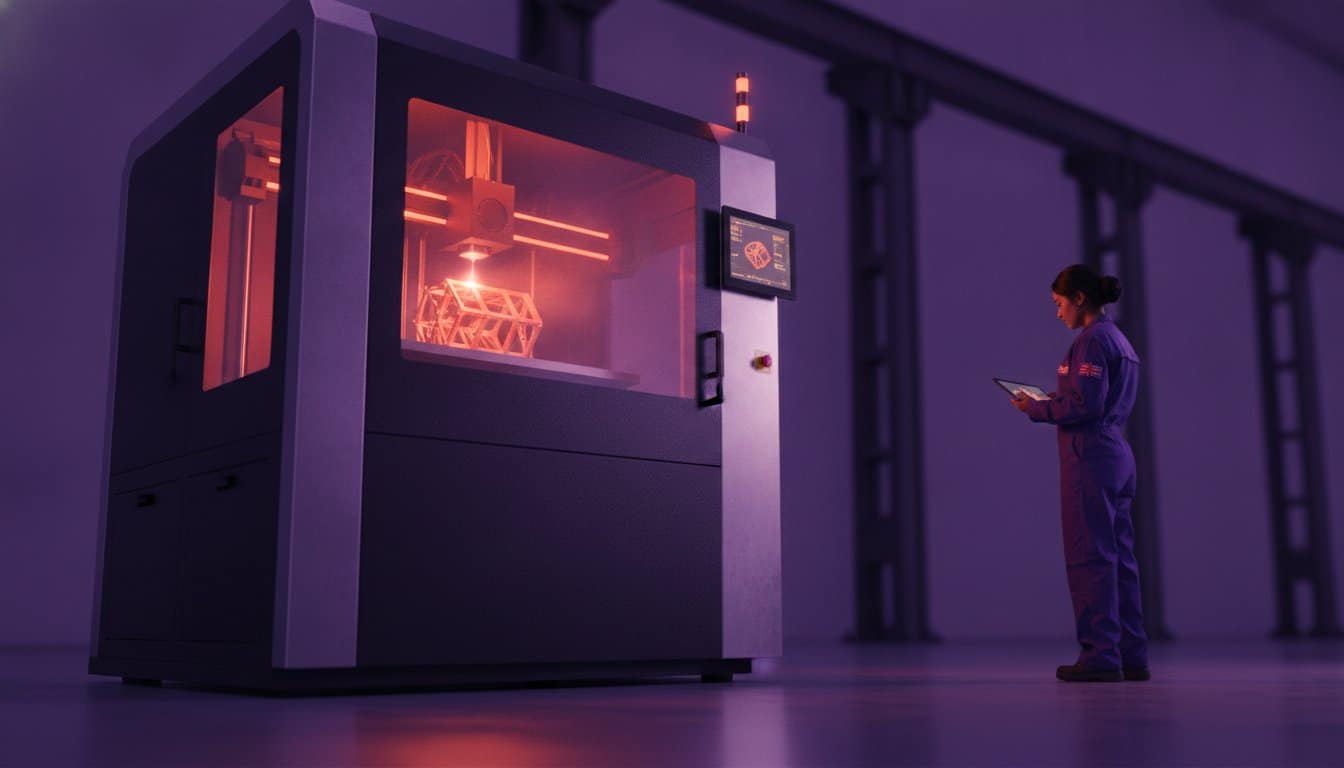
Selecting an industrial 3d printing service uk isn’t just about finding a machine; it’s about matching mechanical requirements to the right additive process. Professional manufacturing demands more than just a basic print. You need a partner capable of translating complex CAD data into functional, high-performance parts. This starts with a rigorous evaluation of the technologies on offer and the materials that will define your project’s success. Understanding the nuances of industrial applications of 3D printing allows you to bypass hobbyist limitations and focus on engineering-grade results.
FDM, SLA, or SLS: Which Technology Fits Your Project?
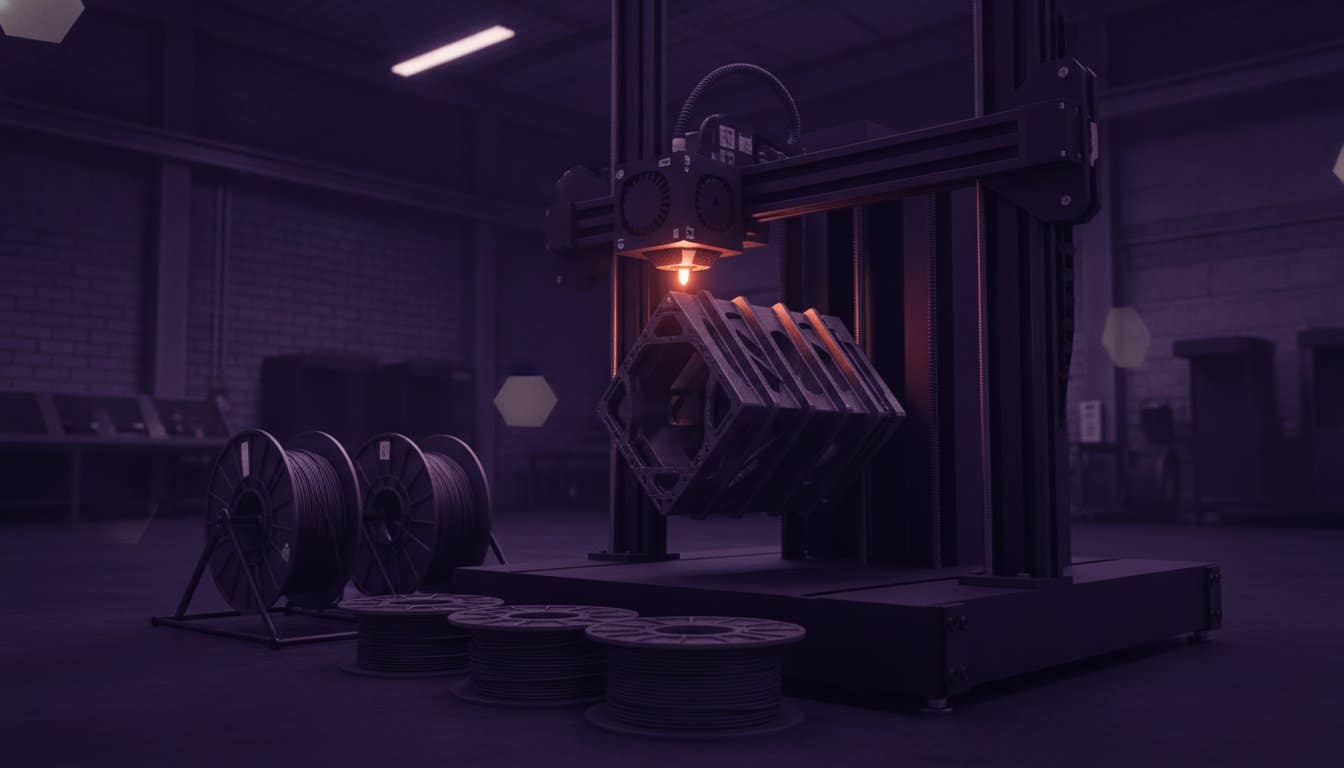
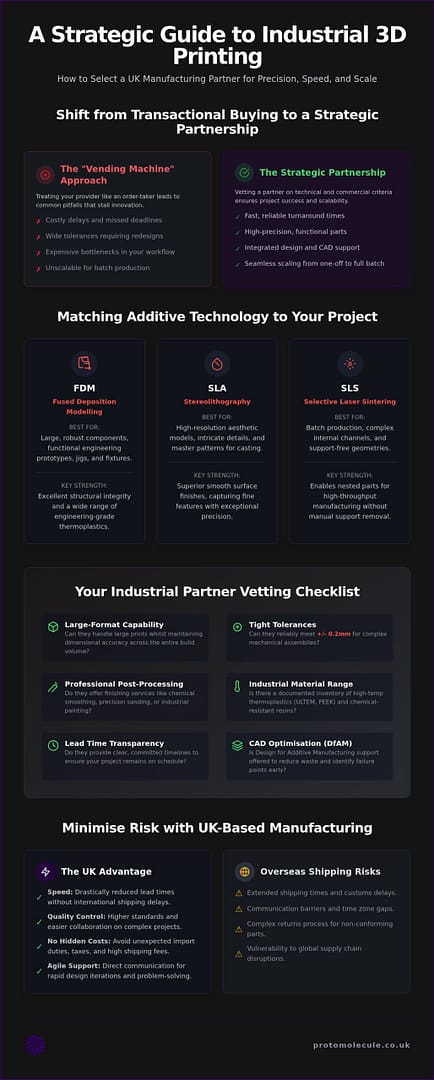
Choose FDM when you need large, robust components for functional testing. It’s the workhorse of rapid prototyping, offering excellent structural integrity for jigs and fixtures. For parts requiring intricate detail and smooth surface finishes, SLA is the superior choice for aesthetic models and master patterns. If your goal is batch production, SLS provides the benefit of support-free geometries, allowing for complex internal channels and nested parts that other methods can’t achieve without significant manual intervention.
Material Properties and Engineering Constraints
Move beyond standard PLA. Industrial projects often require engineering-grade polymers like Carbon Fibre Nylon, ULTEM, or PEEK to withstand high temperatures and chemical exposure. These materials are essential for aerospace and automotive components where mechanical failure isn’t an option. Before committing to an industrial 3d printing service uk, use this checklist to assess a provider’s technical ceiling:
- Large-Format Capability: Can they handle large-format FDM printing whilst maintaining dimensional accuracy?
- Tight Tolerances: Can the service reliably meet tolerances of +/- 0.2mm for complex mechanical assemblies?
- Post-Processing: Do they offer professional finishes like chemical smoothing, precision sanding, or industrial painting?
- Material Range: Is there a documented inventory of high-temp thermoplastics and chemical-resistant resins?
High-end parts rarely come off the build plate ready for the assembly line. Professional standards often dictate specific post-processing steps to ensure the final product meets both aesthetic and functional requirements. Incorporating custom cnc cutting services as part of your workflow ensures you don’t settle for raw prints when your project demands a finished engineering solution.
Reliability and Expertise: Why Speed and Support Define a Service
Reliability is the primary currency of manufacturing. When you select an industrial 3d printing service uk, transparency regarding lead times is paramount. A professional partner doesn’t hide behind vague estimates; they provide clear, committed timelines to ensure your project stays on schedule. This reliability is critical when project cycles are compressed and market windows are narrow. According to a UK additive manufacturing industry report, the sector’s growth is driven by its ability to provide agile solutions to traditional manufacturing bottlenecks. Demand a partner that offers Fast Turnaround 3D Printing to maintain your competitive edge.
The Value of Rapid Prototyping and Design Optimisation
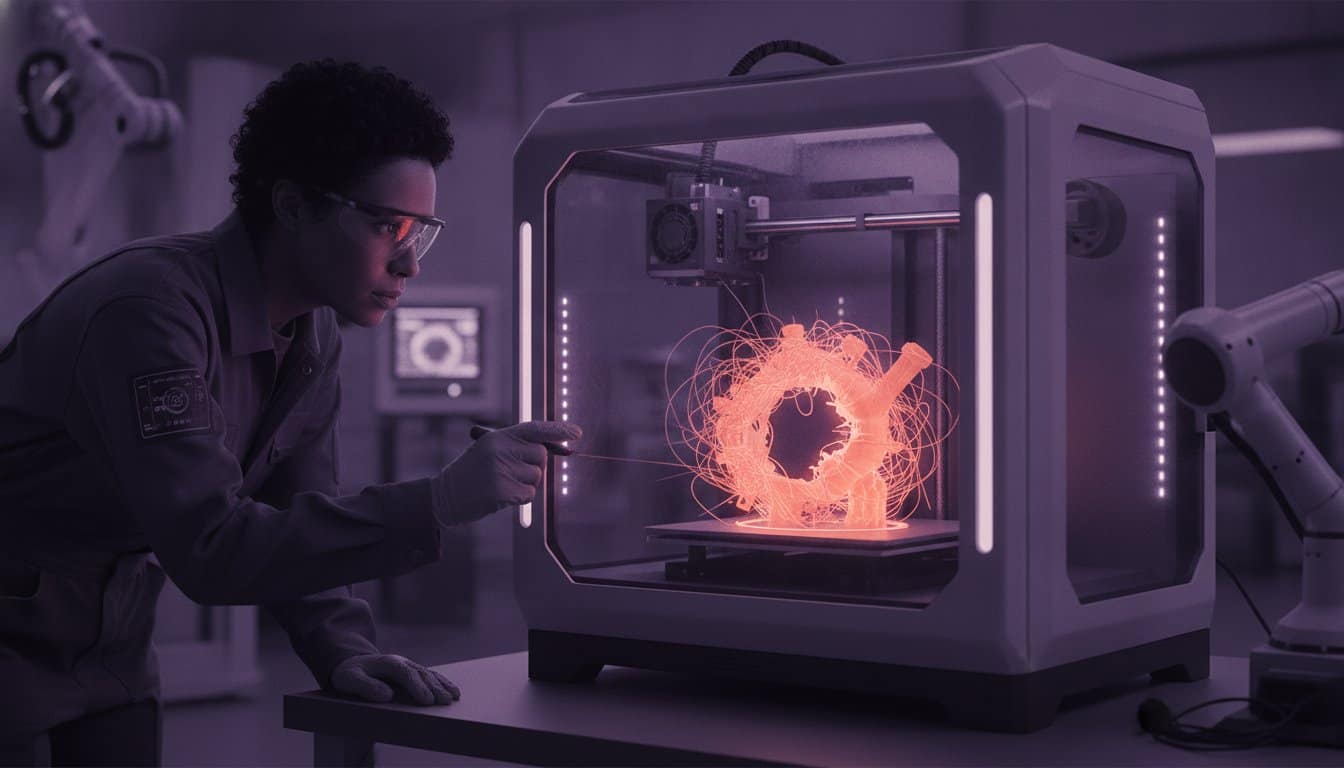
Expertise goes beyond simply operating machinery. Look for integrated 3D Design Services that refine your CAD files for the specific constraints of additive manufacturing. This process, known as Design for Additive Manufacturing (DfAM), reduces material waste and build time whilst lowering your total cost of ownership. Professional studios act as consultants rather than just order-takers. They identify potential failure points in your geometry before production begins, saving you from expensive redesigns. If you need to validate a concept quickly, our rapid prototyping expertise ensures your design is production-ready from day one.
Leveraging 3D Scanning for Precision Manufacturing
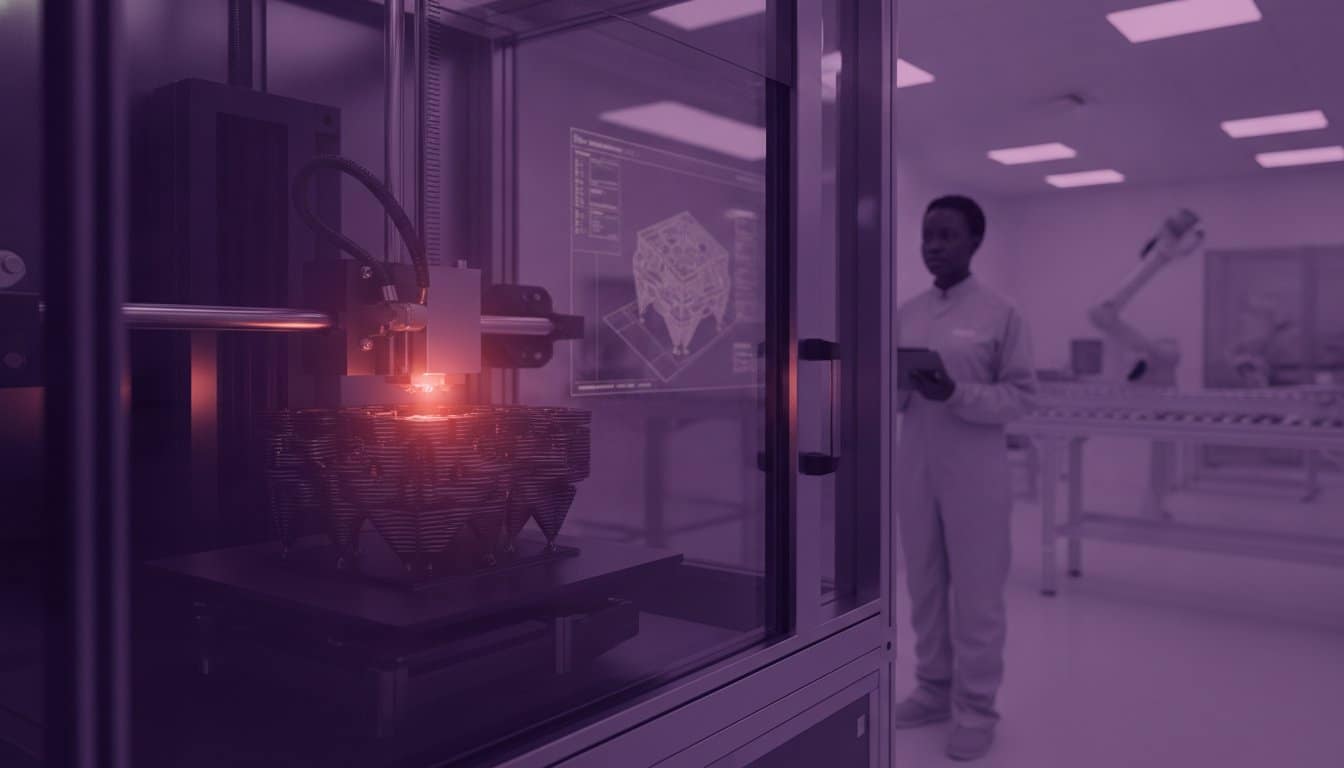
Precision manufacturing often requires working with existing physical assets or complex assemblies. High-resolution 3D Scanning Services allow for the digital capture of intricate surfaces, ensuring perfect fitment for new components. This technology effectively eliminates the inherent errors of manual measurement in engineering. When paired with Reverse Engineering, it enables the recreation of obsolete or worn parts from physical samples with absolute fidelity. This integrated approach ensures that every component is optimised for its intended environment, bridging the gap between physical reality and digital precision.
Scaling Production: From Single Prototypes to Batch Manufacturing
Scaling from a single proof-of-concept to a production run requires more than just additional machines. It demands a rigorous approach to consistency that only a specialist industrial 3d printing service uk can provide. Transitioning to Batch Production allows you to bridge the gap between initial prototyping and full-scale mass manufacturing without the prohibitive costs of traditional tooling. This agility is a cornerstone of the UK’s Defence Advanced Manufacturing Strategy, which highlights how additive technologies bolster sovereign manufacturing resilience. By keeping production local, you eliminate the logistical risks and lead-time volatility associated with overseas shipping.
Consistency and Quality Control in Small Batches
Total Project Value vs Lowest Unit Price
Don’t be tempted by “cheap” services that lack engineering oversight. A lower unit price often masks the hidden costs of failed parts, out-of-tolerance dimensions, and project delays. True value lies in the total cost of ownership. Factor in the time saved by having an expert partner who identifies design flaws early. When you Get a Quote, look for a comprehensive manufacturing solution that includes technical support and quality assurance. Your final choice should be a long-term partner capable of scaling alongside your business growth, ensuring uncompromising standards from the first prototype to the final batch.
Accelerate Your Manufacturing Cycle
Selecting the right partner is the difference between a stalled project and a successful market launch. You’ve seen how matching material properties to engineering constraints and prioritising local, high-speed production reduces commercial risk. By integrating specialist CAD optimisation and 3D scanning from the outset, you ensure that every component meets the rigorous standards required for functional use. Choosing an industrial 3d printing service uk that understands these technical nuances is essential for maintaining your project’s momentum.
Protomolecule provides the specialist expertise required for high-stakes military and space sectors, offering nationwide UK delivery with a core promise of rapid turnaround. Our comprehensive 3D design and scanning integration ensures that your components are ready for the most demanding environments, from niche automotive parts to industrial transport components. We maintain uncompromising standards so you can focus on innovation rather than troubleshooting manufacturing errors.
Don’t let unreliable lead times or poor part accuracy delay your next breakthrough. Request a Precision Quote for Your Project today and experience a manufacturing partnership built on speed and engineering excellence. We’re ready to help you scale from your first prototype to full batch production.
Frequently Asked Questions
How do I know which 3D printing technology is right for my industrial part?
Base your choice on the part’s functional requirements like mechanical load, heat resistance, and surface finish. Use FDM for large-format functional prototypes or durable jigs and fixtures. Select SLA for high-resolution aesthetic models with intricate details. If you require complex, support-free geometries for a production run, SLS is the superior option. Your provider should act as a technical consultant to match your engineering constraints to the most efficient additive process.
Can a 3D printing service help if I only have a physical part but no digital drawing?
Yes, a specialist industrial 3d printing service uk uses high-resolution 3D scanning and reverse engineering to generate a digital CAD model from any physical sample. This process captures complex surfaces with engineering precision, effectively creating a digital twin of your component. It’s a vital solution for replacing obsolete machinery parts or improving legacy designs. Once digitised, we can optimise the file for additive manufacturing and begin production immediately.
How long does a typical industrial 3D printing project take in the UK?
Lead times typically range from 24 hours to five working days depending on project complexity. Our fast turnaround service focuses on rapid prototyping to prevent bottlenecks in your design cycle. Whilst simple components are often delivered within 48 hours, larger batch production or parts requiring industrial post-processing like chemical smoothing may require additional time. Always demand a transparent delivery schedule to ensure your project remains on its critical path.
Is batch production with 3D printing cost-effective compared to injection moulding?
Additive manufacturing is far more cost-effective for low-to-medium volumes as it avoids the massive upfront investment in injection mould tooling. You save thousands of pounds by eliminating the need for steel moulds, which often cost between £5,000 and £50,000 in the UK. This makes it the logical choice for bridge manufacturing or niche industrial components. It also allows for iterative design improvements between batches without incurring any tooling modification fees.