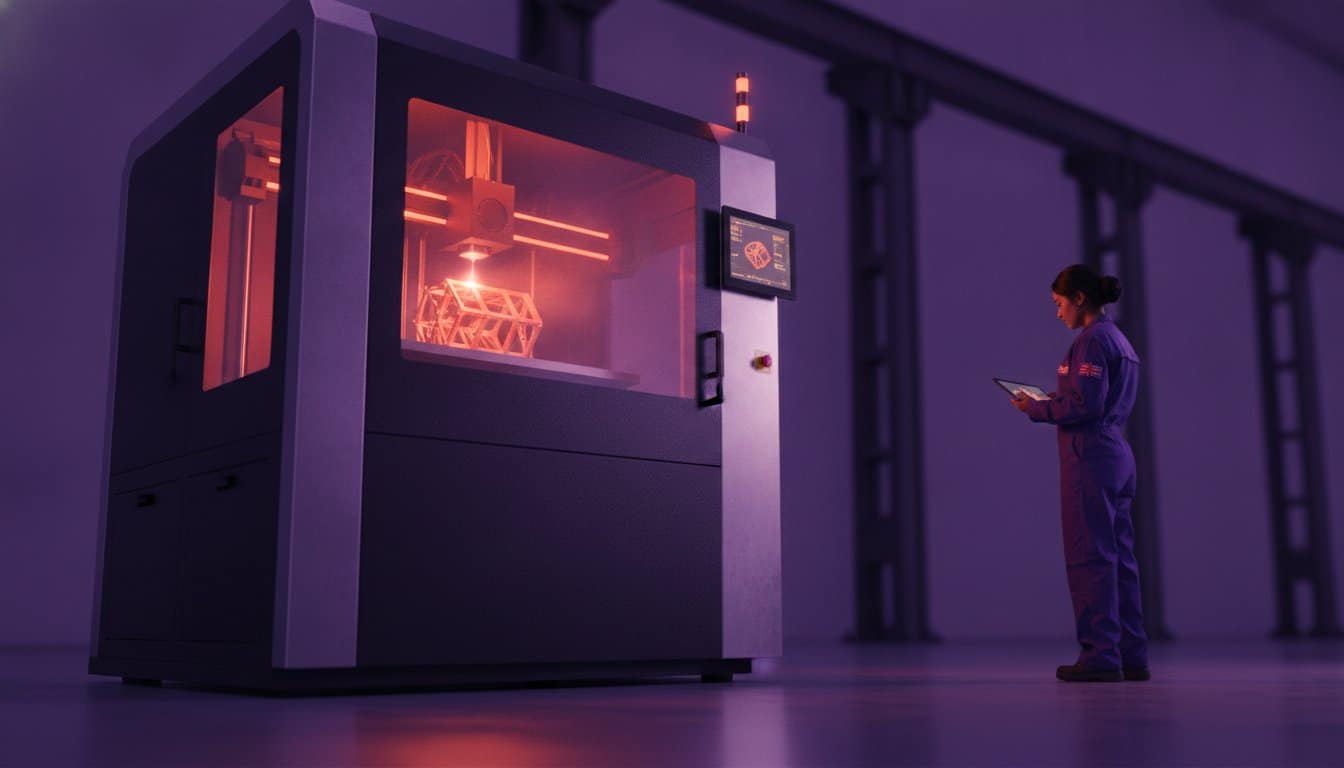
Traditional manufacturing methods are rapidly becoming a liability for UK firms facing volatile supply chains and escalating tooling costs. If your production schedules are currently held hostage by long lead times for critical components, the status quo is costing you more than just time. Building a compelling business case for 3d printing is the most direct path to reclaiming operational control and protecting your margins as we head toward 2026.
We recognise that shifting from conventional machining to additive manufacturing requires more than just technical curiosity; it demands a rigorous financial and operational justification. You need to be certain that the materials will withstand industrial rigour and that the transition will yield a measurable return. This article provides a clear framework for calculating ROI, offers evidence of material durability for heavy industrial use, and demonstrates how to slash your time-to-market. Learn how to integrate these high-speed solutions to build a more resilient, agile, and profitable production strategy whilst staying ahead of the competition.
Key Takeaways
- Calculate the specific break-even point between traditional injection moulding and additive manufacturing to ensure your project remains financially viable.
- Build a robust business case for 3d printing by replacing high-cost fixed tooling with agile, digital manufacturing workflows that respond to market demand.
- Strengthen your supply chain resilience by using high-resolution 3D scanning to create accurate CAD models of legacy parts and obsolete components.
- Match your engineering requirements to the correct technology, utilising FDM for large formats or SLS when uncompromising material strength is required.
- Transition seamlessly from rapid prototyping to full batch production to reduce your time-to-market and eliminate the overheads of traditional manufacturing.
Table of Contents
Quantifying the Economic Shift: Beyond Rapid Prototyping
The business case for 3d printing has evolved from a niche prototyping tool into a fundamental financial instrument for risk mitigation. For decades, UK manufacturers have been tethered to the high-cost, high-risk model of fixed tooling. Shifting to agile, digital manufacturing cycles allows your firm to bypass these capital-intensive barriers. By decoupling production from physical moulds, you gain the freedom to respond to market shifts in real time without the anchor of unamortised equipment costs.
Calculating the break-even point is the first step in this transition. Whilst injection moulding remains efficient for millions of units, additive manufacturing often proves more cost-effective for batches ranging from a single component to several thousand. This shift is driven by “Complexity for Free,” a principle where intricate geometries and internal channels do not increase production costs. This enables diverse industrial applications of 3D printing, such as part consolidation and lightweighting, which are physically impossible or prohibitively expensive via CNC machining.
Tooling Costs vs. Digital Agility
Traditional injection moulding typically requires an upfront investment exceeding £10,000 for a single steel tool. This creates a massive financial hurdle before the first part is even produced. Utilising a rapid prototyping service eliminates these lead costs entirely. Digital Inventory is a method to reduce physical storage overheads by 40% by maintaining parts as CAD data rather than physical stock. Focus your transition on low-volume, high-complexity components where traditional machining waste is highest; these are your prime candidates for immediate ROI.
Time-to-Market: The Ultimate Competitive Advantage
Speed is the primary currency in modern engineering. Compressed design cycles allow UK firms to iterate and launch products weeks, or even months, ahead of global competitors. In technical sectors like aerospace and medical devices, this first-mover advantage is decisive. It secures market share early and establishes your technical standards as the industry benchmark. Don’t let slow tooling cycles dictate your launch date. Adopt a digital-first approach to ensure your products reach the client whilst your competitors are still waiting for their moulds to arrive from overseas.
Strengthening Supply Chain Resilience through Reverse Engineering
Supply chain instability currently threatens the operational continuity of UK industrial firms. When a critical machine part fails and the original equipment manufacturer no longer supports the product, the cost of downtime can escalate into thousands of pounds per hour. The strategic business case for additive manufacturing rests on its ability to eliminate these single points of failure. By digitising your physical assets, you create a permanent, secure library of components ready for immediate production. This shift from physical storage to digital resilience ensures that a machine standing idle is a temporary setback rather than a catastrophic failure.
Material science has advanced to meet these industrial demands. We no longer rely solely on basic plastics; high-performance polymers now provide the durability required for military and space applications. These materials offer the heat resistance and structural integrity necessary to replace metal components in demanding environments. Secure your production line against future disruptions by partnering with an agile manufacturing partner capable of rapid turnaround and engineering-grade results.
Managing Obsolescence with 3D Scanning
Industrial assets often outlive their technical documentation. Our process of reverse engineering allows you to recover lost technical drawings and recreate parts from worn physical assets. High-resolution 3D scanning ensures 0.1mm accuracy for industrial-grade replacements, allowing you to manufacture parts that fit perfectly within existing assemblies. This on-demand approach means you only print what you need, whilst you need it, eliminating the waste and cost associated with overstocking spare parts for obsolete machinery.
Reshoring and Localising Production
Relying on international shipping is becoming increasingly risky and expensive. UK businesses are now prioritising reshoring to avoid rising carbon taxes and unpredictable logistics delays. Localising your production through additive manufacturing significantly lowers your carbon footprint by removing the need for long-distance haulage. It’s a cleaner, faster, and more reliable way to manage your inventory. Transitioning to a local, digital supply chain isn’t just an environmental choice; it’s a calculated move to protect your bottom line from global volatility. Build a robust business case for 3d printing by accounting for these hidden logistics savings and the reduced risk of international trade friction.
Executing the Transition: High-Quality Batch Production
Executing the transition to additive manufacturing requires moving beyond the one-off mindset of the design lab. Industrial-grade batch production is not merely a sequence of individual prints; it’s a synchronised, precision-engineered process. Scaling from a single prototype to a run of 500 or more parts demands rigorous quality assurance to ensure every component meets the same uncompromising standards. Unlike hobbyist setups, professional studios organise multiple high-end machines to deliver volume without the exponential cost increases associated with traditional tooling complexity. This scalability forms a core pillar of the business case for 3d printing, allowing UK firms to bridge the gap between initial development and market-ready stock with total confidence.
Selecting the Right Additive Technology
Choosing the correct technology is vital for meeting specific mechanical requirements. Use this checklist to guide your selection:
- FDM: Best for large format components, durable jigs, and functional fixtures.
- SLA: Ideal for parts requiring high-resolution detail and smooth surface finishes.
- SLS: The gold standard for industrial strength and complex geometries without the need for support structures.
Success relies heavily on 3D design optimisation, often called Design for Additive Manufacturing (DfAM). This process reduces material usage and print time whilst ensuring structural integrity, directly improving your project’s ROI.
The “Buy vs. Build” Decision for UK SMEs
Deciding between in-house investment and outsourcing is a fundamental question of CAPEX versus OPEX. Purchasing industrial printers involves significant capital expenditure, specialised staff training, and ongoing maintenance. Conversely, utilising a specialist UK 3D printing studio converts these costs into operational expenditure, providing immediate access to expert engineering knowledge. You bypass the overhead of internal R&D departments whilst benefiting from the latest hardware and material innovations. This agile approach allows you to scale production based on real-time demand without being anchored to underutilised machinery. Ready to validate your project? Get a precision quote for your 3D printing requirements.
Future-Proof Your Manufacturing Strategy for 2026
The transition toward additive manufacturing is no longer a speculative venture; it’s a strategic necessity for UK firms aiming to navigate a volatile global market. You’ve seen how digital agility eliminates the financial burden of fixed tooling and how reverse engineering protects your operations from the risk of obsolete components. By adopting high-quality batch production, you secure a faster time-to-market whilst maintaining uncompromising standards across every unit produced.
Whether in heavy industry or luxury sectors like bespoke tailoring, the move towards more agile and precise design methodologies is universal. For those interested in how these concepts of form and structure translate to other disciplines, the resources at marlobespoke.com provide a fascinating look at the history and significance of draping in high-end garment construction.
Building a robust business case for 3d printing requires a partner who understands the pressures of time-critical engineering. Protomolecule brings specialist expertise in the space and military sectors, providing the high-resolution industrial scanning and reverse engineering capabilities needed to digitise your most complex assets. Our commitment to rapid turnaround ensures your projects move from CAD data to physical reality without delay. We focus on delivering results that keep your production lines moving and your margins protected.
Don’t let traditional manufacturing constraints limit your growth or leave your supply chain vulnerable. Contact Protomolecule for a professional consultation on your 3D printing business case and take the first step toward a more resilient production model today. We’re ready to help you solve your most complex engineering challenges with precision and speed.
Frequently Asked Questions
Is 3D printing cost-effective for large production runs?
3D printing is highly cost-effective for production runs where the high cost of fixed tooling cannot be justified. Whilst injection moulding remains the standard for millions of units, additive manufacturing offers a superior business case for 3d printing for batches of hundreds or thousands of complex parts. You eliminate the £10,000 upfront mould costs and gain the flexibility to iterate designs without financial penalty.
How accurate are 3D printed parts for engineering applications?
Industrial-grade additive systems deliver exceptional precision suitable for the most demanding sectors. High-resolution technologies like SLA and SLS achieve tolerances that meet stringent engineering standards. When paired with professional 3D scanning, we ensure 0.1mm accuracy for replacement components, making them ideal for integration into existing mechanical assemblies within the military and space sectors.
What materials can be used for industrial-grade 3D printing?
We utilise a range of high-performance materials tailored to specific industrial environments. This includes engineering-grade thermoplastics for FDM, high-resolution resins for SLA, and durable nylons for SLS production. For specialised applications in aerospace and defence, we provide advanced polymers capable of withstanding extreme temperatures and mechanical stress, ensuring your parts perform reliably under pressure.
Can 3D printing replace traditional CNC machining?
3D printing serves as a powerful complement to CNC machining rather than a total replacement. It excels at producing intricate geometries and internal channels that are physically impossible to machine. Whilst CNC remains efficient for simple bulk metal components, additive manufacturing is the faster, more cost-effective choice for part consolidation and reducing material waste in complex assemblies.
How long does the reverse engineering process take for a complex part?
The duration of the reverse engineering process depends on the component’s complexity, but we typically deliver a finalised CAD model within a few working days. Our high-resolution scanning systems capture data rapidly, allowing our design team to reconstruct technical drawings with speed and precision. This accelerated timeline is critical for minimising machine downtime and restoring operational capacity to your production line.
Do I need a 3D CAD file to start the 3D printing process?
You don’t require an existing CAD file to begin your project. Our comprehensive 3D scanning and reverse engineering services allow us to create precise digital models from physical assets, even if they are worn or obsolete. We take your physical part and transform it into a production-ready file, streamlining your path from a broken component to a high-quality replacement.