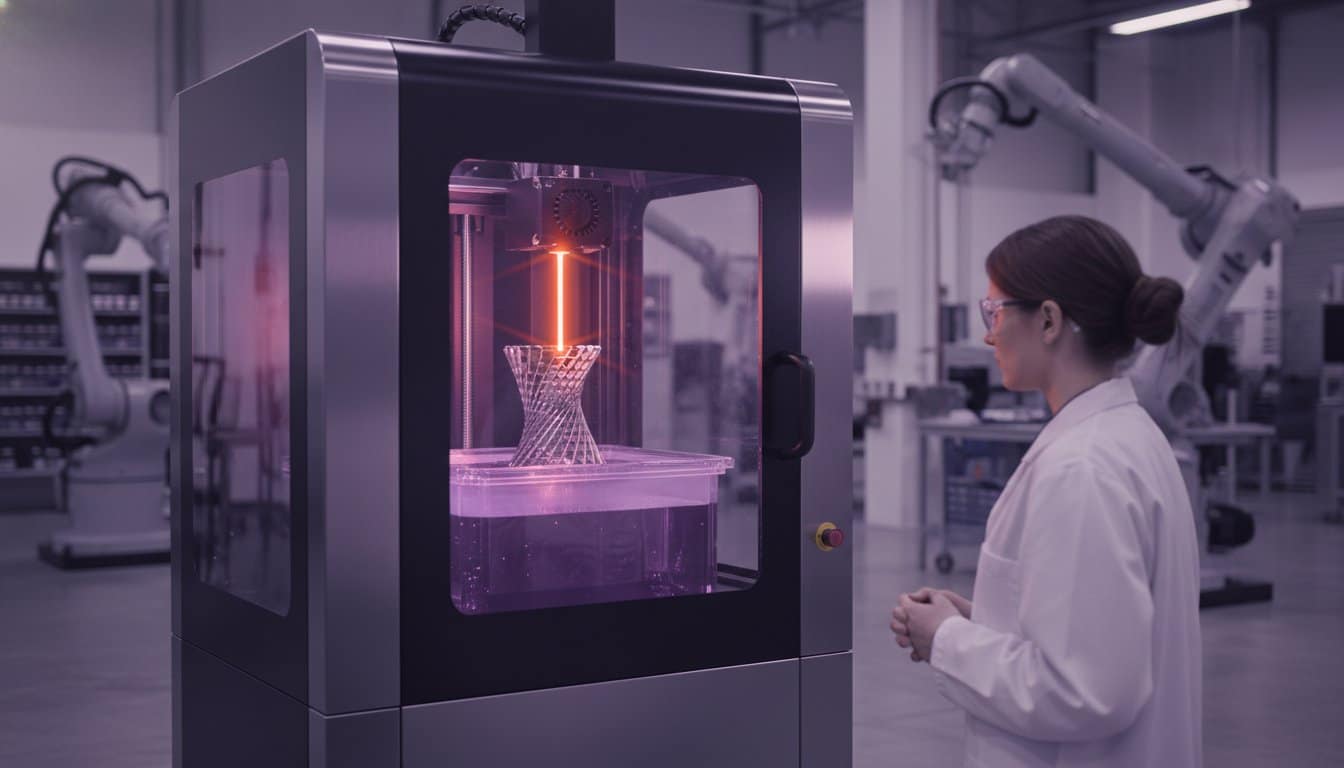
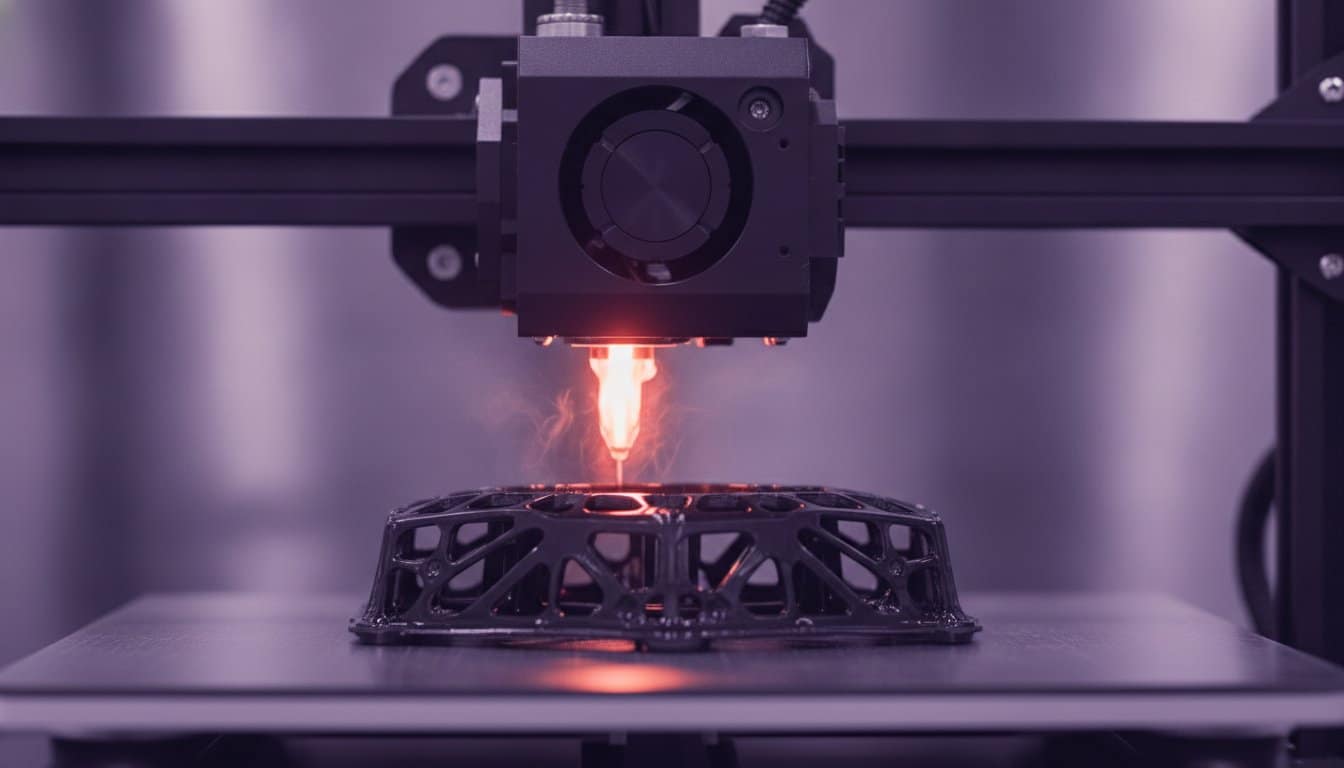
The melting point listed on a material datasheet is often the most dangerous distraction in engineering design. You’ve likely experienced the frustration of a component that meets its thermal specifications on paper but deforms under load during its first hour of operation. This inconsistency often stems from a common confusion between a material’s melting point and its actual functional limit. Selecting the correct heat resistant 3d printing materials is not just about avoiding a liquid state; it’s about maintaining structural integrity and safety standards under constant thermal stress.
This guide delivers the technical specifications and application criteria you need to ensure your industrial components survive extreme thermal environments. We’ll clarify the critical distinctions between Glass Transition Temperature and Heat Deflection Temperature to help you reduce part failure rates immediately. You’ll also discover how high-performance polymers like PEEK, PEKK, and ULTEM 9085 are reshaping aerospace and automotive production in 2026. From specialised hardware requirements to precise post-processing, we provide the roadmap for selecting a reliable UK partner to handle your most demanding high-temperature projects.
Key Takeaways
- Distinguish between Heat Deflection Temperature (HDT) and Glass Transition Temperature (Tg) to accurately predict how components will behave under mechanical load.
- Navigate the hierarchy of heat resistant 3d printing materials to select the most cost-effective polymer that meets your specific thermal and UV requirements.
- Utilise professional post-processing techniques such as annealing to reorganise polymer chains and significantly increase the thermal resistance of finished parts.
- Optimise design parameters including wall thickness and infill density to facilitate superior thermal dissipation in high-stress industrial applications.
Mastering Thermal Metrics: Understanding HDT vs. Glass Transition Temperature
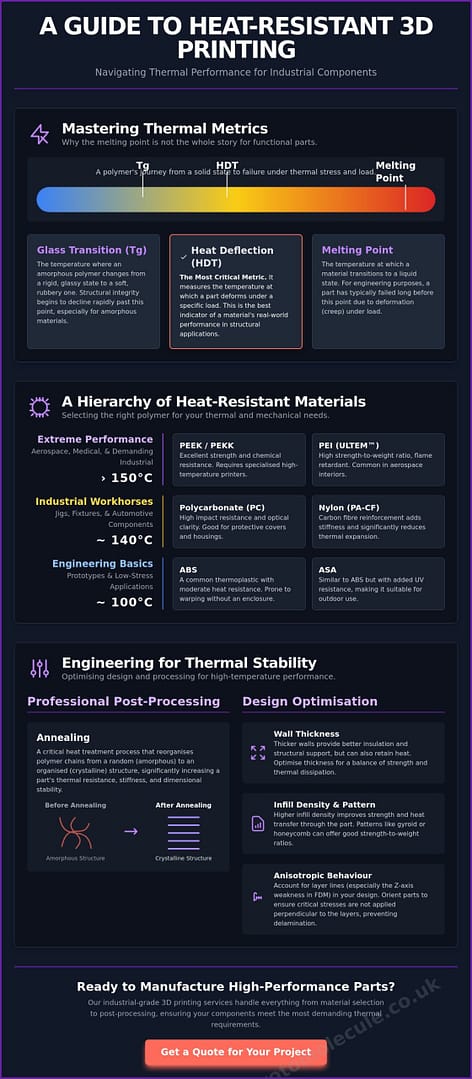
Relying solely on a material’s melting point is a frequent oversight in industrial design. For high-performance components, the critical limit is actually the point where the polymer loses its structural stiffness. Understanding how heat resistant 3d printing materials behave under stress requires a firm grasp of two distinct metrics: Heat Deflection Temperature (HDT) and Glass Transition Temperature (Tg).
HDT represents the temperature at which a specimen deforms by a specific amount under a set load. It’s the most reliable indicator of real-world performance for structural parts. Conversely, Tg marks the transition where an amorphous polymer shifts from a hard, glassy state to a flexible, rubbery one. Whilst semi-crystalline polymers like PEEK maintain better integrity above their Tg due to their organised molecular structures, amorphous materials like Polycarbonate can fail rapidly once this threshold is crossed. Your choice of technology also dictates performance; for instance, parts produced via a 3D printing service using SLS often exhibit better thermal stability than FDM counterparts due to superior layer fusion.
Why Melting Point is a Misleading Metric
Components often fail due to creep or gradual deformation long before they reach their melting point. In professional engineering, HDT at 0.45 MPa serves as the industry standard for evaluating 3D printed parts because it reflects the material’s ability to support weight at elevated temperatures. For long-term reliability, you must also consider the Continuous Operating Temperature (COT). This metric defines the maximum temperature a part can withstand for thousands of hours without losing more than 50% of its mechanical properties. Don’t design for the point of total failure; design for the point of functional stability.
The Role of Isotropic vs. Anisotropic Thermal Behaviour
The additive process inherently creates anisotropic properties. Because parts are built layer-by-layer, thermal expansion and mechanical strength differ across the X, Y, and Z axes. In FDM processes, the Z-axis is typically the weakest link. Thermal stress can cause delamination if the design doesn’t account for expansion. When parts are subjected to thermal cycles, the Z-axis strength determines whether the component remains intact or suffers from interlaminar failure. Ensuring your rapid prototyping partner understands these directional stresses is vital for producing durable, heat-stable components.
A Hierarchy of Heat Resistant 3D Printing Materials
Selecting the correct heat resistant 3d printing materials requires a tiered approach based on the specific thermal ceiling and mechanical load of your application. Whilst basic engineering plastics like ABS and ASA provide moderate resistance up to 100°C, they often fail in high-stress industrial environments. Moving up the hierarchy is essential for components that must survive chemical exposure or constant thermal cycling without losing dimensional accuracy.
Polycarbonate and Nylon: The Industrial Workhorses
Polycarbonate (PC) remains a premier choice for parts requiring impact resistance and clarity at temperatures reaching 140°C. However, for mechanical jigs and fixtures, Carbon Fibre reinforced Nylon (PA-CF) often provides superior performance. The carbon fibres act as a stabilising skeleton, significantly reducing the coefficient of thermal expansion and preventing part warping. Accessing these difficult-to-print materials is simplified through Protomolecule’s 3D printing service, where we maintain the environmental controls necessary for consistent results. These polymers also offer excellent resistance to oils and fuels, making them ideal for industrial transport components.
Advanced Polymers for Extreme Environments
When operating temperatures exceed 150°C, you must transition to high-performance polymers like PEEK, PEKK, and PEI (Ultem). These materials are standard in aerospace and medical sectors because they maintain structural integrity under extreme conditions that would liquify standard filaments. Printing with PEEK requires specialised industrial-grade hardware, including actively heated chambers, to ensure proper crystallisation and prevent delamination. Because these materials represent a significant investment, we recommend utilising rapid prototyping to validate your design geometry before moving to full-scale manufacturing.
Composite reinforcements like glass or carbon fibre further stabilise these high-end polymers against thermal expansion. By integrating these fibres, you ensure that your components maintain their tolerances even as they transition through various thermal zones. For projects requiring uncompromising standards, consider a batch production service to ensure every component meets your rigorous safety and performance criteria.
Engineering for Thermal Stability: Professional Processing and Design
Achieving true thermal performance requires more than just selecting high-spec heat resistant 3d printing materials. It demands a rigorous approach to design geometry and post-processing. Internal stresses, often a byproduct of the rapid cooling cycles in additive manufacturing, can lead to premature failure or warping if you don’t address them during production. Professional-grade manufacturing eliminates these risks by maintaining precise thermal control throughout the build.
The Annealing Process: Unlocking Maximum Performance
Professional annealing involves a strictly controlled heating and cooling cycle designed to reorganise polymer chains. This process increases the crystallinity of semi-crystalline materials like PEEK or Nylon, significantly boosting their mechanical properties. Whilst this enhances structural integrity, you must account for potential dimensional shrinkage during the design phase. “Professional annealing can increase the HDT of certain filaments by up to 20% by relieving internal stresses.” Failing to manage this transition accurately often results in parts that don’t fit their intended assemblies.
Selecting the Right Manufacturing Partner
Design for heat dissipation by optimising wall thickness and infill density. Thicker walls provide better thermal conduction, whilst specific infill patterns can be used to manage heat soak in electronic housings. Transitioning from a single prototype to batch production requires these parameters to be locked in to ensure absolute part-to-part consistency across the entire run.
Industrial-grade machines provide the thermal consistency that desktop printers simply cannot match. Actively heated chambers prevent the thermal shocks that cause interlaminar weakness. For time-critical engineering projects, getting a professional quote from a UK-based specialist ensures your material choice matches your application’s thermal ceiling perfectly. We focus on rapid fulfilment and meticulous standards to ensure your components survive the most extreme operating environments.
Securing Thermal Integrity in Future Engineering
Success in high-temperature applications depends on moving beyond datasheet melting points to embrace the technical realities of HDT and molecular stability. By selecting the correct tier of heat resistant 3d printing materials and applying professional annealing techniques, you transform vulnerable prototypes into resilient industrial components. This guide has outlined the essential metrics and processing standards required to ensure your parts remain dimensionally accurate under extreme thermal stress.
We combine advanced industrial FDM and SLS capabilities with deep expertise in the military and space sectors to solve your most difficult engineering problems. Our team focuses on delivering a fast turnaround for complex engineering prototypes without sacrificing the meticulous standards your project demands. Reliability isn’t an accident; it’s the result of precise material science and industrial-grade manufacturing.
Request a technical quote for your high-temperature project today. Let’s build components that survive the heat and drive your innovation forward.
Frequently Asked Questions
What is the most heat resistant 3D printing material available today?
PEEK (Polyether Ether Ketone) and PEKK (Polyetherketoneketone) currently represent the pinnacle of heat resistant 3d printing materials. These high-performance polymers can withstand continuous operating temperatures exceeding 240°C whilst maintaining structural integrity under extreme mechanical stress. ULTEM 1010 also offers exceptional thermal stability with a Heat Deflection Temperature of approximately 216°C. These materials are essential for aerospace and chemical processing applications where structural failure isn’t an option.
Can I make standard PLA heat resistant through annealing?
You can increase the thermal resistance of specific PLA blends through annealing, but standard PLA remains unsuitable for high-heat environments. The process involves heating the part to a point between its glass transition and melting temperatures to induce crystallisation. Whilst this can raise the HDT from 55°C to nearly 90°C, it often causes significant dimensional shrinkage and warping. For professional applications, it’s more reliable to select a material inherently designed for thermal stability.
Is there a difference between heat resistance and flame retardancy in 3D prints?
Heat resistance refers to a material’s ability to maintain mechanical strength at high temperatures, whilst flame retardancy indicates its ability to self-extinguish when exposed to fire. A material can be heat resistant without being flame retardant. In sectors like aerospace, components often require both properties, specifically meeting UL94 V-0 standards. Always verify the safety certifications of your heat resistant 3d printing materials to ensure they meet the specific fire safety regulations of your industry.
What is the best 3D printing material for under-the-bonnet automotive parts?
Carbon Fibre reinforced Nylon (PA-CF) is generally the best choice for under-the-bonnet automotive components such as air intakes or sensor housings. It offers an excellent balance of thermal stability, chemical resistance to engine oils, and mechanical toughness. For parts positioned closer to exhaust systems or high-heat zones, Polycarbonate or PEEK may be required to handle temperatures reaching 140°C and beyond. Selecting the right polymer ensures your components don’t degrade in the presence of engine fluids.