
The most expensive component in your production line isn’t the raw material; it’s the hours lost to failed prototypes that were fundamentally doomed at the CAD stage. You’ve likely felt the frustration of pulling a warped part off the build plate or watching material costs climb due to excessive, unnecessary support structures. Mastering design for additive manufacturing (dfam) principles is the only way to ensure your engineering intent survives the transition to a physical part. We understand that in a market projected to reach $31.48 billion this year, speed and precision are your only real currencies.
This guide provides the technical framework to optimise your geometry, reduce part weight, and slash lead times. You’ll learn how to move beyond “printable” designs to create high-performance components that traditional subtractive methods simply cannot produce. We’ll examine the latest 2026 quality standards, including ISO/ASTM 52948:2026, and show you how to leverage GPU-accelerated software to accelerate your workflow. Prepare to transform your approach from simple rapid prototyping to high-performance batch production with absolute confidence.
Key Takeaways
- Bridge the gap between digital CAD concepts and physical success by understanding the critical distinction between basic printability and high-level part optimisation.
- Reduce material waste and manufacturing costs by implementing design for additive manufacturing (dfam) principles that target aggressive weight reduction whilst maintaining structural integrity.
- Unlock engineering performance impossible with CNC machining by integrating complex internal geometries for superior thermal and fluid management.
- Accelerate your rapid prototyping phase and transition seamlessly to batch production by mastering part orientation to control surface finish and grain strength.
- Minimise prototype failure rates and ensure first-time print success by aligning your designs with 2026 industrial quality standards and regulatory frameworks.
Fundamental Design for Additive Manufacturing (DfAM) Principles
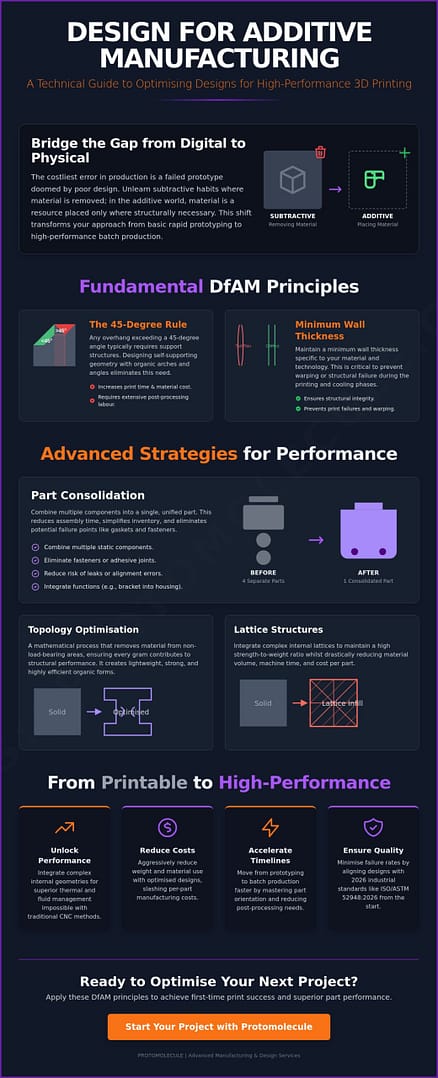
Successful additive production relies on more than just a functional CAD file; it requires a strategic bridge between digital intent and physical reality. Adopting design for additive manufacturing (dfam) principles allows you to move past the basic “can it be printed?” threshold and enter the realm of true performance optimisation. You must unlearn the habits of subtractive manufacturing, where material is a cost to be removed. In the additive world, material is a resource to be placed only where it’s structurally necessary.
Your choice of technology dictates your design boundaries. FDM (Fused Deposition Modelling) requires strict attention to layer adhesion and orientation, whilst resin-based SLA or powder-based SLS processes offer different geometric freedoms and constraints. Understanding these Design for Additive Manufacturing (DfAM) principles ensures your part isn’t just a 3D copy of a CNC component, but a lightweight, high-strength solution tailored for its specific build process.
Geometric Constraints: Wall Thickness and Self-Supporting Angles
Mastering the 45-degree rule is essential for reducing lead times and material costs. Any overhang exceeding this angle typically requires support structures, which increases both print time and post-processing labour. You must also maintain minimum wall thickness specific to your material to prevent warping or structural failure during the cooling phase. Self-supporting geometry is a design choice that eliminates post-processing waste by using organic arches and angles to support the part’s own mass during the build.
Transitioning from 2D Design and Legacy CAD
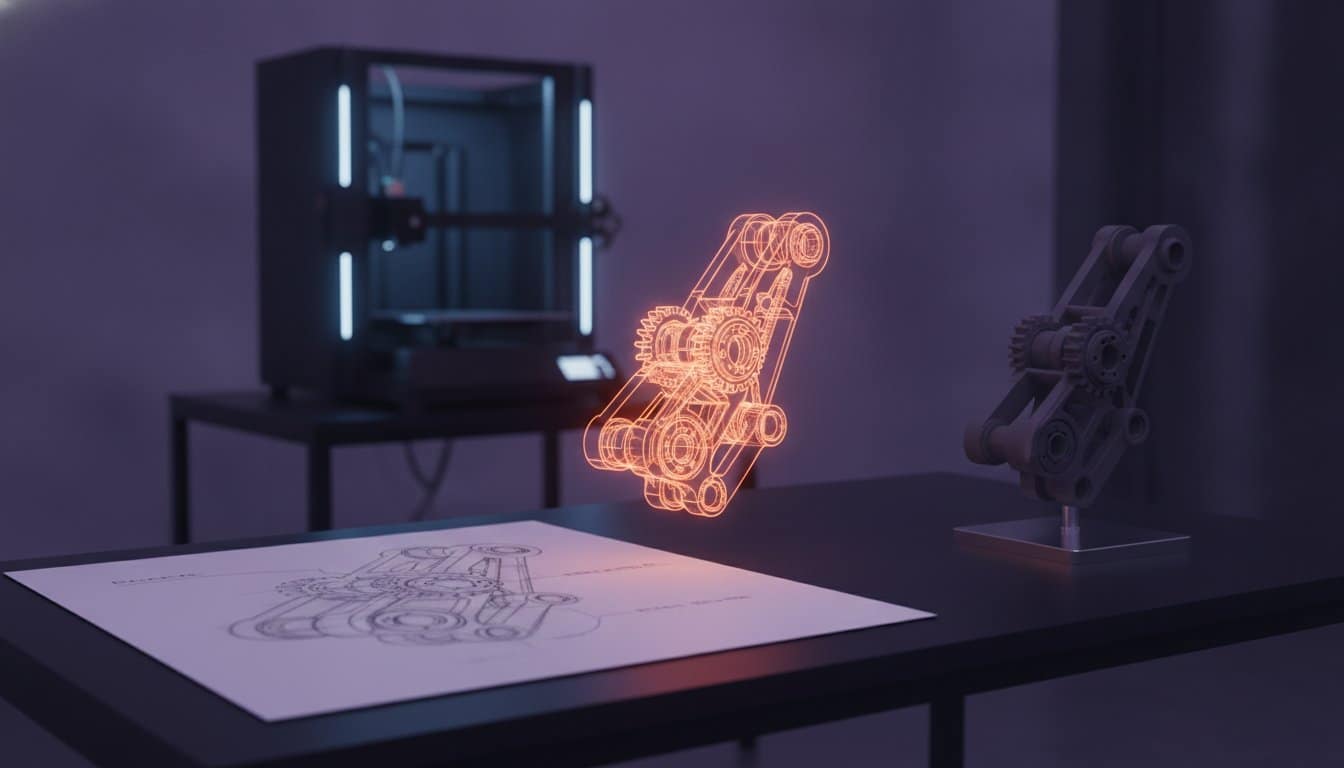
Converting a 2D sketch or a legacy CAD file directly into an STL often results in heavy, inefficient parts that fail to exploit additive benefits. Simply replicating a traditional design misses the opportunity for part consolidation and weight reduction. By utilising reverse engineering, we can modernise legacy components, stripping away unnecessary bulk and re-engineering them for the 2026 manufacturing landscape. This process transforms outdated hardware into high-performance, 3D-ready assets.
Advanced Strategies for Performance and Cost Optimisation
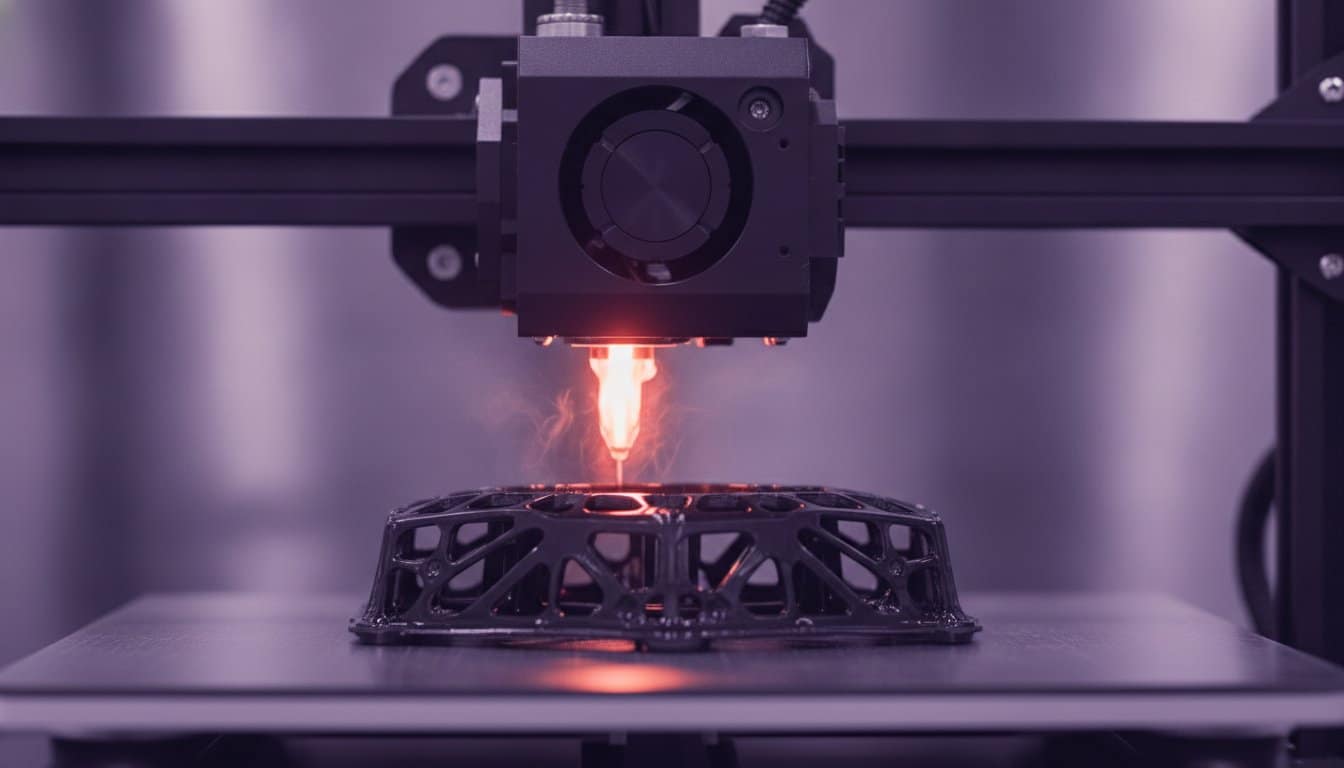
Moving beyond basic printability requires a strategic focus on efficiency. Advanced design for additive manufacturing (dfam) principles allow you to exploit the “complexity is free” mantra. Unlike CNC machining, where intricate features add significant cost, additive processes thrive on complexity if the design is sound. You can integrate lattice structures to maintain high strength-to-weight ratios whilst drastically reducing the total volume of material consumed. This approach directly lowers your cost per part by minimising raw material usage and machine time.
To align with NIST’s fundamental design principles, engineers must prioritise material reduction as the primary driver for both cost efficiency and environmental sustainability. This strategy is particularly effective for thermal and fluid components. You can design complex internal cooling channels or conformal fluid paths that were previously impossible to manufacture. These features significantly enhance heat dissipation and fluid flow without increasing the manufacturing price point.
Part Consolidation and Assembly Reduction
Traditional manufacturing often relies on assembling dozens of small components. DfAM allows you to consolidate these into a single, unified part. This reduces assembly time, simplifies your inventory management, and eliminates potential failure points such as gaskets or fasteners. Identify your best candidates for consolidation with this checklist:
- Does the assembly contain multiple static components?
- Are there several fasteners or adhesive joints?
- Is the current assembly prone to leaks or alignment errors?
- Can you combine functions, such as integrating a mounting bracket into a main housing?
Topology Optimisation and Generative Design
Topology optimisation is a rigorous mathematical approach to removing material from non-load-bearing areas. It ensures every gram of material contributes to the part’s structural performance. Whilst generative design uses AI to explore thousands of geometric iterations, manual optimisation by an expert 3D design service often provides the practical, manufacturing-ready results that industrial projects require. If you’re looking to push the boundaries of what’s possible, our team can help you scale for batch production to ensure your designs are commercially viable from the first build.
Applying DfAM to Rapid Prototyping and Batch Production
Applying design for additive manufacturing (dfam) principles isn’t just about geometry; it’s about time-to-market. In the high-pressure environment of British engineering, reducing the rapid prototyping cycle by even 48 hours can be the difference between winning a contract and falling behind. By designing for the process from day one, you eliminate the “print-fail-redesign” loop that plagues unoptimised projects. This proactive approach ensures that your first physical iteration is as close to the final production part as possible, allowing for immediate functional testing.
As you transition to batch production, the stakes for your design choices increase. A design that’s 10% heavier than necessary might be negligible for a single prototype, but it becomes a massive financial drain across a run of 500 units. Aligning your workflow with the key principles of DfAM allows you to lock in unit costs early. This ensures your scaling efforts are both predictable and profitable whilst maintaining the uncompromising standards your clients expect.
Orientation and Anisotropy: Engineering for Strength
Part orientation is a critical engineering decision, not an afterthought. In FDM processes, the Z-axis is typically the weakest point due to layer-to-layer bonding; you must orient your part so that primary functional loads don’t pull these layers apart. Beyond strength, orientation dictates visual quality. Shallow angles on curved surfaces often result in “stair-stepping” effects that require heavy sanding. By positioning these surfaces vertically, you achieve a superior finish straight from the build plate, bypassing unnecessary manual finishing.
Designing for Efficient Post-Processing
Post-processing is often the hidden bottleneck in additive manufacturing. For SLS or SLA parts, you must include strategically placed escape holes to allow trapped powder or uncured resin to drain from internal cavities. Without these, your hollowed, “optimised” part remains heavy and prone to internal stress failure. You should also integrate sacrificial “pull tabs” or specific geometry that allows for easy part removal without damaging delicate features. Ultimately, the most efficient post-processing is the one that was designed out of the part entirely.
Accelerate Your Production with DfAM Excellence
Mastering design for additive manufacturing (dfam) principles is no longer a luxury for R&D departments; it’s a commercial necessity for any firm looking to scale in 2026. You’ve seen how strategic part consolidation and topology optimisation reduce material waste whilst significantly enhancing component performance. By prioritising build orientation and post-processing at the CAD stage, you eliminate the bottlenecks that typically stall industrial projects. These efficiencies don’t just save money; they provide the agility required to outpace competitors.
Our expert 3D design and engineering team is ready to help you implement these strategies immediately. We’re specialists in the rigorous requirements of the military and space sectors, ensuring your parts meet uncompromising quality standards. We provide rapid turnaround for UK-wide industrial projects, moving your concept from a digital file to a physical assembly with absolute precision. We value your project deadlines as much as you do.
Don’t let inefficient designs slow your development cycle. Get a fast, professional quote for your DfAM-optimised project today and secure your competitive advantage in the modern manufacturing landscape. We’re ready to solve your most complex engineering challenges.
Frequently Asked Questions
What is the most important DfAM principle for beginners?
The most critical principle for beginners is understanding part orientation and its direct impact on support structures. You should design components that are as self-supporting as possible by adhering to the 45-degree rule for overhangs. This approach minimises the need for sacrificial material and reduces the labour required for post-processing. Proper orientation also ensures that the part’s mechanical strength is optimised for its intended functional load.
How does DfAM reduce the cost of 3D printing?
DfAM reduces production costs by aggressively targeting material usage and assembly complexity. By implementing design for additive manufacturing (dfam) principles such as lattice integration, you can maintain structural integrity whilst using significantly less raw material. Consolidating separate components into a single printed part also eliminates the need for fasteners and reduces the time spent on manual assembly. These efficiencies directly lower the total cost per unit in industrial applications.
Can any CAD model be used for additive manufacturing without changes?
Most CAD models designed for traditional subtractive manufacturing require significant modification to be viable for 3D printing. Legacy files often include solid sections that are unnecessarily heavy or sharp internal corners that lead to thermal stress and warping. You must audit every digital model for wall thickness, drainage holes, and support requirements before sending it to the build plate. Failing to adapt these designs usually results in high failure rates and wasted production time.
What is the difference between DfM and DfAM?
Design for Manufacture (DfM) focuses on simplifying geometry for traditional tools like CNC mills, whereas design for additive manufacturing (dfam) principles exploit geometric complexity for performance gains. DfM prioritises tool access and draft angles to lower machining costs. DfAM focuses on managing layer adhesion, thermal dissipation, and material placement. This shift allows for the creation of lightweight, consolidated parts that traditional manufacturing methods simply cannot produce.