Why are you still waiting weeks for CNC-machined aluminium when your production line is stalling today? Relying on traditional manufacturing instead of custom jigs and fixtures 3d printing is no longer the most efficient route for UK engineers. You likely feel the pressure of rising costs for low-volume bespoke tooling and the physical strain that heavy, metal assembly aids place on your workforce. It’s a common bottleneck that slows down throughput and eats into your margins.
This article demonstrates how to reduce lead times by 90% and significantly slash tooling costs using our high-performance 3D printing service. You’ll discover how to create lighter, more ergonomic tools that improve worker safety whilst maintaining industrial-grade durability. We’ll also examine the 2026 landscape for additive manufacturing, including how to utilise the merged R&D tax relief scheme and the latest BSI standards to ensure your production floor remains competitive and compliant.
Key Takeaways
- Eliminate the CNC bottleneck and slash costs for one-off bespoke tools by switching to additive manufacturing.
- Select the right engineering-grade materials, from standard polymers to high-strength carbon-fibre reinforced nylon, for industrial durability.
- Utilise our 3D scanning service to create perfectly fitting nests and fixtures for even the most complex physical components.
- Optimise UK production with custom jigs and fixtures 3d printing to reduce lead times by 90% whilst improving tool ergonomics.
- Access industrial-grade hardware and expert 3D design services to scale your manufacturing capability without significant capital expenditure.
The Shift to Additive Manufacturing for Custom Jigs and Fixtures
Traditional CNC machining for a Jig (tool) or fixture has become a significant bottleneck in modern UK workshops. Machining aluminium or steel requires skilled labour and machine time that is better spent on customer-facing production. When you need a one-off bespoke tool, the setup costs and material waste of subtractive methods often make low-volume batches prohibitively expensive. This is where custom jigs and fixtures 3d printing changes the equation. By shifting to additive processes, you eliminate the need for complex toolpaths and expensive raw billets.
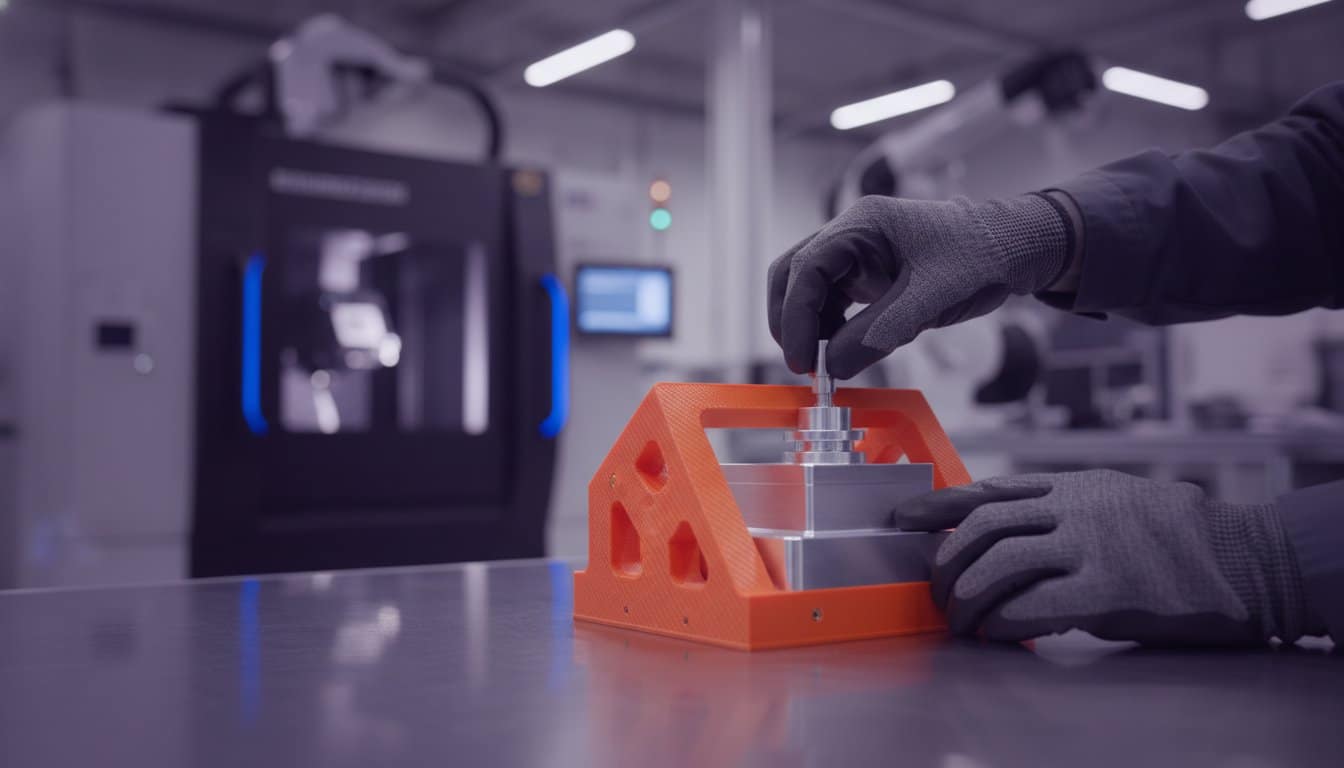
Speed is the ultimate advantage. Our rapid prototyping service allows you to test, refine, and re-print a fixture in under 24 hours. If a tool breaks on the assembly line, you don’t wait weeks for a replacement; you print a new one overnight. Beyond speed, 3D printed polymers offer a massive weight reduction compared to metal. Lighter tools reduce worker fatigue and improve ergonomics, directly impacting safety and productivity on the factory floor.
Traditional vs. 3D Printed Tooling
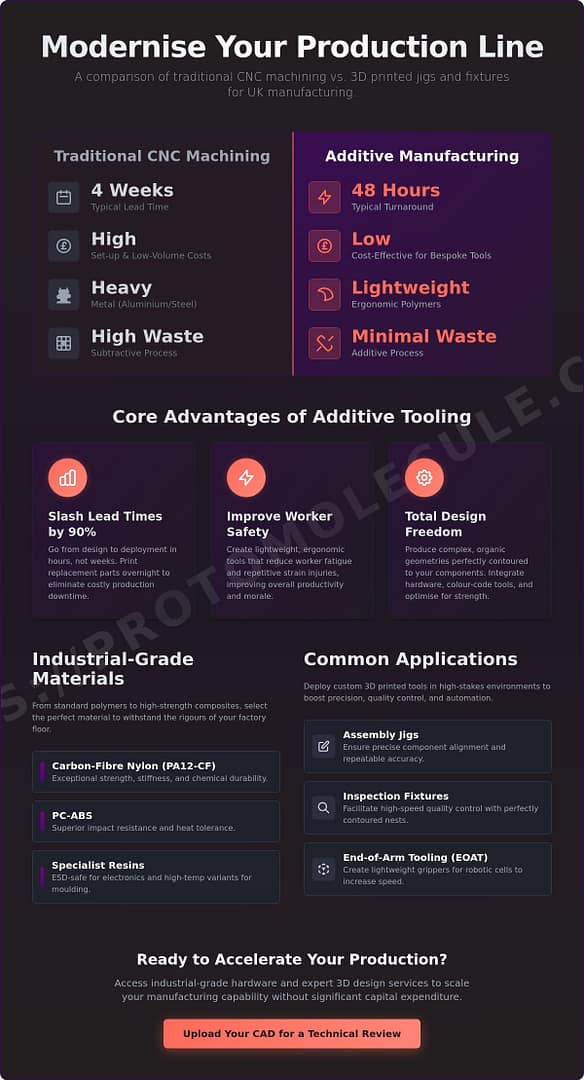
The numbers are stark. A traditional aluminium fixture often carries a 4-week lead time, whilst our 3D printing service can deliver the same part in 48 hours. Additive manufacturing also wins on sustainability. Instead of milling away 80% of a block of metal, we only use the material required for the part. This makes complex, organic geometries achievable without the price penalties associated with difficult CNC setups.
Common Applications on the Factory Floor
Manufacturers across the UK are already deploying these tools in high-stakes environments:
- Assembly Jigs: Ensure precise component alignment and repeatable accuracy for every unit.
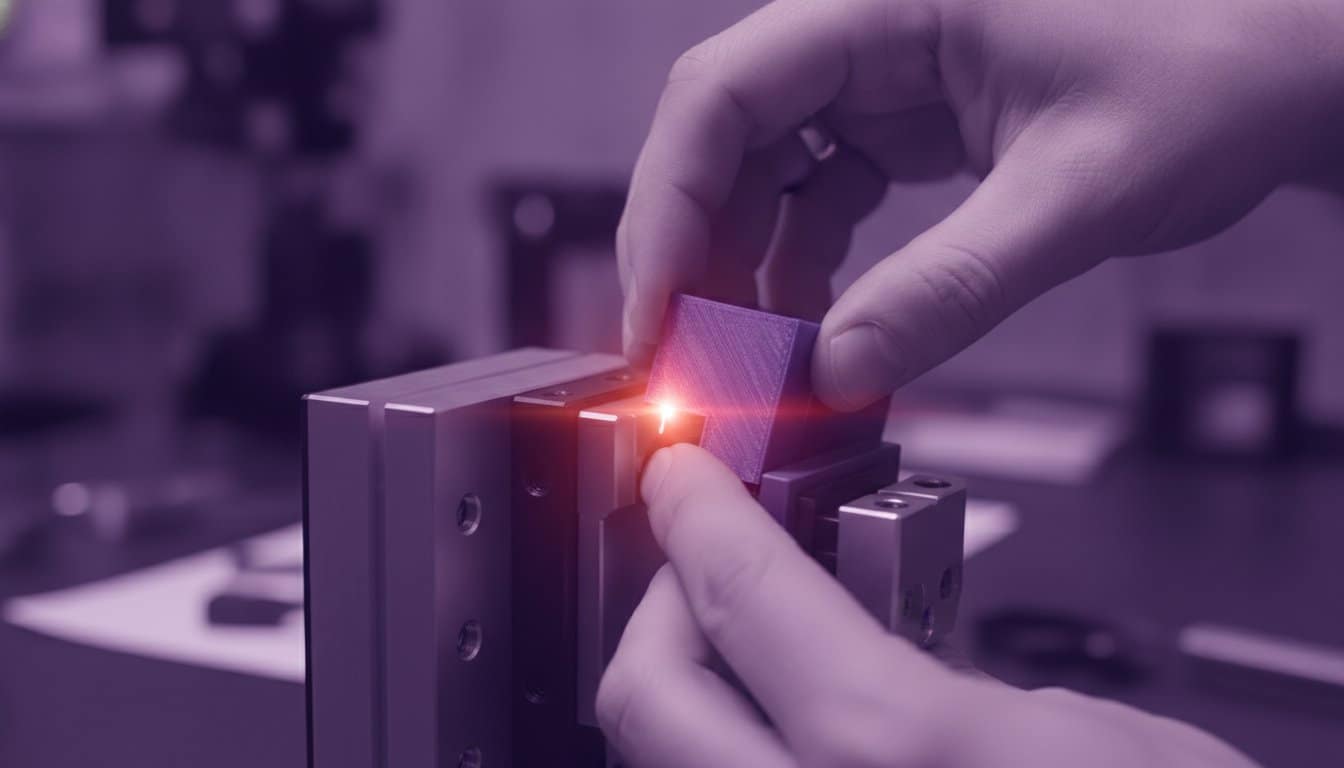
- Inspection Fixtures: Facilitate high-speed quality control and CMM checks with perfectly contoured nests.
- End-of-Arm Tooling (EOAT): Create lightweight grippers for robotic cells to increase speed and reduce motor wear.
Engineering High-Performance Tooling: Materials and Design
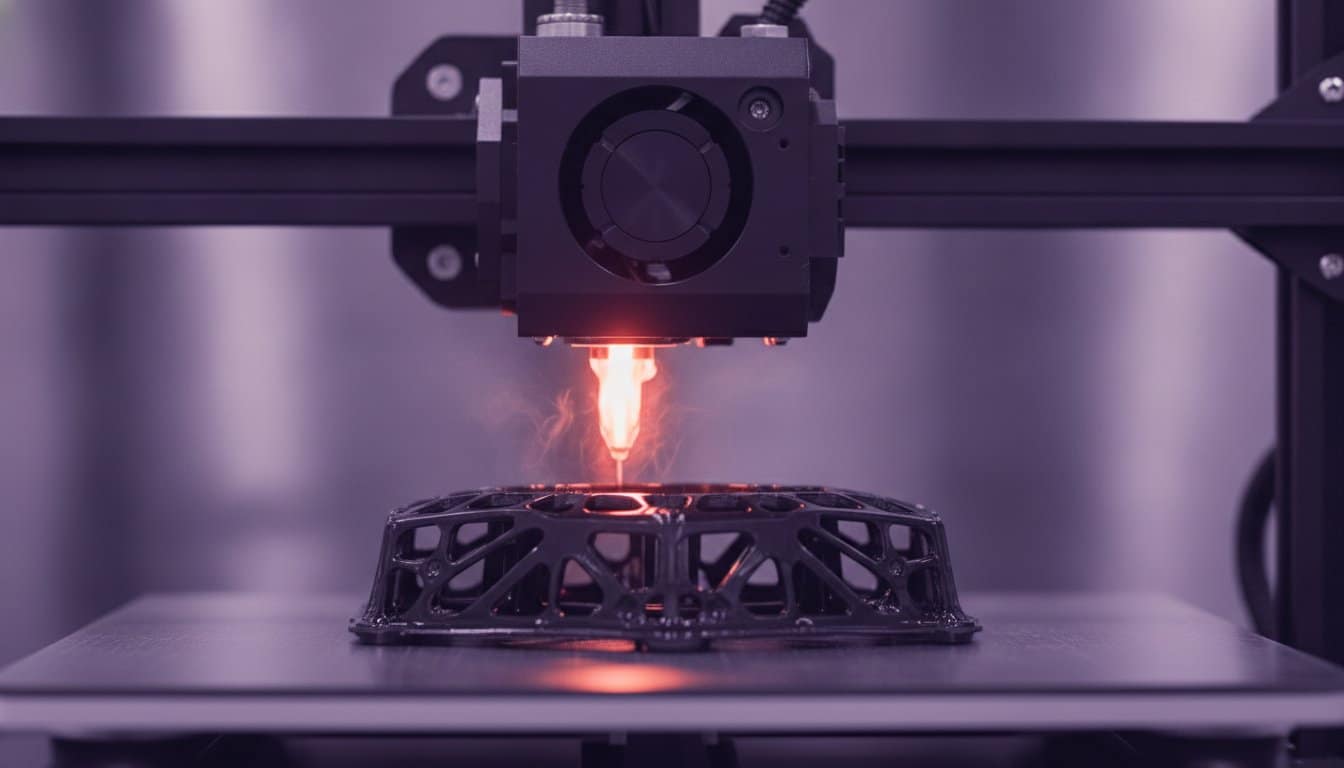
Engineering high-performance tooling requires moving beyond basic plastics. Whilst PLA serves well for simple templates, industrial environments demand materials like carbon-fibre reinforced nylon (PA-CF) or PC-ABS for superior impact resistance. Modern custom jigs and fixtures 3d printing relies on these engineering-grade filaments to withstand the rigours of a 24-hour production cycle. By utilising internal lattice structures, we provide the rigidity of solid metal without the unnecessary weight. This strategic approach eases 3D printing onto the factory floor by proving that polymer tools can handle heavy-duty mechanical loads.
Industrial Materials for Every Environment
Our 3D printing service utilises diverse technologies to match your workshop’s specific needs. FDM processes using Nylon-12 Carbon Fibre (PA12-CF) offer exceptional chemical durability and high-impact resistance for harsh environments. For high-detail inspection aids or smooth surface finishes, SLA and SLS methods produce parts with superior dimensional accuracy. We also provide specialist resins, such as ESD-safe materials for electronics assembly or high-temperature variants for moulding applications.
Design Guidelines for Better Ergonomics
Operator safety is paramount. When you use our 3D design service, we focus on organising handles and grip points to reduce repetitive strain. Colour-coding tools by production line or shift improves workshop organisation and prevents costly assembly errors. Topology optimisation reduces material use whilst maintaining structural integrity by placing material only where mechanical stresses occur.
To make these tools truly industrial-grade, we integrate hardware directly into the print. Incorporating heat-set threaded inserts, hardened steel bushings, or magnets ensures that your 3D printed fixtures offer the same longevity as their machined counterparts. If you’re ready to upgrade your shop floor, you can upload your CAD files for a technical review and receive a rapid response from our engineering team.
Accelerate Your Production with Professional 3D Printing Services
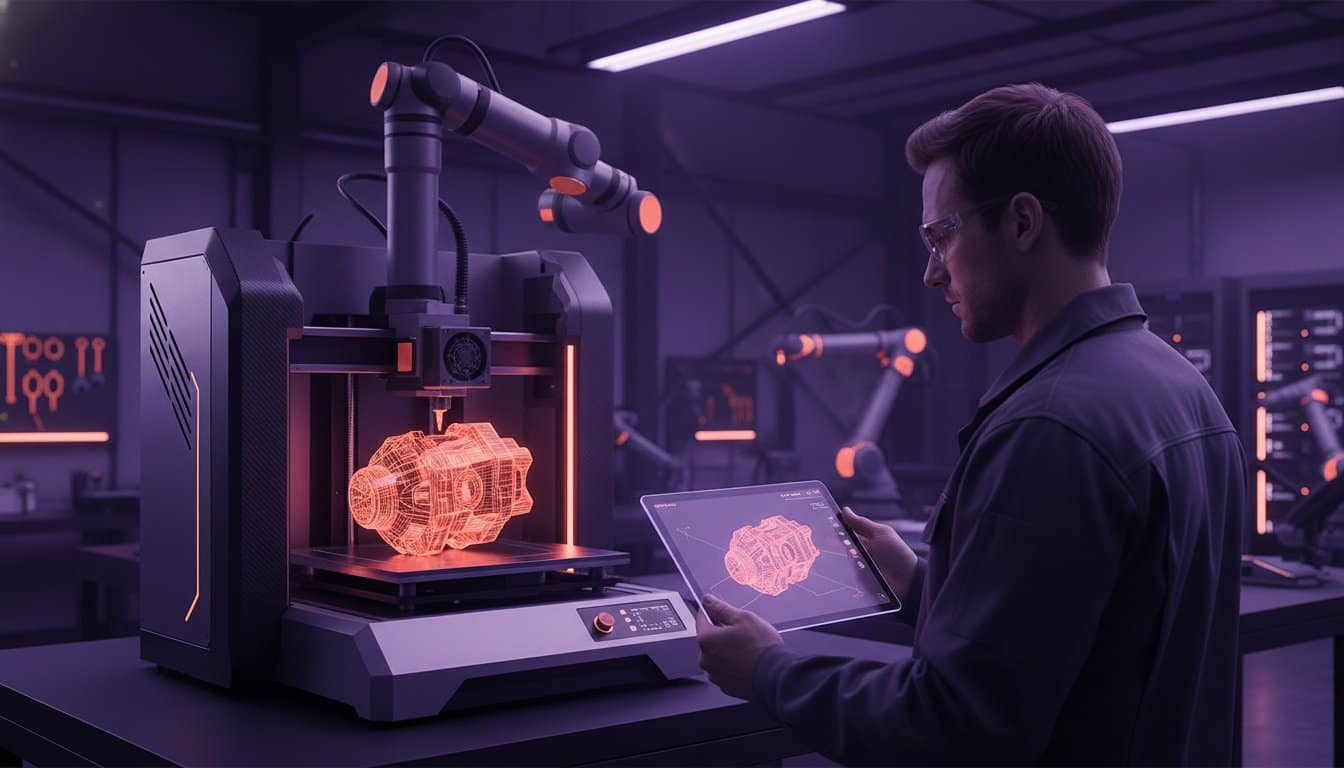
Partnering with a specialist studio provides immediate access to industrial-grade hardware without the burden of capital expenditure or maintenance. Whilst desktop printers are common, they often lack the dimensional stability and material range required for high-precision manufacturing aids. Protomolecule bridges this gap by offering a comprehensive custom jigs and fixtures 3d printing solution that prioritises your project deadlines. We understand that a stalled assembly line costs money; therefore, our fast turnaround is a standard, not a premium extra.
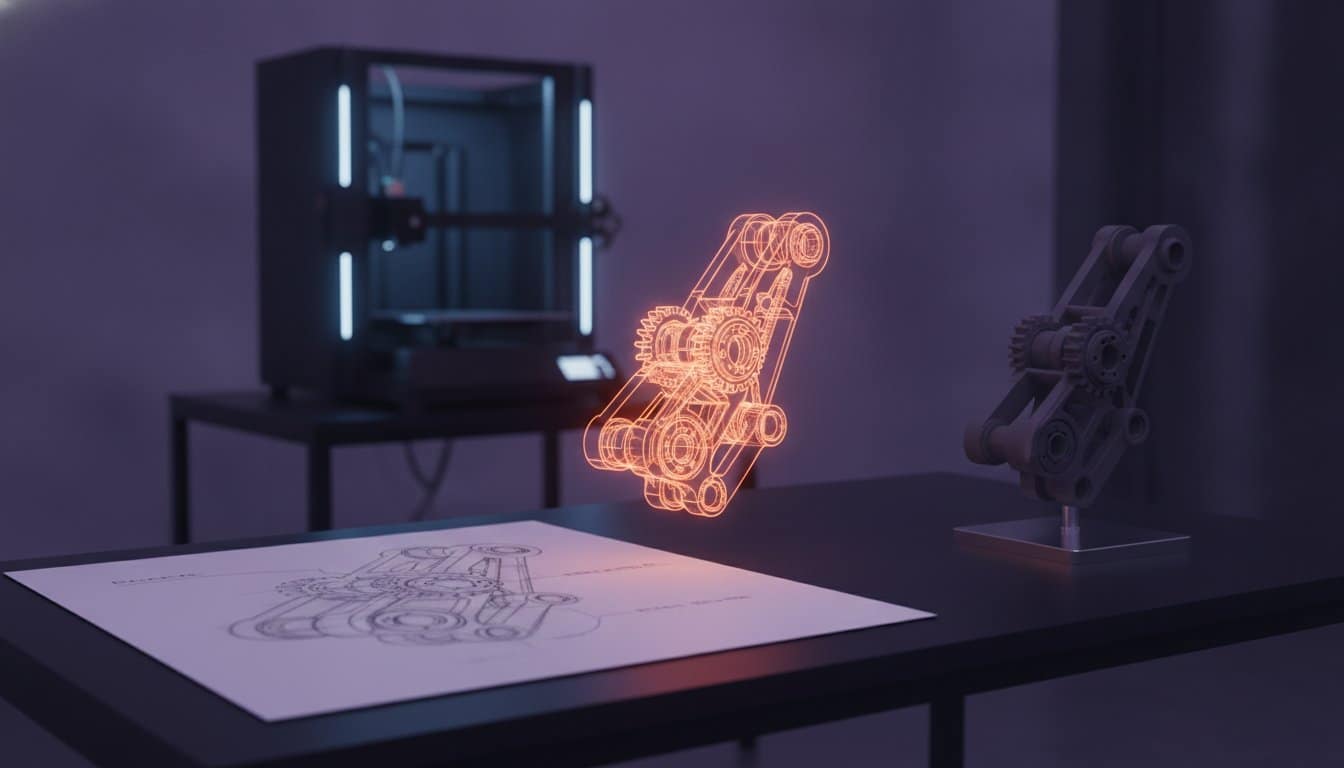
The transition from a physical component to a digital tool is seamless with our technical workflow. We frequently encounter legacy parts or complex geometries that lack original CAD data. By digitising the physical part, we create a perfectly fitting nest or fixture that matches your required tolerances exactly. This ensures your new tooling performs perfectly on its first day of use, eliminating the trial-and-error often associated with traditional toolmaking.
End-to-End Tooling Development
Our 3D design service transforms your rough sketches or physical prototypes into production-ready digital models. We don’t just print; we engineer for functionality, ensuring every jig is optimised for its specific task. For legacy components, we utilise 3D scanning to capture every contour with sub-millimetre accuracy. Once the design is finalised, we conduct validation to confirm that the fixture meets your operational requirements before it hits the factory floor.
Scaling with Batch Production
When your process requires multiple assembly stations, we transition your validated prototype into batch production. This ensures consistent quality across every tool in the run, maintaining the high standards your facility demands for custom jigs and fixtures 3d printing. Every part is inspected to guarantee it matches the master CAD file. Get a fast quote for your custom jigs today and see how we can accelerate your production cycle.
Future-Proof Your Manufacturing Line
The transition toward additive manufacturing is a strategic necessity for UK firms aiming to remain competitive. You’ve seen how engineering-grade polymers and topology optimisation replace heavy, expensive metal tools with lightweight, ergonomic alternatives. By integrating 3D scanning and professional design, you eliminate the risk of poor tolerances and ensure every tool fits its application perfectly. Implementing custom jigs and fixtures 3d printing into your workflow today will slash your lead times and protect your margins for the long term.
Protomolecule stands as your dedicated partner in this transition. As fast turnaround 3D printing specialists with deep expertise in military and aerospace-grade manufacturing, we provide the precision your facility requires. Our comprehensive design, scan, and print service removes the friction from your development cycle. We don’t just deliver parts; we provide industrial-grade solutions that solve complex engineering problems under tight deadlines.
Streamline your production today with a professional 3D printing quote. We’re ready to help you transform your workshop efficiency with speed and uncompromising standards.
Frequently Asked Questions
Are 3D printed jigs strong enough for heavy-duty industrial use?
Yes, 3D printed jigs are capable of withstanding heavy-duty industrial loads when engineered with high-performance materials like carbon-fibre reinforced nylon. We utilise strategic infill patterns and internal lattice structures to provide the necessary rigidity whilst keeping the tool lightweight. This approach ensures that custom jigs and fixtures 3d printing can replace traditional metal tools in most factory floor applications without compromising on durability.
How accurate are 3D printed fixtures compared to machined aluminium?
Professional 3D printed fixtures achieve dimensional accuracies within +/- 0.1mm; this is more than sufficient for the vast majority of assembly and inspection tasks. Whilst machined aluminium can hold tighter tolerances for specialised micron-level applications, additive manufacturing provides the repeatable precision required for high-speed production lines. Our industrial-grade hardware ensures that your tools meet your CAD specifications without the variance found in hobbyist-level machines.
What is the typical lead time for a custom 3D printed jig?
Our fast turnaround 3D printing service typically delivers custom fixtures within 48 hours. This is a significant improvement over traditional CNC machining, which often requires four weeks or more for scheduling and production. We prioritise speed to ensure your production line remains operational. We can often move from a digital design to a finished part in a single day.
Can you 3D print fixtures that are resistant to oils and chemicals?
Yes, we offer specific materials like Nylon-12 (PA12) and chemical-resistant resins that are designed to survive harsh workshop environments. These polymers are inert to most common industrial oils, coolants, and cleaning agents. Using custom jigs and fixtures 3d printing with these materials ensures your assembly aids don’t degrade or warp when exposed to factory fluids over time.
Do I need a CAD file to order a custom fixture from Protomolecule?
No, you don’t need an existing digital model to start your project. Our 3D scanning service allows us to capture the geometry of physical parts and reverse engineer a perfectly fitting fixture from scratch. We also provide a comprehensive 3D design service to help you develop a tool from a basic sketch or a specific manufacturing problem.
What are the most common materials used for 3D printed manufacturing aids?
The most effective materials for industrial aids include carbon-fibre reinforced nylon for strength, PC-ABS for impact resistance, and ESD-safe resins for electronic assembly. We also utilise high-temperature materials for applications involving heat-curing or moulding. Each material is selected based on the specific mechanical requirements and environmental conditions of your production facility to ensure uncompromising performance.