Doubling the dimensions of a 3D model doesn’t simply double your production invoice; it often quadruples it because of the “Risk of Occupancy” on the factory floor. When build times stretch into days and material volumes climb, the cost of large scale 3d printing follows a non-linear curve that can catch even experienced engineers off guard. You’ve likely faced the frustration of unpredictable quotes or the anxiety of a high-value failure during a marathon print run. These risks are a critical consideration now that industrial systems drive over 77% of all global additive manufacturing revenue.
We recognise that your project deadlines and budgets require absolute certainty. This guide provides the clear framework you need to estimate industrial-scale projects with precision. You’ll learn how to select the right technology for your specific part size and discover strategies to optimise material usage without sacrificing structural integrity. We break down the primary cost drivers of 2026 manufacturing to ensure you achieve the best ROI on every large-format build. Stop guessing at your manufacturing overheads and start leveraging data-driven production strategies to secure your project’s success.
Key Takeaways
- Define industrial projects as builds exceeding 300mm and understand how the Volume-Time-Risk triad impacts your final quote.
- Compare Large Format FDM and SLS technologies to determine which system provides the best ROI for components over 500mm.
- Master Design for Additive Manufacturing (DfAM) techniques to significantly reduce the cost of large scale 3d printing without compromising part strength.
- Implement strategic infill and shell thickness settings to accelerate build times and lower material consumption on industrial-grade projects.
- Learn why 10-15% infill is the engineering sweet spot for large structural parts to ensure maximum cost-efficiency.
The Primary Drivers of Large Scale 3D Printing Costs
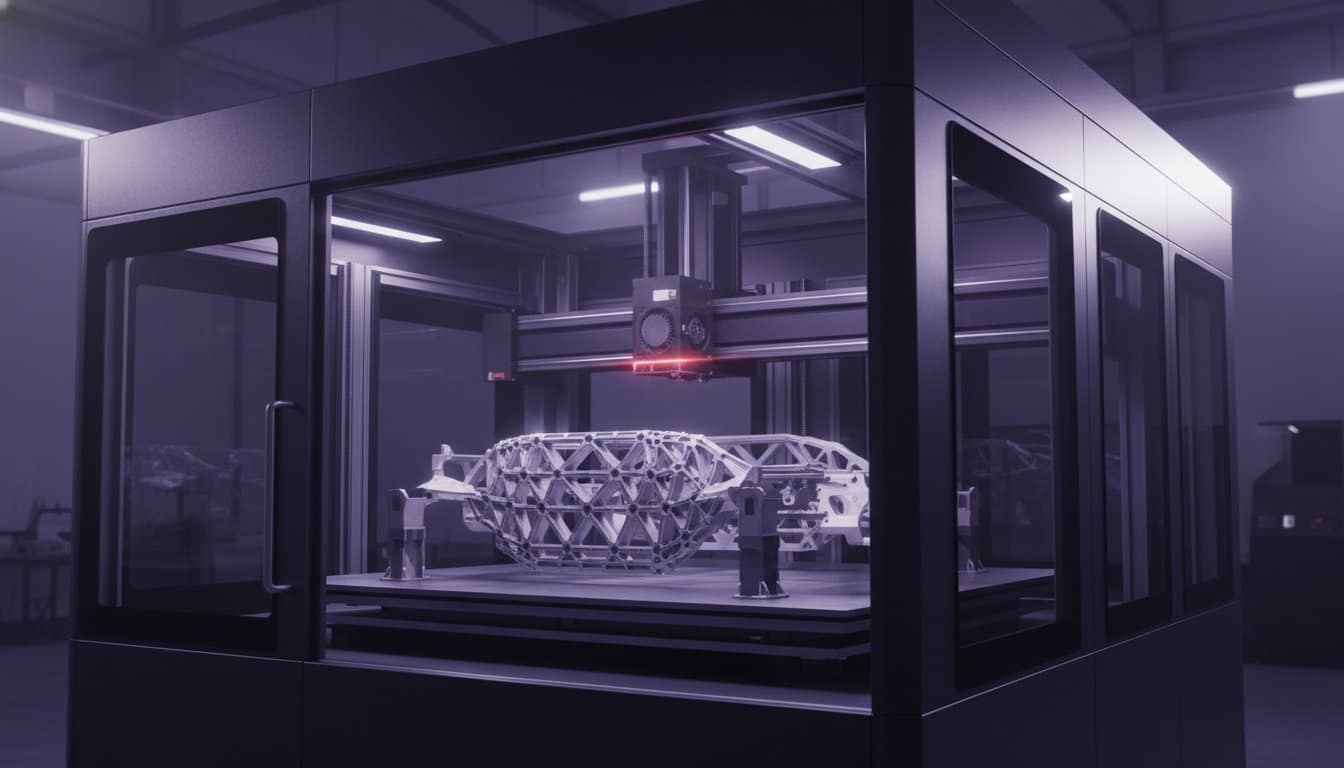
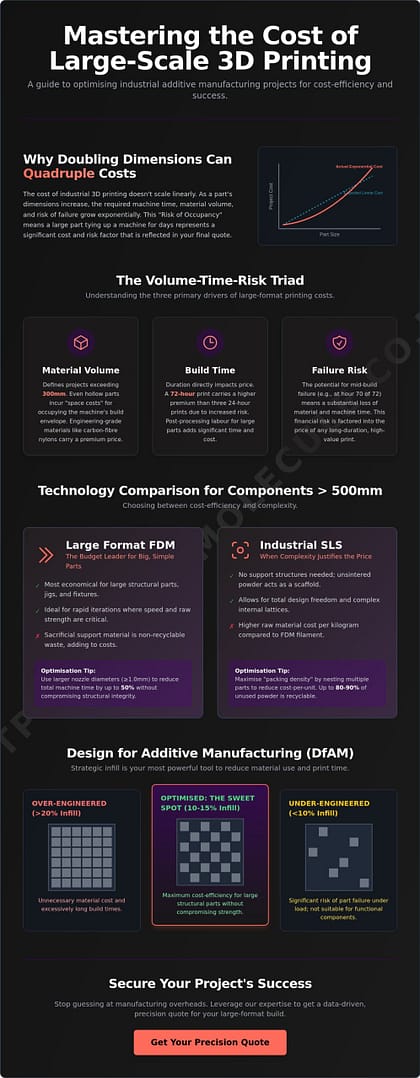
Large-scale 3D printing describes builds that exceed 300mm in any single axis. These projects require industrial-grade machinery capable of maintaining thermal stability and precision over long durations. The cost of large scale 3d printing isn’t a linear calculation; it’s driven by the “Volume-Time-Risk” triad. As parts grow, build time increases the chance of failure, which service providers must reflect in the final price. Large-format printers also represent a significant capital investment. This expense is amortised across build hours, making machine occupancy a primary pricing factor for any industrial project.
Material Volume vs. Build Envelope
A part that is mostly hollow still incurs “space” costs because it occupies the machine’s build chamber and prevents other jobs from running. Build envelope efficiency is the ratio of part volume to total machine capacity. Engineering-grade materials for a professional 3D printing service, such as carbon-fibre reinforced nylons, cost considerably more than standard PLA. These advanced 3D printing processes ensure structural integrity for transport or automotive parts but require precise thermal management to prevent warping across large spans.
The Hidden Cost of Build Time
Build duration directly impacts project risk. A 72-hour print run carries a premium over three 24-hour runs due to the heightened risk of mid-build mechanical failure or power fluctuations. If a printer fails at hour 70, the loss of material and machine time is substantial. Post-processing also adds significant labour costs to the invoice. Large components often require hours of manual support removal and surface finishing to meet industrial standards. Our rapid prototyping service manages these variables by optimising toolpaths to deliver reliable results without unnecessary delays.
Comparing Technologies: Cost-Efficiency of FDM vs. SLS
Choosing between FDM and SLS for components exceeding 500mm requires a strategic assessment of geometry and volume. The cost of large scale 3d printing varies significantly between these two industrial pillars. FDM remains the most economical choice for large, structural components with simple geometries, such as vehicle bumpers or industrial housings. However, whilst the entry cost for FDM is lower, Selective Laser Sintering (SLS) becomes highly competitive when your project involves complex internal lattices or requires a high-volume batch production run within a single build chamber.
Large Format FDM: The Budget Leader for Big Parts
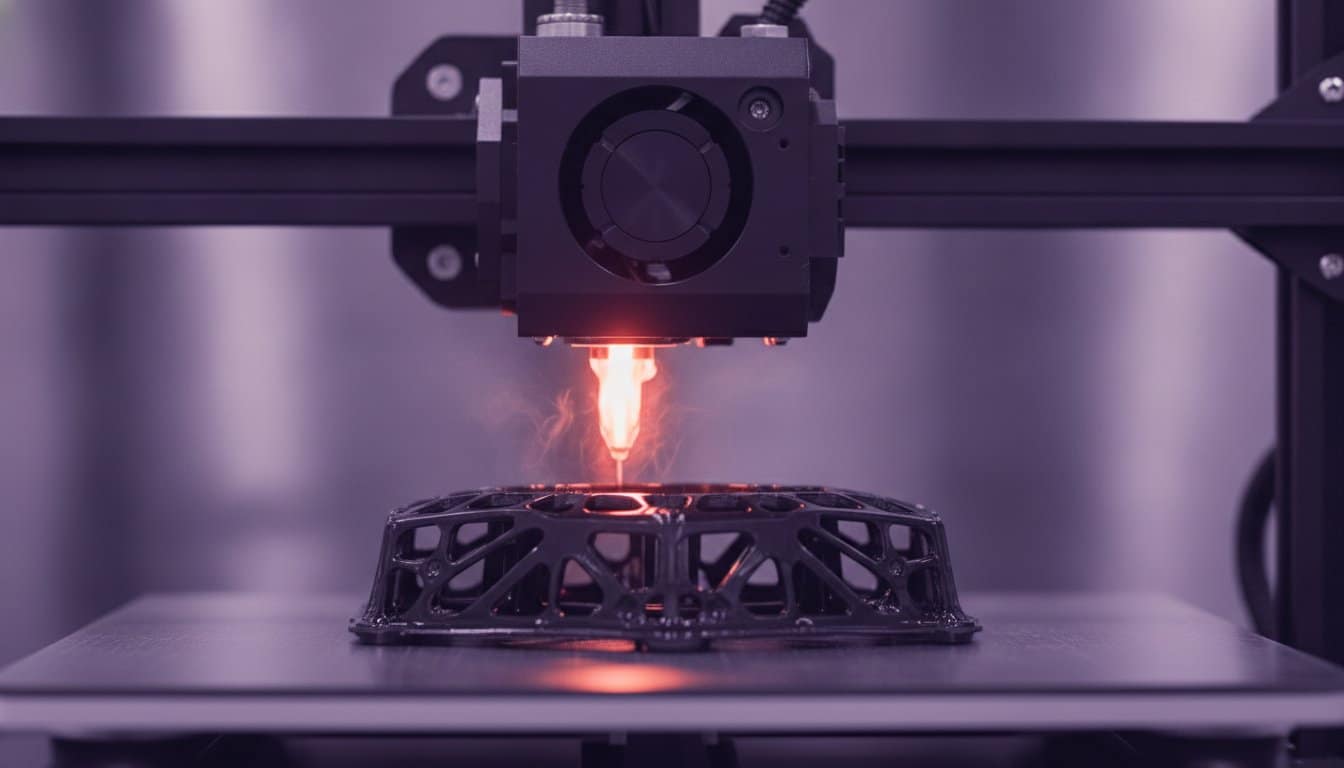
Our Large Format FDM Printing service provides a cost-effective route for producing oversized jigs, fixtures, and functional prototypes. To optimise your budget, we utilise larger nozzle diameters of 1.0mm or greater. This adjustment can reduce total machine time by up to 50% without compromising the structural integrity of the part. This approach is ideal for rapid iterations where speed and raw strength are more critical than a perfectly smooth aesthetic finish. If you need to validate a design quickly, our Rapid Prototyping Service ensures you receive high-quality parts with a fast turnaround.
Industrial SLS and MJF: When Complexity Justifies the Price
SLS pricing is governed by “packing density.” By nesting multiple parts closely together in the powder bed, you reduce the cost per unit significantly. Unlike FDM, SLS requires no sacrificial support structures because the unsintered powder acts as a natural scaffold. This lack of supports saves substantial labour costs during post-processing and allows for total design freedom. Whilst the raw material powder is more expensive per kilogram than FDM filament, the ability to recycle up to 80-90% of unsintered powder helps offset the initial material investment for large-scale production runs.
The final decision often rests on the volume of sacrificial material. FDM supports are non-recyclable waste that adds to your material bill and labour overheads. If your part is complex and requires extensive support, the efficiency of a powder-based system may offer a better long-term ROI. Evaluate your part’s complexity early to select the technology that delivers the most precise results for your specific industrial application.
Optimising Your Project for Cost-Effective Production
Design for Additive Manufacturing (DfAM) represents the most powerful tool in your arsenal to manage the cost of large scale 3d printing. By engineering parts specifically for the process, you eliminate waste before the printer even starts. For large industrial components, a shell thickness of 2-3mm paired with a 10-15% infill is often more than sufficient to maintain structural integrity whilst slashing material consumption. If you’re building a structural housing or a transport jig, don’t pay for solid volume when smart geometry provides the same performance at half the price.
Consider “splitting and joining” as a risk-mitigation strategy. Printing a massive component in sections allows you to utilise smaller, faster machines and significantly reduces the impact of a potential build failure. This method also allows for easier post-processing and faster replacement of individual sections if required. Before committing to a full-scale industrial run, use our Rapid Prototyping Service to validate your fit and function. This small initial step prevents costly errors on the final production floor and ensures your final part is right the first time.
Geometric Optimisation and Infill Strategies
Structural strength doesn’t require solid plastic. Utilise honeycomb or gyroid infill patterns to provide multi-directional support with minimal filament. These complex internal geometries are impossible with traditional machining but are standard in industrial 3D printing. Remember this rule: the most expensive material in 3D printing is the material that shouldn’t be there; optimise your geometry to pay only for the strength you need.
Batch Production and Scaling Efficiency
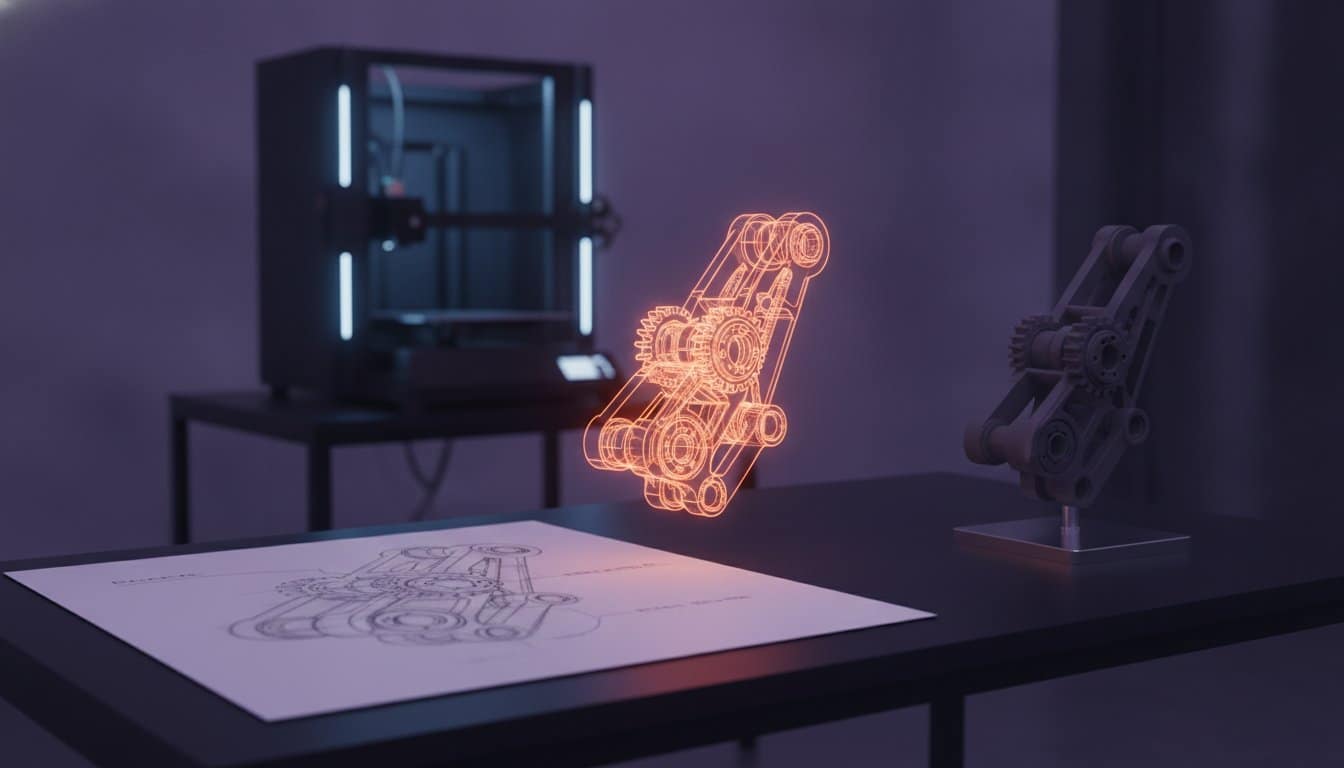
Transitioning from a single prototype to Batch Production changes your unit economics. Fixed costs like file preparation and machine setup are spread across multiple units, lowering the individual price. Our 3D Design Service can assist in refining your CAD files specifically for these production environments. By thinning walls where stress is low and consolidating multiple parts into one, you ensure your project remains as lean as possible. Refine your designs now to secure a more competitive manufacturing quote.
Secure Your Industrial Advantage
Managing the cost of large scale 3d printing requires more than just a competitive quote; it demands a strategic alignment of design and technology. You’ve seen how the “Volume-Time-Risk” triad dictates pricing and why selecting the correct process, whether Large Format FDM or SLS, is vital for your project’s ROI. By implementing DfAM strategies like hollow geometries and optimised infills, you can significantly reduce material waste and machine occupancy times whilst maintaining structural performance.
Our team provides the technical expertise to turn these cost-saving theories into tangible results. We offer specialist Large Format FDM capabilities and expert 3D design and reverse engineering support to ensure your components meet uncompromising industrial standards. Whether you require legacy part reproduction or a fast turnaround for industrial-grade components, we deliver the precision your project demands. Don’t let unpredictable manufacturing costs stall your development cycle.
Get an instant quote for your large-scale 3D printing project today and take the next step toward efficient manufacturing. We’re ready to solve your most complex engineering challenges with speed and reliability.
Frequently Asked Questions
How do I estimate the cost of a large 3D print before uploading a file?
Estimate your project by calculating the part’s total volume and the dimensions of its bounding box. Since machine occupancy is a primary driver for the cost of large scale 3d printing, a part with a large footprint but low volume still consumes significant build time. Factor in the expected material weight and a risk premium for builds exceeding 48 hours to arrive at a realistic baseline before requesting a formal quote.
Is large scale 3D printing cheaper than traditional CNC machining for big parts?
3D printing is typically more cost-effective for large parts with complex geometries or internal voids where CNC machining would result in excessive material waste. Subtractive manufacturing requires purchasing a solid billet of material, whereas additive processes only use what is necessary for the part and its supports. For simple, blocky components, CNC may remain faster, but 3D printing wins on lead time and material efficiency for intricate industrial designs.
What is the most cost-effective material for large industrial 3D prints?
PLA and PETG are the most economical choices for Large Format FDM Printing when producing prototypes or non-structural jigs. These materials offer a balance of low raw cost and ease of printing, which reduces the failure risk on long runs. For industrial-grade components requiring higher durability, engineering-grade filaments like ASA provide excellent UV and chemical resistance whilst remaining more affordable than high-performance composites like PEEK or carbon-fibre nylons.
Does the orientation of a part in the 3D printer affect the final price?
Orientation significantly influences the cost of large scale 3d printing by determining the total number of layers and the volume of sacrificial support material. A part printed vertically often takes longer and requires more supports than the same part printed horizontally. Orient your part to minimise the Z-axis height and support contact points to reduce both machine time and the manual labour needed for post-processing.